

Where Renters and Owners Face the Highest Cost Burdens

2025-11-24T11:16:25-06:00

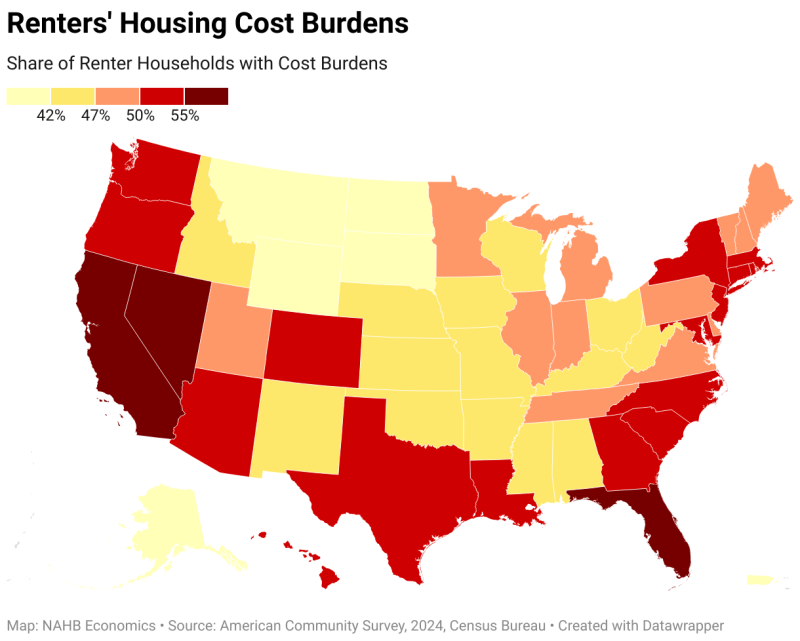
The housing affordability crisis continues to disproportionately affect renters, with more than half of renter households experiencing high-cost burdens — i.e., paying 30% or more of their income on rent and utilities. At the same time, current home owners, buoyed by significant home equity gains and locked in by below-market mortgage rates, are in a more advantageous financial position to weather the growing affordability crisis. According to the latest 2024 American Community Survey (ACS), more than half of all renter households (50.3%), or 23.2 million, are burdened by housing costs. Among home owners, this share is less than a quarter (24.3%) representing 21 million households. As a result, states and counties with higher shares of renters in their housing markets are more likely to have higher overall shares of households with cost burdens. Geographically, Florida, Nevada, and California have the largest concentration of cost-burdened renters. In Florida, 60% of all renters pay more than 30% of their income on rent and utilities. In Nevada, the share is 57%, and in California, 55% of renters experience housing cost burdens. Even in states with comparatively low renter cost-burden rates—such as South Dakota, Alaska, and North Dakota—more than one-third of renters still spend 30% or more of their income on housing. For home owners, cost-burden rates are generally lower, but the geographic pattern mirrors that of renters. California, Florida, and several Northeastern states report the highest shares of cost-burdened home owners. California faces the most severe affordability challenges, with one in three owners paying more than 30% of their income for housing. Florida and Hawaii follow closely, with 31% of existing home owners struggling to afford their homes. At the opposite end of the spectrum, nine states in the Midwest and South report that fewer than 20% of homeowners are cost-burdened. West Virginia and North Dakota have the lowest rates, at just 16%.
Where Renters and Owners Face the Highest Cost Burdens2025-11-24T11:16:25-06:00

State-Level Analysis of Canadian Softwood Lumber Trade

2025-11-11T09:15:24-06:00

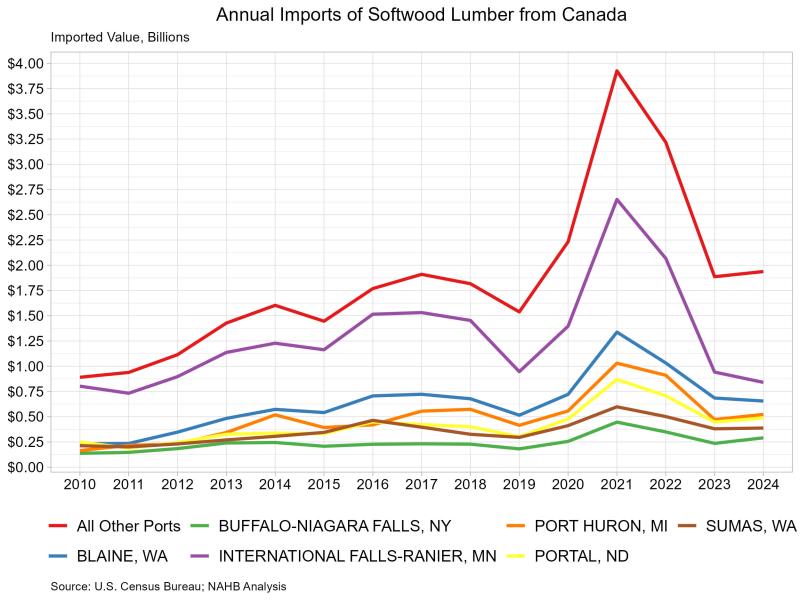
International trade remains a source of volatility across the building materials sector, particularly in the softwood lumber market. Recent adjustments to antidumping and countervailing duty (AD/CVD) rates, combined with the imposition of Section 232 tariffs, have increased the trade-related cost of Canadian imports. As a result, the average duty rate on Canadian softwood lumber entering the U.S. has tripled, now hovering around 45%. These elevated trade barriers pose additional challenges for home builders who rely on Canadian lumber to meet construction demand. In 2024, Canadian softwood lumber exports to the U.S. totaled $5.1 billion, accounting for approximately 74% of the total value of softwood lumber imports. Canada remains the dominant supplier and a longstanding trade partner in the sector. Trade data from the U.S. Census Bureau enables tracking of import destinations at the state level. The majority of Canadian softwood lumber enters through the International Falls, MN port of entry, which saw $840 million in imports in 2024, which is roughly $150 million more than the next busiest port, Blaine, WA. These figures represent a decline from 2021 and 2022, largely due to lower U.S. lumber prices during the current period. This analysis invites the question of where Canadian softwood lumber imports are ultimately headed within the United States. In 2024, Washington state was the top destination, receiving $560.1 million worth of imports. Texas followed closely behind with $451.7 million, reflecting strong demand in the southern housing market. On the other end of the spectrum, Alaska recorded the lowest import volume, with just $284,053 in softwood lumber shipments. However, it is important to note a key limitation in the data. The “state of destination” reflects where the importer is located or where the shipment is initially received, not necessarily where the lumber is ultimately used. This means that while trade data can highlight logistical patterns, it does not fully capture the final point of consumption, especially in cases where materials are redistributed across state lines.

State-Level Analysis of Canadian Softwood Lumber Trade2025-11-11T09:15:24-06:00

About My Work

Phasellus non ante ac dui sagittis volutpat. Curabitur a quam nisl. Nam est elit, congue et quam id, laoreet consequat erat. Aenean porta placerat efficitur. Vestibulum et dictum massa, ac finibus turpis.

Recent Works

Recent Posts