
Lowest Mortgage Rates in Over a Year in October 

2025-10-31T12:14:39-05:00

Average mortgage rates in October trended downward to the lowest rates in over a year. According to Freddie Mac, the 30-year fixed-rate mortgage averaged 6.25% in October, 10 basis points (bps) lower than September. Meanwhile, the 15-year rate declined just 1 bp to 5.49%. Both the 30-year and 15-year rates remain lower than a year ago, dropping by 17 bps and 11 bps year-over-year, respectively.   The 10-year Treasury yield, a key benchmark for long-term borrowing, averaged 4.09% in October – a 5-basis point decrease from the previous month. Markets priced in rate cuts from the Fed at the start of the month, resulting in relatively unchanged rates following the announcement of a 25 bps cut to the federal funds rate on October 29th.  Falling mortgage rates have shown some small impacts on housing activity. According to the latest Mortgage Bankers Association (MBA) report, mortgage application activity strengthened, with refinancing applications rising and purchase applications also increasing. Additionally, existing home sales rose to a seven-month high in September. There is no data available for new home sales in September due to the government shutdown.  Looking forward, the industry faces a bifurcated market characterized by a weakening job market and elevated inflation. Additionally, there are wildcard factors such as the upcoming Supreme Court case regarding the legality of recent tariffs and lack of economic data. As a result, the vote at the December Fed meeting will be difficult to predict.   Discover more from Eye On Housing Subscribe to get the latest posts sent to your email.

Lowest Mortgage Rates in Over a Year in October 2025-10-31T12:14:39-05:00

HBA Staff Appreciation Week Kicks Off

2025-10-31T11:14:31-05:00

From Nov. 3-7, NAHB will celebrate HBA Staff Appreciation Week, an annual event that recognizes the individuals who serve the more than 650 home builders associations that make up NAHB.

HBA Staff Appreciation Week Kicks Off2025-10-31T11:14:31-05:00

How to Navigate Immigration Reform and Enforcement on the Jobsite

2025-10-31T09:14:35-05:00

Immigration policy is shaping the U.S. labor market as home builders adapt to ever-changing employment eligibility and immigration compliance requirements. NAHB will host two webinars designed to highlight current policies, employer rights, and responsibilties to help members navigate the current environment.

How to Navigate Immigration Reform and Enforcement on the Jobsite2025-10-31T09:14:35-05:00

Which Local Markets Track National Trends the Most: 2024 Single-Family MAI

2025-10-30T09:17:46-05:00

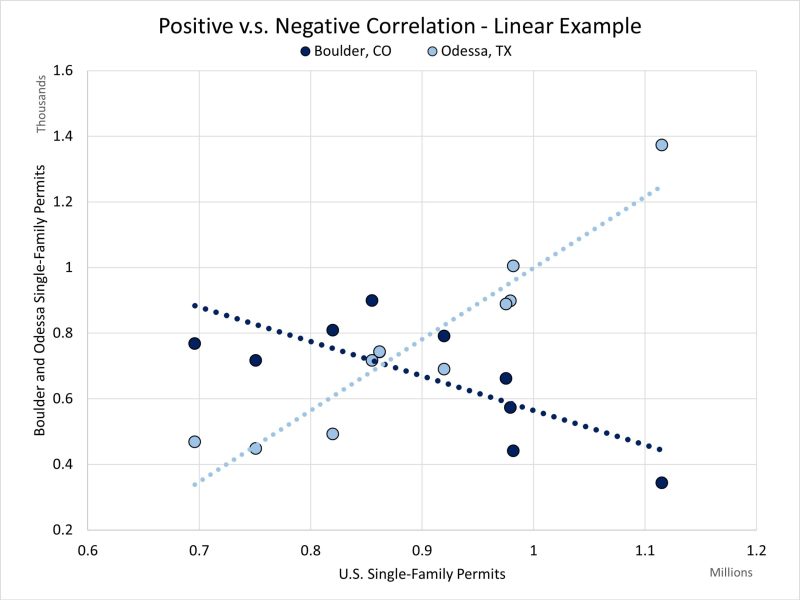
The National Association of Home Builders developed the Single-Family Market Association Index (MAI) to measure how closely single-family building permits in metro areas follow national patterns. By comparing local and national trends, the MAI helps industry leaders and forecasters better understand and predict housing market activity. The MAI uses 2015-2024 single permit data to create five- and ten-year correlations for each metropolitan statistical area (MSA), showing their similarity to national patterns. The five- and ten-year correlations are then averaged, with more weight given to the five-year correlation. The resulting correlation coefficient ranges from negative one to positive one, indicating the strength and direction of the relationship between local and national trends. The MSA that had one of the highest associations with the national trends was Odessa, Texas with a correlation of 0.97. Meanwhile, Boulder, Colorado, a similarly sized MSA, had the most negative correlation of -0.81. The scatter plot below illustrates the linear relationship between these MSAs and the national trend. For example, when national permit levels rose toward 1.1 million, Odessa (positive correlation) also has relatively high permit levels of around 1,400. At the same time, Boulder (negative correlation) has relatively low permits, below 400. Of the 387 metro areas included in the single-family MAI, the average correlation is 0.43. In total, 342 MSAs had a correlation greater than zero, and 45 MSAs had less than zero. A positive correlation is expected as MSAs in total accounted for almost 90% of all single-family permits in the U.S. on average between 2015 and 2024. A complete list of the MSA correlations is found here and shown on the map below. The MSA that most closely followed the national permit trend was San Antonio-New Braunfels, TX. Strong association was present throughout the South region. The West and Northeast regions are where many MSAs show weak association with the national permit trend. Below are tables of the top ten highest and lowest associated MSAs. A release of the Multifamily MAI will be followed in another post shortly. Discover more from Eye On Housing Subscribe to get the latest posts sent to your email.

Which Local Markets Track National Trends the Most: 2024 Single-Family MAI2025-10-30T09:17:46-05:00

Fed Cuts Rate Amid Partly Cloudy Conditions

2025-10-29T16:18:12-05:00

With the government shutdown limiting the quantity of economic data available to markets and policymakers, the central bank’s Federal Open Market Committee (FOMC) enacted a widely anticipated 25 basis point cut for the short-term federal funds rate. This marks the second consecutive cut this fall.

Fed Cuts Rate Amid Partly Cloudy Conditions2025-10-29T16:18:12-05:00

About My Work

Phasellus non ante ac dui sagittis volutpat. Curabitur a quam nisl. Nam est elit, congue et quam id, laoreet consequat erat. Aenean porta placerat efficitur. Vestibulum et dictum massa, ac finibus turpis.

Recent Works

Recent Posts