
Bedrooms in New Single-Family Homes in 2024

2025-11-05T09:15:33-06:00

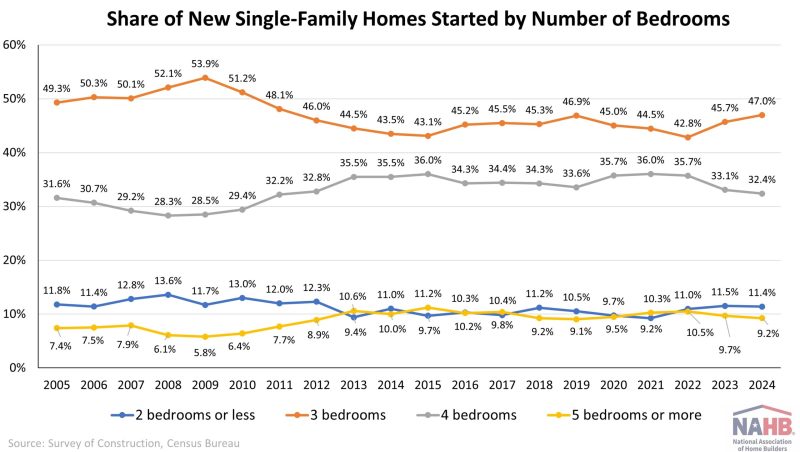
Three-bedroom single-family homes reached their largest share of starts since 2011 and remained the most prevalent number of bedrooms among new homes. The share of starts for four-bedroom homes declined for the third consecutive year but remained well above the shares for two-bedroom or less and five-bedroom or more homes. The share of single-family homes started with three bedrooms rose for the second straight year to its highest level since 2011 to 47.0%. All other bedroom number categories fell from 2023, with 4-bedroom homes falling the most from 33.1% to 32.4%, a 0.7 percentage point decline from the year prior. The share of single-family homes with 2 bedrooms or less remained greater than that of 5 bedrooms or more for the third straight year. U.S. Divisions Across U.S. Census Divisions, the share of new single-family homes with four or more bedrooms displays geographic variation. The share ranged from a low of 22.2% in the New England division to the highest share of 46.7% in the West South Central division. Coinciding with the fall in the share of new single-family homes with 4 bedrooms or more nationally, there are no divisions that have a share above 50%. Purpose of Construction The number of bedrooms in new homes varies depending on the purpose of construction (built-for-sale, contractor-built, owner-built, built-for-rent). Most of this variation comes from the two-bedroom or less homes and four-bedrooms homes. For example, the share of new single-family homes with two bedrooms or less ranges from 5.6% of homes built-for-sale to 37.8% of homes built-for-rent. Meanwhile, three-bedroom homes and five or more-bedroom homes display relatively little change across purpose of construction. Five or more-bedrooms homes held the smallest share of starts across purpose of construction for all types except for built-for-sale homes. Discover more from Eye On Housing Subscribe to get the latest posts sent to your email.

Bedrooms in New Single-Family Homes in 20242025-11-05T09:15:33-06:00

The International Builders’ Show: The Leading Economic Forecast Event of the Year 

2025-11-04T10:16:35-06:00

Every year, NAHB and other industry experts and economists bring their latest insights to the NAHB International Builders’ Show® (IBS). For 2026, IBS offers an unparalleled lineup of IBS Education sessions that cover every sector of the housing industry: single-family, multifamily, remodeling, design trends, and building materials.   The Builders’ Show in 2026 is in Orlando, February 17 – 19. This is the only event where you’ll find all these speakers and sessions at one conference:  The Outlook: 2026 Housing & Economic Forecast (Super Session)   Tuesday, February 17 | 2:15 – 3:45 PM   This IBS Super Session is hosted by our very own Chief Economist, Robert Dietz, as well as Chief Economist of Realtor.com, Danielle Hale, and Chief Economist of Zonda, Ali Wolf. Not only does this session give you the chance to hear from these three nationally recognized economists, but it also gives you a complete overview of the housing economy.   2026 Multifamily Market Outlook  Tuesday, February 17 | 10:00 – 11:00 AM   Danushka Nanayakkara-Skillington, NAHB AVP of Forecasting & Analysis, and Selma Hempp, Chief Economist of Cotality, host a deep dive into multifamily housing. Explore the construction pipeline, financing challenges, rent growth, and more. Join the discussion for an exclusive forecast of where the multifamily sector is headed.   Remodeling by the Numbers: Market Outlook & Business Benchmarks for 2026  Wednesday, February 18 | 8:15 – 9:15 AM  Featuring NAHB Economist Eric Lynch, as well as remodeling expert Alan Hanbury, learn what key indicators and trends are shaping the home improvement industry and where it is headed. Compare how your business is doing with exclusive benchmarks on profit margins, operating costs, and more with exclusive findings from the NAHB ‘Remodelers’ Cost of Doing Business’ study.   Home Trends, Buyer Preferences & Most Likely Features for 2026  Wednesday, February 18 | 10:00 – 11:00 AM  Explore the latest research on the home and community features buyers want most in this session led by NAHB AVP of Survey Research, Rose Quint and architect and industry thought-leader Donald Ruthroff. Discover what trends are shaping new home designs, including how preferences shift by price– point. See these trends in action, illustrated through award-winning designs from recent Best in American Living Awards™ (BALA) winners.  Building Materials in Flux: Pricing Trends, Trade Dynamics & Supply Chain  Wednesday, February 18 | 2:15 – 3:15 PM  Gain timely insights into the ever-evolving trending issue of building materials, hosted by NAHB Director of Tax and Trade, Jesse Wade, custom builder and industry leader Don Dabbert, and industry expert and analyst Nishu Sood from John Burns Research and Consulting. Learn how key building materials like lumber are affected by tariffs and other international trade dynamics. Explore what’s driving material costs and availability, and how global and domestic supply chains are adapting.    Register Now   To attend IBS Education sessions, you must register for an Expo+Education Pass.  Seating for sessions is on a first-come, first-served basis. So, register for an IBS Expo+Education Pass and then mark these sessions on your calendar. For more information on all that IBS has to offer, please visit BuilderShow.com. We hope to see you there!   Discover more from Eye On Housing Subscribe to get the latest posts sent to your email.

The International Builders’ Show: The Leading Economic Forecast Event of the Year 2025-11-04T10:16:35-06:00

Laundry Room Locations in New Homes and Apartments, 2024 

2025-11-03T11:16:15-06:00

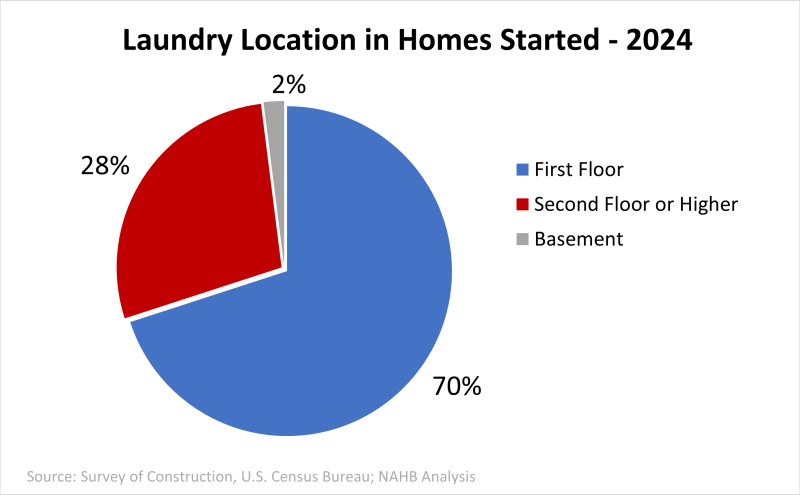
In 2024, most new single-family homes included laundry connections on the first floor (70%), according to the Census Bureau’s Survey of Construction. The first floor is also where most customers prefer to have the laundry, as shown in Chapter 2 of What Home Buyers Really Want.      The second floor was the next most common location, accounting for 28% of new single-family homes, while laundry areas in the basement accounted for just 2%. The share of new homes with laundry in any other location was negligible.  Across all Census Divisions, the first floor remains the most common location for laundry, even in regions where two-story homes are more prevalent. Nevertheless, some regional differences exist. In the West South Central division, 91% of homes had a laundry area on the first floor, compared to just 51% in the Pacific division. Meanwhile, a second-floor laundry was most popular in the Pacific division at 46%, and least common in the West South Central at 8%.  Not surprisingly, laundry connections in basements are more common in areas of the country where basements themselves are more common: primarily in the northern regions. The West North Central division led with 14% of homes featuring a basement laundry, followed by New England at 9%. These two divisions are also among the few where most new homes include a full or partial basement.   Among age-restricted homes, where accessibility and main-level living are key design priorities, 93% featured laundry on the first floor.  Multifamily Laundry Trends For multifamily units completed in 2024, 88% of apartments included an individual laundry, while 12% offered shared or no laundry facilities. This share has remained relatively stable since 2015, reflecting continued renter demand for in-unit laundry.  Regionally, the Northeast has the highest shared or no laundry facilities percentage at 33%. In contrast, shared or no laundry facilities remained far less common elsewhere: 3% in the Midwest, 4% in the South, and 9% in the West.  The pattern extends to the built-for-rent (BFR) segment, where 88% of units had an individual laundry, unchanged from the prior two years. In contrast, built-for-sale multifamily units saw a decrease—from 92% with individual laundry in 2023 to 81% in 2024—suggesting a possible shift toward more affordable condo projects, which are more likely to include shared facilities.  Discover more from Eye On Housing Subscribe to get the latest posts sent to your email.

Laundry Room Locations in New Homes and Apartments, 2024 2025-11-03T11:16:15-06:00

Where are Porches Most Common for Newly-Built Homes?

2025-10-22T11:16:10-05:00

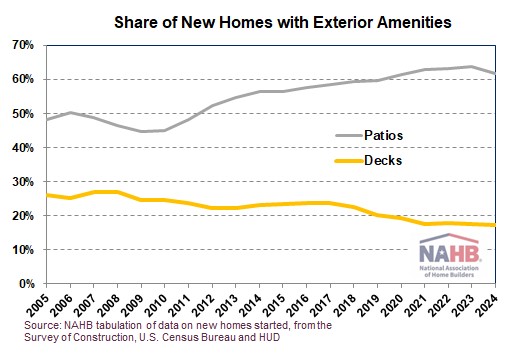
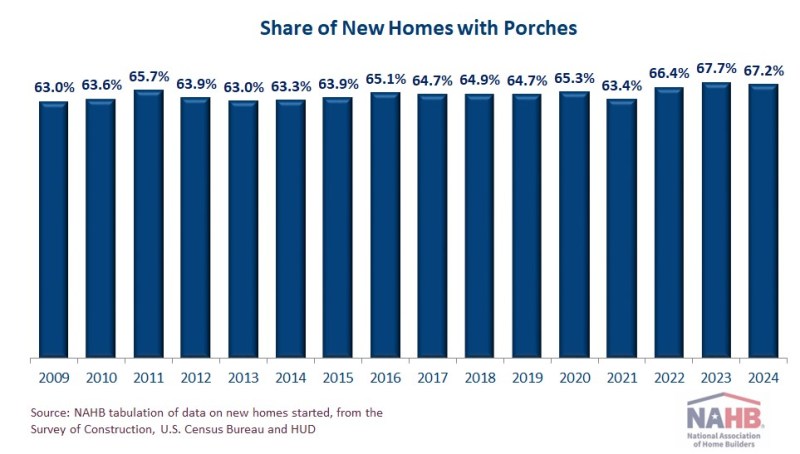
Although the share of new homes with porches edged down in 2024, porches continue to rank as the most common outdoor feature on new homes, according to NAHB tabulation of the latest data from the Survey of Construction (SOC, conducted by the U.S. Census Bureau with partial funding from HUD). Of the roughly 1.0 million single-family homes started in 2024, the SOC data show that 67.2% were built with porches. This is down, but only slightly, from the all-time peak of 67.7% reported a year earlier. Porches also continue to be more common on new homes than the other outdoor features covered in the SOC: patios and, especially, decks.   Traditionally, porches on new homes have been most common in the four states that make up the East South Central Census division. That was true again in 2024, although only by a narrow margin. In 2024, 81% of new homes in the East South Central had porches, but this share was well over 70% in three other divisions: the Pacific (78%), Mountain (77%), and South Atlantic (74%) divisions. Compared to the 2023 numbers reported in last year’s post, the porch percentages were up by two points in the East and West South Central divisions, unchanged in the Mountain and South Atlantic divisions, and down at least slightly in the other five divisions. Detail about the characteristics of porches on new homes is available from the Builder Practices Survey (BPS), conducted annually by Home Innovation Research Labs. Among other things, the 2025 BPS report (based on homes built in 2024) shows that porches continue to be far more common on the front of new single-family homes than on the side or rear. When on the front, porches average approximately 100 square feet of floor area. The other categories of porches distinguished in the SOC, although comparatively rare, tend to be noticeably larger: 140 square feet for a side or rear porch, and just over 200 square feet for a screened-in porch. On a square foot basis, builders continue to use concrete more than any other material to build new-home porches. Only one division remains a clear outlier in this regard. In New England, builders seldom use concrete in new-home porches, instead most often building them out of composite (a blend of usually recycled wood fibers and plastic). In that division, they also use treated wood, PVC or other plastics, cedar, and natural stone more often than concrete. Discover more from Eye On Housing Subscribe to get the latest posts sent to your email.

Where are Porches Most Common for Newly-Built Homes?2025-10-22T11:16:10-05:00

Custom Home Building Share Declines in 2024

2025-10-14T09:20:26-05:00

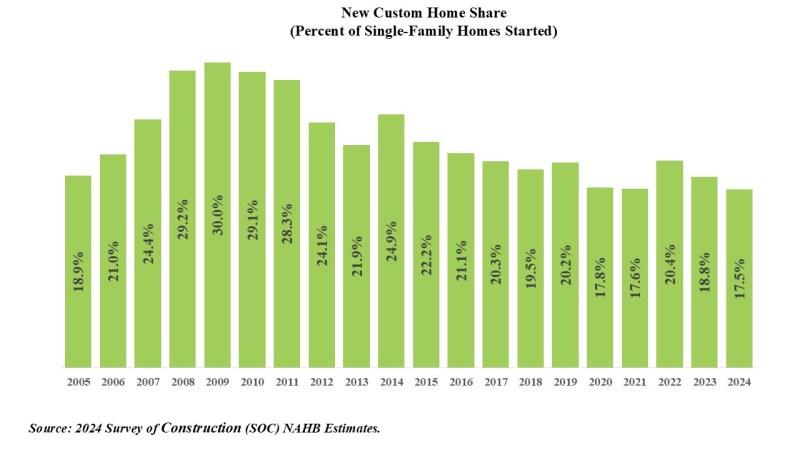
In 2024, 17.5% of all new single-family homes started were custom homes. This share decreased from 18.8% in 2023 and from 20.4% in 2022, according to data tabulated from the Census Bureau’s Survey of Construction (SOC). The custom home market consists of contractor-built and owner-built homes—homes built for owner occupancy on the owner’s land, with either the owner or a builder acting as a general contractor. The alternatives are homes built-for-sale (on the builder’s land, often in subdivisions, with the intention of selling the house and land in one transaction) and homes built-for-rent. In 2024, 73.1% of the single-family homes started were built-for-sale and 9.3% were built-for-rent. At a 17.5% share, the number of custom homes started in 2024 was 176,932, falling from 177,850 in 2023.    Quarterly statistics published by the Census Bureau for the second quarter of 2025 show year-over-year growth for custom home building amid broader single-family home building weakness. Although the quarterly statistics are timelier, they are often revised and lack the geographic detail available in the annual data set.  When analyzed across the nine census divisions, the annual data show that the highest custom home share in 2024 was 41.2% in the New England division. The lowest share was in the West South-Central division at just 10.7%.  Discover more from Eye On Housing Subscribe to get the latest posts sent to your email.

Custom Home Building Share Declines in 20242025-10-14T09:20:26-05:00

Vinyl Surpasses Stucco as Most Used Principal Exterior Wall Material 

2025-10-10T10:15:39-05:00

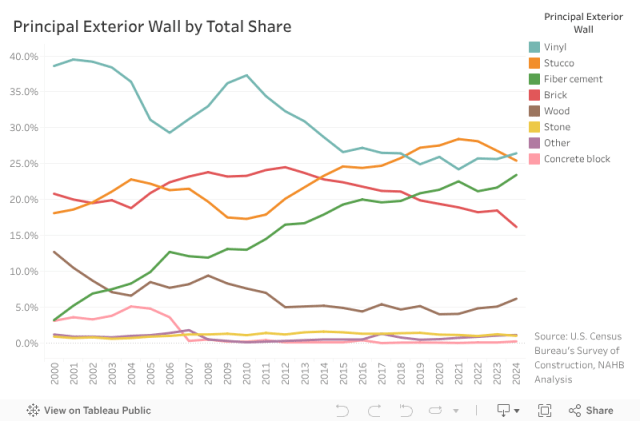
In 2024, vinyl siding was the most used principal exterior wall material for homes started. It holds just over a quarter share of homes, slightly surpassing stucco for the first time since 2018. For homes started in 2024, 26% had vinyl siding (including vinyl-covered aluminium) as their principal exterior wall material, according to the latest annual release of the U.S. Census Bureau’s Survey of Construction (SOC). Vinyl was followed closely by stucco at 25%, and by fiber cement siding (such as Hardiplank or Hardiboard) at 23%. Each of these materials holds about a quarter of the market, with another 16% held by brick or brick veneer. Far smaller shares of single-family homes started last year had wood or wood products (6%), stone, rock or other stone materials (1%), other (1%), or cement blocks (.2%) as the principal exterior wall material.  While vinyl has historically held a much larger share, at highs of almost 40% in 2001, the share fell rapidly between 2010 to 2015 by over 10 percentage points. However, since 2015, this share has remained fairly steady at around 26%. Meanwhile, stucco rose rapidly from 17% in 2010 until recently peaking at 28% in 2021.    However, the strongest trend has been the growing popularity in fiber cement siding. The share of exterior siding material for fiber cement siding has increased by 5.5 percentage points in the last ten years and by more than 15 percentage points in the past 20 years. Also notable is the decline of brick siding, from almost a quarter of homes in 2012, to just 16% in 2024. Although vinyl siding is most popular in the entire U.S., there are substantial differences in the use of siding when you look across geographies. In 2024, vinyl siding was the most used in the Midwest and Northeast regions. More specifically, vinyl siding was used on 73% of the new homes started in New England, 69% in the East North Central, 68% in the Middle Atlantic, and 49% in the West North Central.  Meanwhile, stucco was the most used primary exterior wall material in the Pacific, Mountain, and South Atlantic divisions in 2024 at 64%, 48% and 33%, respectively. Brick or brick veneer was the most common exterior siding material in the East South Central (39%) and West South Central (48%) divisions.  The West South Central division also had a substantially higher share of wood principal exterior homes at 27%.   Discover more from Eye On Housing Subscribe to get the latest posts sent to your email.

Vinyl Surpasses Stucco as Most Used Principal Exterior Wall Material 2025-10-10T10:15:39-05:00

About My Work

Phasellus non ante ac dui sagittis volutpat. Curabitur a quam nisl. Nam est elit, congue et quam id, laoreet consequat erat. Aenean porta placerat efficitur. Vestibulum et dictum massa, ac finibus turpis.

Recent Works

Recent Posts