
The No. 1 Factor Driving Home Values

2025-11-26T13:14:14-06:00

Square footage, curb appeal and bedroom count only tell part of the story when it comes to the value of a single-family home. Arguably, the biggest factor is where the home is located.

The No. 1 Factor Driving Home Values2025-11-26T13:14:14-06:00

Property Taxes by State – 2024

2025-11-26T08:15:30-06:00

Nationally, across the 87 million owner-occupied homes in the U.S., the average amount of annual real estate taxes paid in 2024 was $4,271, according to NAHB analysis of the 2024 American Community Survey. Homeowners in New Jersey continued to pay the highest real estate taxes, paying an average of $9,767, $2,194 more than the next closest state, New York, at $7,573. On the other end of the distribution, homeowners in West Virginia paid the lowest average amount of real estate taxes at $1,044. The map below shows the geographic variation of average annual real estate taxes (RETs) paid. The 2024 data indicate that there is no state where real estate taxes paid were on average less than $1,000, the first time in the ACS data. There continues to be noticeable differences in the average amount of taxes paid based on geographic location. States in the Northeast, where home values tend to be higher, pay more on average in real estate taxes compared to states in other parts of the nation. Average Effective Property Tax Rates While average annual real estate taxes paid is important, it provides an incomplete picture. Property values vary across states, which explains some, if not most, of the variation across the nation in average annual real estate taxes. To control for property values and create a more informative state-by-state analysis, NAHB calculates the average effective property tax rates by dividing aggregate real estate taxes paid by aggregate value of owner-occupied housing within each state. For example, the aggregate real estate taxes paid across the U.S. was $370.0 billion with an aggregate value of owner-occupied real estate totaling $41.7 trillion in 2024. Using these two amounts, the average effective property tax rate nationally was $8.88 ($370.0 billion/$41.7 trillion) per $1,000 in home value. This effective rate can be expressed as a percentage of home value or as a dollar amount taxed per $1,000 of a home’s value. The map below displays the effective rate by state. Illinois, for the second consecutive year, had the highest effective property tax rate at $17.93 per $1,000 of home value. Hawaii continued to have the lowest effective property tax rate at $3.08 per $1,000 of home value. Hawaii also had the highest average home value, at $1.05 million in 2024. Notably, the average effective property tax rate tends to be higher in the Northeast, in addition to the presence of higher home values.

Property Taxes by State – 20242025-11-26T08:15:30-06:00

Share of New Homes with Decks Edges Lower

2025-11-25T13:16:13-06:00

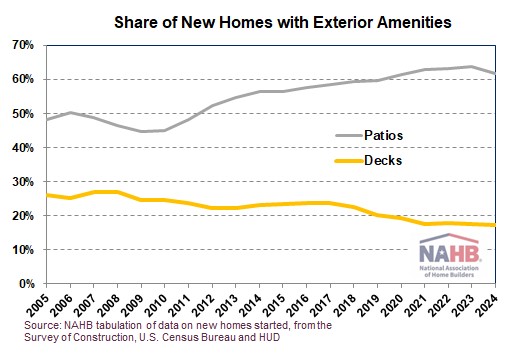
The share of new homes with decks edged down from 17.6% in 2023 to a new all-time low of 17.4% in 2024, according to NAHB tabulation of data from the HUD/Census Bureau Survey of Construction (SOC). Over the longer term, the share of new homes with decks has been declining steadily since reaching a peak of 27.0% in 2007 and 2008. Amidst that decline, the share of new homes with patios has been trending upward, from under 50% to over 60% (despite a minor reversal of the upward trend in 2024). From the re-design of the SOC in 2005 through 2024, the correlation between the percentages of new homes with patios and decks is -0.85, indicating that patios and decks are functioning as substitutes over time—i.e., as patios become more common, they are crowding out decks. Decks and patios appear to be substitutes across the U.S. On the single-family homes started in 2024, decks tended to be more common where patios were comparatively rare. For example, only 14% of the homes in the New England Census Division included patios, while a high of 69% included decks. Conversely, 82% of new homes included patios in the West South Central, while only 3% included decks. Across all nine divisions, the correlation between the percentages of new homes with decks and patios was -0.77. Even so, decks remain relatively popular on new homes in some parts of the country. In addition to New England, over 30% of new homes came with decks in the West North Central (46%), Middle Atlantic (34%) and East South Central (31%) divisions. Moreover, in the latest edition of  What Home Buyers Really Want, 79% of recent and prospective home buyers rated a deck as an essential or desirable feature. Additional detail on the characteristics of new-home decks is available from the Annual Builder Practices Survey (BPS) conducted by Home Innovation Research Labs. Nationally, the 2025 BPS report (based on homes built in 2024) shows that the average size of a deck on a new single-family home is 278 square feet. Across Census Divisions, the average ranges from a low of 163 square feet in the West South Central to a high of 422 square feet in the Mountain division. Beyond size, there continue to be strong geographic differences in builders’ choice of deck materials. On a square foot basis, treated wood is the most popular choice in the New England, South Atlantic, East South Central, and Mountain divisions. In the Middle Atlantic, East North Central, and West North Central, composite material predominates. In the Pacific Division, builders use concrete more than any other material, while in the West South Central there is a roughly even split between treated wood and concrete. Of course, decks can be—and often are—added after the home itself is built. In the fourth-quarter 2024 survey for the NAHB/Westlake Royal Remodeling Market Index, decks ranked seventh among 22 listed remodeling projects, cited as a common job by 23% of the professional remodelers who responded to the survey.

Share of New Homes with Decks Edges Lower2025-11-25T13:16:13-06:00

Building Material Prices Continued to Rise in September

2025-11-25T11:18:14-06:00

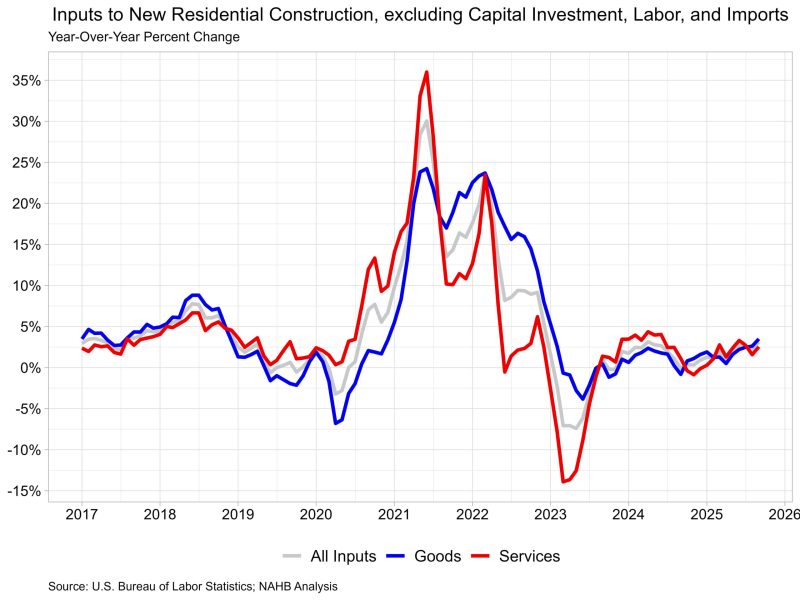
Aggregate residential building material prices rose at their fastest pace since January 2023 in the latest Producer Price Index release from the Bureau of Labor Statistics. Input energy prices increased for the first time in over a year, while service price growth remained lower than goods. The Producer Price Index for final demand increased 0.3% in September, after falling 0.1% in August. The index for final demand goods increased 0.9% in September, the largest monthly increase since February 2024. Final demand energy prices were responsible for most of the goods index increase, as they rose 3.5% in September. This index for final demand for services was unchanged in September. The price index for inputs to new residential construction rose 0.2% in September and was up 3.1% from last year. The price of goods inputs was up 0.1% over the month and 3.5% from last year, while prices for services were up 0.3% over the month and 2.5% from last year. Input Goods The goods component has a larger importance to the inputs to residential construction price index, representing around 60%. On a monthly basis, the price of input goods to new residential construction was up 0.1% in September. The input goods to residential construction index can be further broken down into two separate components, one measuring energy inputs with the other measuring remaining goods. The latter of these two components simply represents building materials used in residential construction, which makes up around 93% of the goods index. Energy input prices rose 1.0% in September and were 3.0% higher than one year ago. Building material prices were up 0.1% in September and up 3.5% compared to one year ago. The 3.5% year-over-year increase is the largest increase since the 4.9% experienced back in January 2023. Residential building material price inflation slowly accelerated over the year, after starting around 2.0%. The largest year-over-year price changes continue to be parts for construction machinery and equipment, sold separately, up 41.3% compared to September of last year. Metal molding and trim prices are up 31.0% from last year. Ready-mix concrete, a key input to new residential construction, has shown little price growth in 2025, up only 0.4% from last year. Additionally, softwood lumber prices were down 2.3% in September from last year. Lumber prices have experienced declines over the past few months despite higher tariffs now in place. Ongoing weaknesses during 2025 in new residential construction have led to an acute oversupply of lumber on the market, with demand below expectations. Input Services Prices for service inputs to residential construction reported an increase of 0.3% in September. On a year-over-year basis, service input prices were up 2.5%. The price index for service inputs to residential construction can be broken out into three separate components: a trade services component, a transportation and warehousing services component, and a services excluding trade, transportation and warehousing component (other services).  The most significant component is trade services (around 60%), followed by other services (around 29%), and finally transportation and warehousing services (around 11%). The largest component, trade services, was up 3.1% from a year ago. The other services component was up 1.3% over the year.  Lastly, prices for transportation and warehousing services rose 2.6% compared to August of last year.

Building Material Prices Continued to Rise in September2025-11-25T11:18:14-06:00

Fannie, Freddie Multifamily Loan Purchase Caps to Rise 20% in 2026

2025-11-25T09:15:39-06:00

The Federal Housing Finance Agency (FHFA) announced yesterday that the 2026 multifamily loan purchase caps for Fannie Mae and Freddie Mac will be $88 billion each, for a combined total of $176 billion to support the multifamily market — a 20.5% increase from 2025.

Fannie, Freddie Multifamily Loan Purchase Caps to Rise 20% in 20262025-11-25T09:15:39-06:00

About My Work

Phasellus non ante ac dui sagittis volutpat. Curabitur a quam nisl. Nam est elit, congue et quam id, laoreet consequat erat. Aenean porta placerat efficitur. Vestibulum et dictum massa, ac finibus turpis.

Recent Works

Recent Posts