
Employment Loss and Post-COVID Recovery Across U.S. Metro Areas

2025-11-12T08:15:10-06:00

In April 2020, total payroll employment in the United States fell by an unprecedented 20.5 million, following a loss of 1.4 million in March, as the COVID-19 pandemic brought the economy to a sudden halt. The unemployment rate surged by 10.4 percentage points to 14.8% in April. It was the highest rate effectively since the Great Depression. Tracking the labor market impact is critical for understanding the follow-on effect on home building activity during the last five years. As people stayed at home and businesses shut down under government directives, millions of Americans lost their jobs. Initial unemployment insurance claims soared to 2.9 million during the week of March 21, 2020. For the following 19 consecutive weeks, more than one million Americans filed for unemployment each week, totaling roughly 50.9 million claims over just five months. While the national labor market suffered an unprecedented collapse in both speed and depth, the effects varied significantly across U.S. metro areas. Local economies experience dramatically different outcomes depending on their industrial composition, the feasibility of remote work, and the strictness of local public health restrictions. A map of metro areas across the United States reveals striking variations in employment losses from February 2020 to the pandemic’s employment trough. Nonfarm employment payrolls declined by anywhere from 5% to 35% across 393 metro areas. Kahului-Wailuku, Hawaii, experienced the steepest job losses, with employment plummeting by 35%. This metro area’s deep dependence on tourism and hospitality, particularly in accommodation and food services, left it vulnerable to travel restrictions and widespread shutdown. Similarly, Atlantic City-Hammonton, New Jersey, as a prime tourism destination, was devastated by pandemic-related closures. By May 2020, its total employment dropped 34% from the February 2020 level. Some metro areas experienced major setbacks tied to their dominant industries. In Elkhart-Goshen, Indiana, as the heart of the U.S. RV manufacturing industry, employment plunged 34% as production ground to a halt. At the other end of the spectrum, Logan, UT-ID, recorded the mildest downturn, with a relatively modest 5% employment drop, reflecting a more resilient local economy. In sheer numbers, New York-Newark-Jersey City, New York-New Jersey saw the largest employment losses in the nation, shedding nearly 2 million jobs, or about 20% of its pre-pandemic workforce. Los Angeles–Long Beach–Anaheim, California, followed closely, losing 1.1 million jobs, about 17% of its February 2020 level. Despite the historic scale of these losses, the U.S. labor market rebounded faster than many anticipated. Within just 26 months, overall employment had fully recovered, surpassing its February 2020 level to reach 152.4 million by June 2022. Yet, as with the initial losses, the recovery varied widely across metro areas. By August 2025, 93 of the 393 metro areas had still not regained their pre-pandemic employment levels. Lake Charles, Louisiana, remains the slowest to recover, with employment at only 87% of its February 2020 level. The region’s setbacks have been compounded by multiple disasters—COVID-19, followed by Hurricanes Laura and Delta in 2020—that disrupted both infrastructure and labor markets. Kankakee, Illinois (92% recovered), and Weirton–Steubenville, West Virginia–Ohio (93%), also lagged, highlighting how recovery can be delayed by structural and regional challenges. In contrast, many other metro areas have not only recovered but expanded beyond their pre-pandemic employment levels. As of August 2025, 300 metro areas have fully rebounded, with some even booming. Wildwood–The Villages, Florida, leads the nation with employment reaching 127% of its February 2020 level, followed by St. George, Utah, at 125%. Notably, the areas that suffered the sharpest employment declines in 2020 did not necessarily experience the slowest recoveries. Las Vegas–Henderson–North Las Vegas, Nevada, for instance, lost 277,900 jobs, about 26% of its workforce, but has rebounded strongly, reaching 109% of its pre-pandemic employment. By contrast, Enid, Oklahoma, which lost just 1,600 jobs, remains slightly below its February 2020 level, still 2% short of full recovery. The story of employment loss and recovery across U.S. metro areas underscores the uneven geography of the COVID-19 economy. The resilience of local economies has since reshaped the post-pandemic landscape, revealing not only where recovery has taken root but also where it remains incomplete. And of course, the health of local labor markets has important impacts on the status of local home building and remodeling conditions.

Employment Loss and Post-COVID Recovery Across U.S. Metro Areas2025-11-12T08:15:10-06:00

The International Builders’ Show: The Leading Economic Forecast Event of the Year 

2025-11-04T10:16:35-06:00

Every year, NAHB and other industry experts and economists bring their latest insights to the NAHB International Builders’ Show® (IBS). For 2026, IBS offers an unparalleled lineup of IBS Education sessions that cover every sector of the housing industry: single-family, multifamily, remodeling, design trends, and building materials.   The Builders’ Show in 2026 is in Orlando, February 17 – 19. This is the only event where you’ll find all these speakers and sessions at one conference:  The Outlook: 2026 Housing & Economic Forecast (Super Session)   Tuesday, February 17 | 2:15 – 3:45 PM   This IBS Super Session is hosted by our very own Chief Economist, Robert Dietz, as well as Chief Economist of Realtor.com, Danielle Hale, and Chief Economist of Zonda, Ali Wolf. Not only does this session give you the chance to hear from these three nationally recognized economists, but it also gives you a complete overview of the housing economy.   2026 Multifamily Market Outlook  Tuesday, February 17 | 10:00 – 11:00 AM   Danushka Nanayakkara-Skillington, NAHB AVP of Forecasting & Analysis, and Selma Hempp, Chief Economist of Cotality, host a deep dive into multifamily housing. Explore the construction pipeline, financing challenges, rent growth, and more. Join the discussion for an exclusive forecast of where the multifamily sector is headed.   Remodeling by the Numbers: Market Outlook & Business Benchmarks for 2026  Wednesday, February 18 | 8:15 – 9:15 AM  Featuring NAHB Economist Eric Lynch, as well as remodeling expert Alan Hanbury, learn what key indicators and trends are shaping the home improvement industry and where it is headed. Compare how your business is doing with exclusive benchmarks on profit margins, operating costs, and more with exclusive findings from the NAHB ‘Remodelers’ Cost of Doing Business’ study.   Home Trends, Buyer Preferences & Most Likely Features for 2026  Wednesday, February 18 | 10:00 – 11:00 AM  Explore the latest research on the home and community features buyers want most in this session led by NAHB AVP of Survey Research, Rose Quint and architect and industry thought-leader Donald Ruthroff. Discover what trends are shaping new home designs, including how preferences shift by price– point. See these trends in action, illustrated through award-winning designs from recent Best in American Living Awards™ (BALA) winners.  Building Materials in Flux: Pricing Trends, Trade Dynamics & Supply Chain  Wednesday, February 18 | 2:15 – 3:15 PM  Gain timely insights into the ever-evolving trending issue of building materials, hosted by NAHB Director of Tax and Trade, Jesse Wade, custom builder and industry leader Don Dabbert, and industry expert and analyst Nishu Sood from John Burns Research and Consulting. Learn how key building materials like lumber are affected by tariffs and other international trade dynamics. Explore what’s driving material costs and availability, and how global and domestic supply chains are adapting.    Register Now   To attend IBS Education sessions, you must register for an Expo+Education Pass.  Seating for sessions is on a first-come, first-served basis. So, register for an IBS Expo+Education Pass and then mark these sessions on your calendar. For more information on all that IBS has to offer, please visit BuilderShow.com. We hope to see you there!   Discover more from Eye On Housing Subscribe to get the latest posts sent to your email.

The International Builders’ Show: The Leading Economic Forecast Event of the Year 2025-11-04T10:16:35-06:00

Which Local Markets Track National Trends the Most: 2024 Single-Family MAI

2025-10-30T09:17:46-05:00

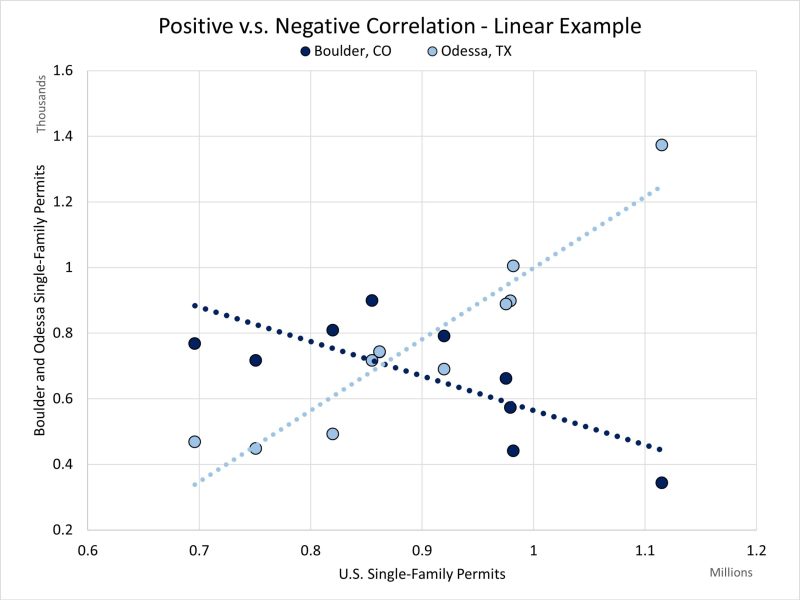
The National Association of Home Builders developed the Single-Family Market Association Index (MAI) to measure how closely single-family building permits in metro areas follow national patterns. By comparing local and national trends, the MAI helps industry leaders and forecasters better understand and predict housing market activity. The MAI uses 2015-2024 single permit data to create five- and ten-year correlations for each metropolitan statistical area (MSA), showing their similarity to national patterns. The five- and ten-year correlations are then averaged, with more weight given to the five-year correlation. The resulting correlation coefficient ranges from negative one to positive one, indicating the strength and direction of the relationship between local and national trends. The MSA that had one of the highest associations with the national trends was Odessa, Texas with a correlation of 0.97. Meanwhile, Boulder, Colorado, a similarly sized MSA, had the most negative correlation of -0.81. The scatter plot below illustrates the linear relationship between these MSAs and the national trend. For example, when national permit levels rose toward 1.1 million, Odessa (positive correlation) also has relatively high permit levels of around 1,400. At the same time, Boulder (negative correlation) has relatively low permits, below 400. Of the 387 metro areas included in the single-family MAI, the average correlation is 0.43. In total, 342 MSAs had a correlation greater than zero, and 45 MSAs had less than zero. A positive correlation is expected as MSAs in total accounted for almost 90% of all single-family permits in the U.S. on average between 2015 and 2024. A complete list of the MSA correlations is found here and shown on the map below. The MSA that most closely followed the national permit trend was San Antonio-New Braunfels, TX. Strong association was present throughout the South region. The West and Northeast regions are where many MSAs show weak association with the national permit trend. Below are tables of the top ten highest and lowest associated MSAs. A release of the Multifamily MAI will be followed in another post shortly. Discover more from Eye On Housing Subscribe to get the latest posts sent to your email.

Which Local Markets Track National Trends the Most: 2024 Single-Family MAI2025-10-30T09:17:46-05:00

How COVID-19 Reshaped the U.S. Labor Market and Housing Demand

2025-10-22T09:19:14-05:00

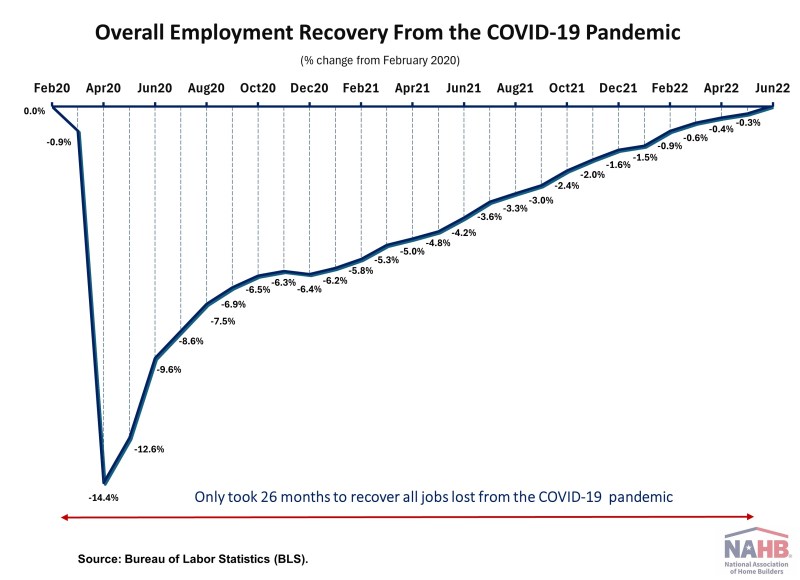
Between February 2020 and June 2022, the U.S. labor market experienced the deepest downturn on record followed by the fastest recovery in at least a century. The COVID-19 pandemic disrupted every corner of the economy, forcing massive shutdowns and triggering record job losses across all industries. Yet, in just two years, the labor market rebounded with remarkable speed, marking a historic recovery that continues to reshape both employment trends and the broader economy. Overall Employment Recovery At the beginning of 2020, the U.S. economy was enjoying a “Goldilocks” moment at the end of Trump’s first term with the longest continuous stretch of job growth on record. The unemployment rate remained near a 50-year low of 3.5%, job openings were steady, and wage growth was modestly outpacing inflation. Then, the COVID-19 pandemic struck, reshaping the labor market dramatically. In April 2020 alone, the U.S. lost roughly 20.5 million jobs—an unprecedented drop since data collection began in 1939—bringing total nonfarm payroll employment to its lowest level since February 2011. By the end of that spring, the economy shed nearly 22.9 million jobs due to shutdowns and restrictions. Meanwhile, the unemployment rate soared to 14.8% in April 2020, the highest level since the Great Depression. This recession was not only the deepest in U.S. history but also the fastest to recover. It took just 26 months for overall employment to return to pre-pandemic levels—a speed unmatched by any previous downturn. In February 2020, total employment stood at 152.3 million but plunged 14.4% to 130.4 million by April. From there, the labor market rebounded relentlessly, surpassing the February 2020 level to reach 152.4 million by June 2022. Notably, May 2020 saw the largest monthly job gain on record, signaling the beginning of a historic recovery. Uneven Industrial Recoveries While the overall U.S. labor market made a remarkable recovery from the historic COVID-19 downturn, the path of recovery varied widely across industries. Among all the major industries, the leisure and hospitality sector was hit the hardest, losing approximately 8.2 million jobs—nearly half their workforce—in just two months. However, by August 2025, this sector had not only fully recovered but exceeded its pre-pandemic employment level. Other major industries that experienced significant job losses include health care and social assistance (down by nearly 2.3 million jobs), retail trade (2.27 million), and professional and business services (2.26 million). All of these sectors have not only recovered but also expanded beyond their pre-pandemic employment levels by August 2025. Government employment, although not driven by market forces and constraints, declined by about 1.46 million jobs but has rebounded to 103% of its pre-pandemic size. Construction, another vital sector, lost around 1.09 million jobs but has experienced a robust recovery, now standing at 109% of the February 2020 level. However, not all sectors have bounced back fully. Manufacturing, especially in durable goods, remains just shy of full recovery, at 99% of its pre-pandemic employment level after losing 933,000 jobs. The mining and logging sector, which lost 145,000 jobs, continues to lag, with employment still at just 89% of its February 2020 level. These industries continue to face challenges in returning to their pre-pandemic workforce size. Meanwhile, several sectors, such as private educational services, transportation and warehousing, non-durable goods manufacturing, wholesale trade, information, financial activities, and utilities, all experienced smaller job losses relative to the hardest-hit industries and have now surpassed their pre-pandemic employment levels, with transportation and warehousing showing the strongest rebound at 117% of the February 2020 level. From Job Market to Housing Market: Pandemic Reshapes Housing Market The labor market recovery has occurred alongside a broader reshaping of household behavior, particularly around how and where Americans live. As lockdowns and remote work kept people home, the share of expenditures devoted to at-home consumption rose sharply. This shift had profound effects on housing demand. In response to the COVID-19 pandemic, the Federal Reserve lowered the federal funds rate to a target range of 0% to 0.25% in March 2020 and remained at this historically low level for nearly two years to stimulate borrowing and spending to support the economy. Fueled by historically low interest rates, the housing market experienced an unprecedented surge. Sales of both new and existing single-family homes soared. New home sales peaked at more than 160% of 2019 levels by mid-2020, while existing home sales also rose sharply. However, as inflationary pressures grew, the Federal Reserve began raising rates aggressively in 2022. This tightening cycle significantly cooled the housing market, particularly for existing homes. Existing home sales fell below pre-pandemic levels and continued to trend downward through 2025. In contrast, new home sales—while volatile—generally remained above 2019 levels in the past two years. A shortage of resale inventory, coupled with homeowners hesitant to give up locked-in low mortgage rates, led many buyers to turn to new construction despite elevated interest rates. Looking Ahead: Easing Rates and a Potential Market Rebound In recent months, there have been signs of a potential rebound in the housing market. Following the Federal Reserve’s rate cut in September 2025, mortgage rates fell below 6.5% for the first time this year. As of last week, the average 30-year fixed mortgage rate had dropped to 6.27%. With additional Fed rate cuts expected in the coming quarters, lower borrowing costs and improving inventory levels could stimulate housing market activity on both the buying and selling sides of the industry. Discover more from Eye On Housing Subscribe to get the latest posts sent to your email.

How COVID-19 Reshaped the U.S. Labor Market and Housing Demand2025-10-22T09:19:14-05:00

Median Age of Construction Labor Force Holds at 42 

2025-10-21T09:15:17-05:00

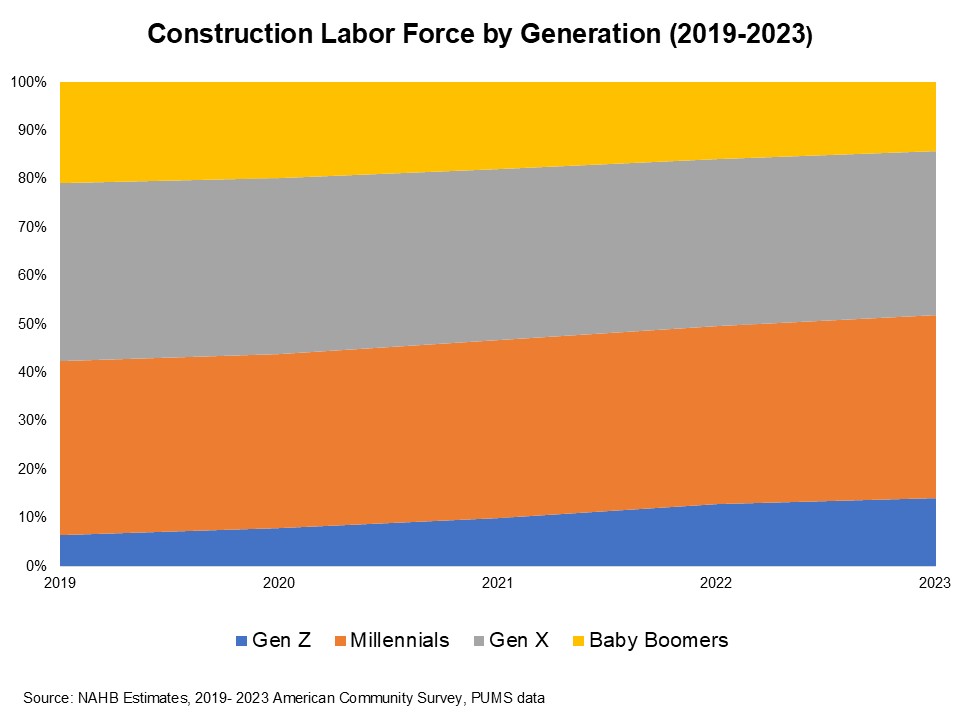
The median age of construction labor force is 42, one year older than a typical worker in the national labor force, according to NAHB analysis of the most recent 2023 American Community Survey (ACS) data. However, more younger people are joining the construction industry. Despite some improvements since the peak of the skilled labor shortage in 2021, attracting skilled labor remains the primary long-term goal for the construction industry.   The median age of construction labor force varies across states. The color coding in the map below tracks the median age of people working in the construction industry.  The state with the oldest median age (46 years old) is Alaska, followed by Connecticut and Maine, where the median age of workers in construction is 45. Construction labor force is younger on average in the central part of the nation. For example, half of all people working in construction in Utah are under 39.  The second data series mapped above is the difference between the median age of workers in construction in each state and the median age of all industry workers. These estimates are reported as the numbers printed on each state. A positive number indicates that on average, people in construction are older than a typical worker in the state labor force. Alaska has the largest difference, where the median age of construction labor force is 6 years higher than the overall median in the state. On the other hand, a negative number indicates the construction labor force is, in general, younger than the state labor force. In Vermont and Delaware, the median age of workers in construction is 2 years younger than the overall median.   Analysis of the age distribution of workers in construction over time reveals that Gen Z, those born between 1997 and 2012, are more likely to enter the construction industry than Millennials, when they were the youngest generation in the labor force. They are drawn to careers in the construction industry due to factors such as new innovations in modern construction technologies, high costs of college education, competitive wages in construction, job security and potential for growth.    Generational shifts are reshaping the construction labor force. The share of Gen Z has more than doubled, increasing from 6.4% in 2019 to 14.1% in 2023, reflecting a growing pipeline of younger workers. Millennials’ share also rose from 35.7% to 37.7% over the same period. In contrast, Gen X declined from 36.6% to 33.7%, while Baby Boomers fell sharply from 20.6% to 14.2% as workers moved to retirement.  The chart below shows that, as of 2023, only about 14.1% of construction labor force were Gen Zers. Around 71% of the construction labor force were Millennials and Gen-Xers, who are considered in their prime working years, compared to 66% in overall labor force. The relative greater share of Gen X construction labor force reveals the current challenge of the labor shortage. Gen X is a smaller generational group than the Baby Boomers. The share of Baby Boomer construction labor force is 14.2%, implying that a substantial portion of the labor force will retire in the near future. Attracting more skilled labor, especially younger generations, remains the primary long-term goal for the construction industry. Discover more from Eye On Housing Subscribe to get the latest posts sent to your email.

Median Age of Construction Labor Force Holds at 42 2025-10-21T09:15:17-05:00

About My Work

Phasellus non ante ac dui sagittis volutpat. Curabitur a quam nisl. Nam est elit, congue et quam id, laoreet consequat erat. Aenean porta placerat efficitur. Vestibulum et dictum massa, ac finibus turpis.

Recent Works

Recent Posts