
Number of Bathrooms in New Single-Family Homes in 2024

2025-12-04T09:15:50-06:00

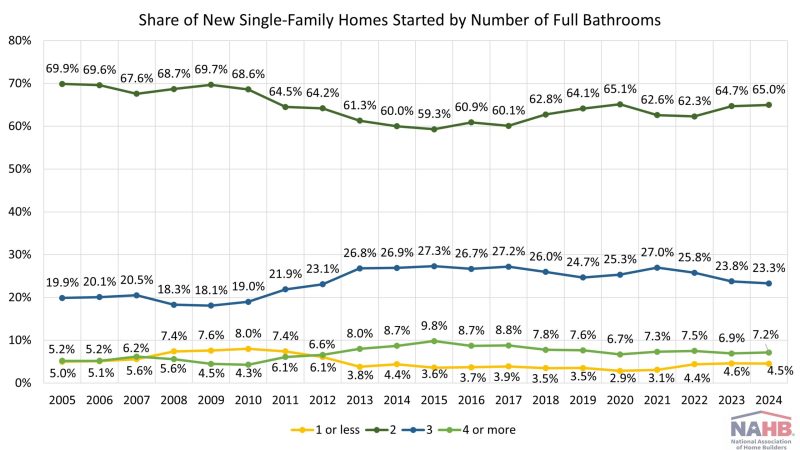
Single-family homes started in 2024 typically had two full bathrooms, according to the U.S. Census Bureau’s Annual Survey of Construction. Homes with three full bathrooms continued to have the second largest share of starts at around 23%. Meanwhile, both homes with four full bathrooms or more and homes with one bathroom or less made up under ten percent of homes started. A full bathroom, as defined by the Bureau, is one that has a washbasin, a toilet and either a bathtub or shower, or a combination of a bathtub and shower. In 2024, 65.0% of new single-family homes started in 2024 had two full bathrooms, marking  the second consecutive year that this share has increased.  The share of single-family starts with three full bathrooms fell for the third straight year, down to 23.3%, while the share of single-family starts with four or more bathrooms increased to 7.2%. For starts with one full bathroom or less, the share fell to 4.5%. Across the U.S., the East South Central division had the highest share, 71.6%, of new single-family starts having two full bathrooms. No other division had above a 70% share. The Census division with the lowest share was the Middle Atlantic, with 52.0% of new single-family starts reporting two full bathrooms. Starts in Middle Atlantic division were far more likely to have 4 full bathrooms or more, at 20.2%, more than double any other division in terms of share. Half-Bathrooms Most new single-family homes started in 2024 had no half-bathrooms at 53.7%. Following closely is the share of new single-family homes with one half-bathroom at 44.9%. New single-family starts with two or more half-bathrooms had a small share of 1.4% in 2024.  A half bathroom contains a toilet, bathtub, or shower, but not all facilities to be classified as a full bathroom. Half-bathrooms are historically more prevalent in the New England Census division as compared to the other eight divisions. In 2024, 64.0% of new single-family homes started in the New England division had at least one half-bathroom. The lowest share occurred in the Pacific division, where only 38.3% of starts had at least one half-bathroom.
Number of Bathrooms in New Single-Family Homes in 20242025-12-04T09:15:50-06:00

Share of New Homes with Decks Edges Lower

2025-11-25T13:16:13-06:00

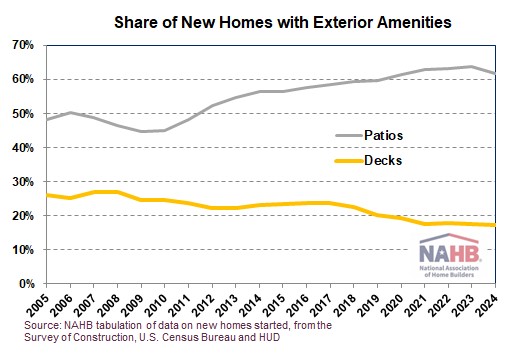
The share of new homes with decks edged down from 17.6% in 2023 to a new all-time low of 17.4% in 2024, according to NAHB tabulation of data from the HUD/Census Bureau Survey of Construction (SOC). Over the longer term, the share of new homes with decks has been declining steadily since reaching a peak of 27.0% in 2007 and 2008. Amidst that decline, the share of new homes with patios has been trending upward, from under 50% to over 60% (despite a minor reversal of the upward trend in 2024). From the re-design of the SOC in 2005 through 2024, the correlation between the percentages of new homes with patios and decks is -0.85, indicating that patios and decks are functioning as substitutes over time—i.e., as patios become more common, they are crowding out decks. Decks and patios appear to be substitutes across the U.S. On the single-family homes started in 2024, decks tended to be more common where patios were comparatively rare. For example, only 14% of the homes in the New England Census Division included patios, while a high of 69% included decks. Conversely, 82% of new homes included patios in the West South Central, while only 3% included decks. Across all nine divisions, the correlation between the percentages of new homes with decks and patios was -0.77. Even so, decks remain relatively popular on new homes in some parts of the country. In addition to New England, over 30% of new homes came with decks in the West North Central (46%), Middle Atlantic (34%) and East South Central (31%) divisions. Moreover, in the latest edition of  What Home Buyers Really Want, 79% of recent and prospective home buyers rated a deck as an essential or desirable feature. Additional detail on the characteristics of new-home decks is available from the Annual Builder Practices Survey (BPS) conducted by Home Innovation Research Labs. Nationally, the 2025 BPS report (based on homes built in 2024) shows that the average size of a deck on a new single-family home is 278 square feet. Across Census Divisions, the average ranges from a low of 163 square feet in the West South Central to a high of 422 square feet in the Mountain division. Beyond size, there continue to be strong geographic differences in builders’ choice of deck materials. On a square foot basis, treated wood is the most popular choice in the New England, South Atlantic, East South Central, and Mountain divisions. In the Middle Atlantic, East North Central, and West North Central, composite material predominates. In the Pacific Division, builders use concrete more than any other material, while in the West South Central there is a roughly even split between treated wood and concrete. Of course, decks can be—and often are—added after the home itself is built. In the fourth-quarter 2024 survey for the NAHB/Westlake Royal Remodeling Market Index, decks ranked seventh among 22 listed remodeling projects, cited as a common job by 23% of the professional remodelers who responded to the survey.

Share of New Homes with Decks Edges Lower2025-11-25T13:16:13-06:00

Bedrooms in New Single-Family Homes in 2024

2025-11-05T09:15:33-06:00

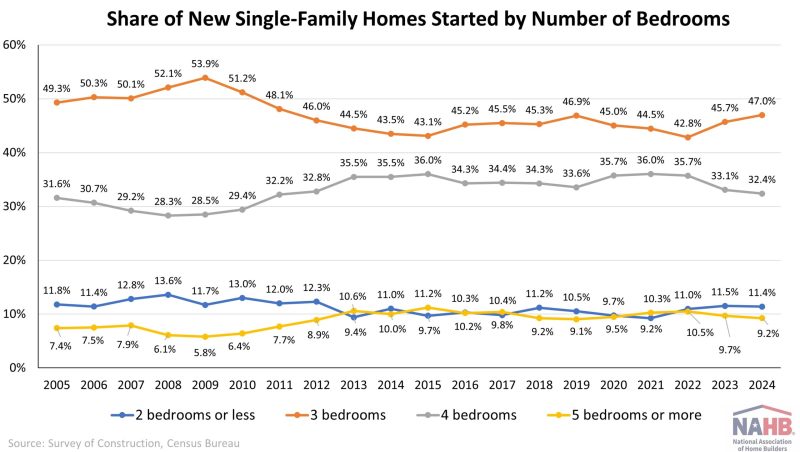
Three-bedroom single-family homes reached their largest share of starts since 2011 and remained the most prevalent number of bedrooms among new homes. The share of starts for four-bedroom homes declined for the third consecutive year but remained well above the shares for two-bedroom or less and five-bedroom or more homes. The share of single-family homes started with three bedrooms rose for the second straight year to its highest level since 2011 to 47.0%. All other bedroom number categories fell from 2023, with 4-bedroom homes falling the most from 33.1% to 32.4%, a 0.7 percentage point decline from the year prior. The share of single-family homes with 2 bedrooms or less remained greater than that of 5 bedrooms or more for the third straight year. U.S. Divisions Across U.S. Census Divisions, the share of new single-family homes with four or more bedrooms displays geographic variation. The share ranged from a low of 22.2% in the New England division to the highest share of 46.7% in the West South Central division. Coinciding with the fall in the share of new single-family homes with 4 bedrooms or more nationally, there are no divisions that have a share above 50%. Purpose of Construction The number of bedrooms in new homes varies depending on the purpose of construction (built-for-sale, contractor-built, owner-built, built-for-rent). Most of this variation comes from the two-bedroom or less homes and four-bedrooms homes. For example, the share of new single-family homes with two bedrooms or less ranges from 5.6% of homes built-for-sale to 37.8% of homes built-for-rent. Meanwhile, three-bedroom homes and five or more-bedroom homes display relatively little change across purpose of construction. Five or more-bedrooms homes held the smallest share of starts across purpose of construction for all types except for built-for-sale homes. Discover more from Eye On Housing Subscribe to get the latest posts sent to your email.

Bedrooms in New Single-Family Homes in 20242025-11-05T09:15:33-06:00

Laundry Room Locations in New Homes and Apartments, 2024 

2025-11-03T11:16:15-06:00

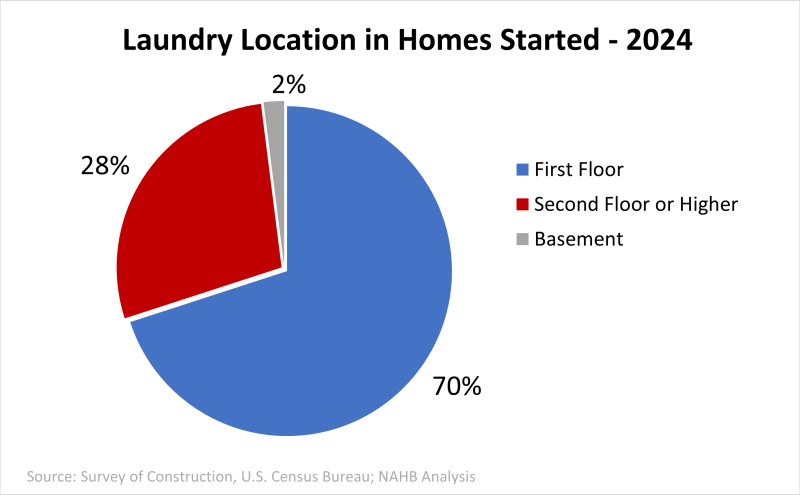
In 2024, most new single-family homes included laundry connections on the first floor (70%), according to the Census Bureau’s Survey of Construction. The first floor is also where most customers prefer to have the laundry, as shown in Chapter 2 of What Home Buyers Really Want.      The second floor was the next most common location, accounting for 28% of new single-family homes, while laundry areas in the basement accounted for just 2%. The share of new homes with laundry in any other location was negligible.  Across all Census Divisions, the first floor remains the most common location for laundry, even in regions where two-story homes are more prevalent. Nevertheless, some regional differences exist. In the West South Central division, 91% of homes had a laundry area on the first floor, compared to just 51% in the Pacific division. Meanwhile, a second-floor laundry was most popular in the Pacific division at 46%, and least common in the West South Central at 8%.  Not surprisingly, laundry connections in basements are more common in areas of the country where basements themselves are more common: primarily in the northern regions. The West North Central division led with 14% of homes featuring a basement laundry, followed by New England at 9%. These two divisions are also among the few where most new homes include a full or partial basement.   Among age-restricted homes, where accessibility and main-level living are key design priorities, 93% featured laundry on the first floor.  Multifamily Laundry Trends For multifamily units completed in 2024, 88% of apartments included an individual laundry, while 12% offered shared or no laundry facilities. This share has remained relatively stable since 2015, reflecting continued renter demand for in-unit laundry.  Regionally, the Northeast has the highest shared or no laundry facilities percentage at 33%. In contrast, shared or no laundry facilities remained far less common elsewhere: 3% in the Midwest, 4% in the South, and 9% in the West.  The pattern extends to the built-for-rent (BFR) segment, where 88% of units had an individual laundry, unchanged from the prior two years. In contrast, built-for-sale multifamily units saw a decrease—from 92% with individual laundry in 2023 to 81% in 2024—suggesting a possible shift toward more affordable condo projects, which are more likely to include shared facilities.  Discover more from Eye On Housing Subscribe to get the latest posts sent to your email.

Laundry Room Locations in New Homes and Apartments, 2024 2025-11-03T11:16:15-06:00

Two-Story Foyer Trend Stabilize in 2024

2025-10-27T11:17:19-05:00

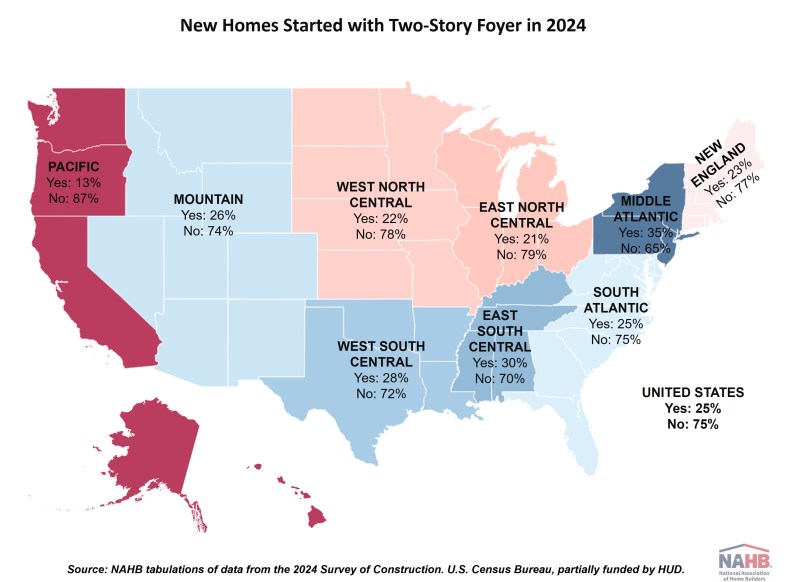
In 2024, nearly a quarter of new homes were built with a two-story foyer, virtually unchanged from 2023, according to data obtained from the Census Bureau’s Survey of Construction (SOC) and tabulated by NAHB. The market share of two-story foyers has been generally trending downward over the past eight years, with most new single-family homes being built without a two-story foyer nationally and regionally.   According to the Census, a two-story foyer is defined as the entranceway inside the front door of a house and has a ceiling that is at the level of the second-floor ceiling. In the United States, the share of new homes with two-story foyers slightly fell from 24.9% to 24.6% in 2024, the lowest level since NAHB began tracking this data in 2017. This feature is often considered energy-inefficient and is seen as undesirable by both builders and buyers. The declining trend is in line with NAHB’s What Home Buyer’s Really Want, in which recent and prospective buyers rated their preference for 18 specialty rooms. The study found that two-story entry foyers was one of the least desired specialty rooms, with 32% buyers likely to reject a potential home with this feature, and only 13% seeing it as an essential/must-have feature. Though the national decline continued, regional patterns were mixed compared to the broader declines seen in 2023. Three of the nine divisions saw a decline in 2024, including the West North Central, West South Central, and Pacific. The West North Central division reversed the notable increase seen in 2023, decreasing from 26.9% to 21.5%. Meanwhile, shares in both the West South Central and Pacific fell to their lowest levels since NAHB began tracking this data in 2017. Meanwhile, shares of two-story foyers rose in the other six divisions. New England rebounded from 17.5% to 23.2%, after declining in 2023. The Middle Atlantic continued its upward trend reaching 35.3%, the highest share since 2017. The East South Central and Mountain divisions also posted solid gains, increasing by 3.6 and 3.5 percentage points respectively. The South Atlantic and East North Central divisions saw modest increases, remaining relatively stable in 2024. Discover more from Eye On Housing Subscribe to get the latest posts sent to your email.

Two-Story Foyer Trend Stabilize in 20242025-10-27T11:17:19-05:00

Where are Porches Most Common for Newly-Built Homes?

2025-10-22T11:16:10-05:00

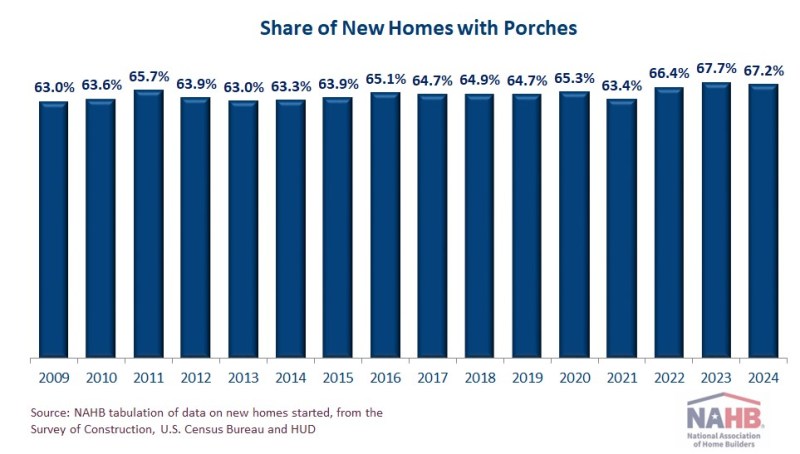
Although the share of new homes with porches edged down in 2024, porches continue to rank as the most common outdoor feature on new homes, according to NAHB tabulation of the latest data from the Survey of Construction (SOC, conducted by the U.S. Census Bureau with partial funding from HUD). Of the roughly 1.0 million single-family homes started in 2024, the SOC data show that 67.2% were built with porches. This is down, but only slightly, from the all-time peak of 67.7% reported a year earlier. Porches also continue to be more common on new homes than the other outdoor features covered in the SOC: patios and, especially, decks.   Traditionally, porches on new homes have been most common in the four states that make up the East South Central Census division. That was true again in 2024, although only by a narrow margin. In 2024, 81% of new homes in the East South Central had porches, but this share was well over 70% in three other divisions: the Pacific (78%), Mountain (77%), and South Atlantic (74%) divisions. Compared to the 2023 numbers reported in last year’s post, the porch percentages were up by two points in the East and West South Central divisions, unchanged in the Mountain and South Atlantic divisions, and down at least slightly in the other five divisions. Detail about the characteristics of porches on new homes is available from the Builder Practices Survey (BPS), conducted annually by Home Innovation Research Labs. Among other things, the 2025 BPS report (based on homes built in 2024) shows that porches continue to be far more common on the front of new single-family homes than on the side or rear. When on the front, porches average approximately 100 square feet of floor area. The other categories of porches distinguished in the SOC, although comparatively rare, tend to be noticeably larger: 140 square feet for a side or rear porch, and just over 200 square feet for a screened-in porch. On a square foot basis, builders continue to use concrete more than any other material to build new-home porches. Only one division remains a clear outlier in this regard. In New England, builders seldom use concrete in new-home porches, instead most often building them out of composite (a blend of usually recycled wood fibers and plastic). In that division, they also use treated wood, PVC or other plastics, cedar, and natural stone more often than concrete. Discover more from Eye On Housing Subscribe to get the latest posts sent to your email.

Where are Porches Most Common for Newly-Built Homes?2025-10-22T11:16:10-05:00

Custom Home Building Share Declines in 2024

2025-10-14T09:20:26-05:00

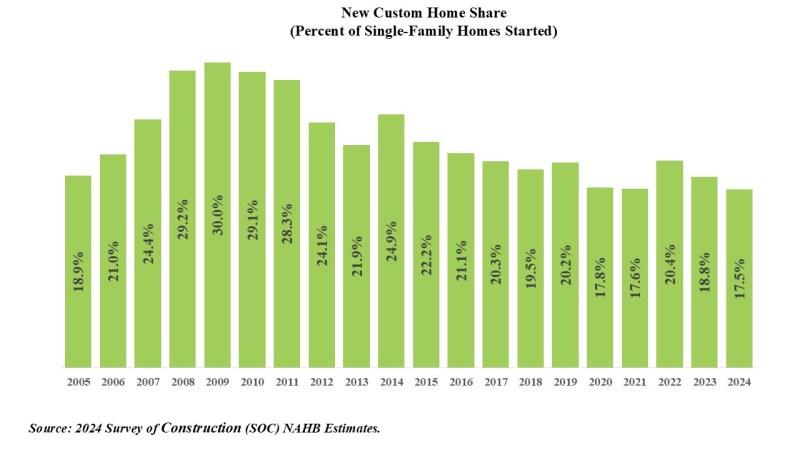
In 2024, 17.5% of all new single-family homes started were custom homes. This share decreased from 18.8% in 2023 and from 20.4% in 2022, according to data tabulated from the Census Bureau’s Survey of Construction (SOC). The custom home market consists of contractor-built and owner-built homes—homes built for owner occupancy on the owner’s land, with either the owner or a builder acting as a general contractor. The alternatives are homes built-for-sale (on the builder’s land, often in subdivisions, with the intention of selling the house and land in one transaction) and homes built-for-rent. In 2024, 73.1% of the single-family homes started were built-for-sale and 9.3% were built-for-rent. At a 17.5% share, the number of custom homes started in 2024 was 176,932, falling from 177,850 in 2023.    Quarterly statistics published by the Census Bureau for the second quarter of 2025 show year-over-year growth for custom home building amid broader single-family home building weakness. Although the quarterly statistics are timelier, they are often revised and lack the geographic detail available in the annual data set.  When analyzed across the nine census divisions, the annual data show that the highest custom home share in 2024 was 41.2% in the New England division. The lowest share was in the West South-Central division at just 10.7%.  Discover more from Eye On Housing Subscribe to get the latest posts sent to your email.

Custom Home Building Share Declines in 20242025-10-14T09:20:26-05:00

Vinyl Surpasses Stucco as Most Used Principal Exterior Wall Material 

2025-10-10T10:15:39-05:00

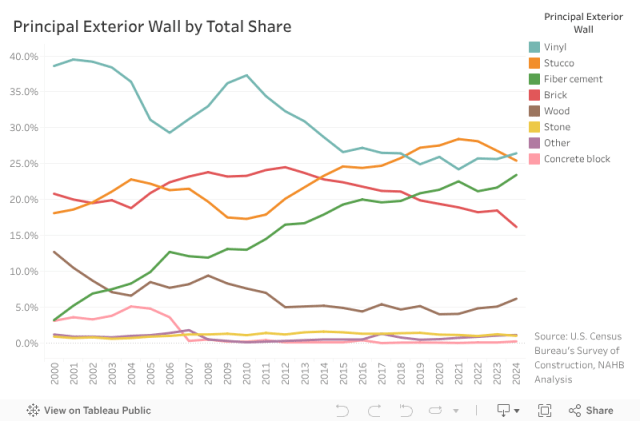
In 2024, vinyl siding was the most used principal exterior wall material for homes started. It holds just over a quarter share of homes, slightly surpassing stucco for the first time since 2018. For homes started in 2024, 26% had vinyl siding (including vinyl-covered aluminium) as their principal exterior wall material, according to the latest annual release of the U.S. Census Bureau’s Survey of Construction (SOC). Vinyl was followed closely by stucco at 25%, and by fiber cement siding (such as Hardiplank or Hardiboard) at 23%. Each of these materials holds about a quarter of the market, with another 16% held by brick or brick veneer. Far smaller shares of single-family homes started last year had wood or wood products (6%), stone, rock or other stone materials (1%), other (1%), or cement blocks (.2%) as the principal exterior wall material.  While vinyl has historically held a much larger share, at highs of almost 40% in 2001, the share fell rapidly between 2010 to 2015 by over 10 percentage points. However, since 2015, this share has remained fairly steady at around 26%. Meanwhile, stucco rose rapidly from 17% in 2010 until recently peaking at 28% in 2021.    However, the strongest trend has been the growing popularity in fiber cement siding. The share of exterior siding material for fiber cement siding has increased by 5.5 percentage points in the last ten years and by more than 15 percentage points in the past 20 years. Also notable is the decline of brick siding, from almost a quarter of homes in 2012, to just 16% in 2024. Although vinyl siding is most popular in the entire U.S., there are substantial differences in the use of siding when you look across geographies. In 2024, vinyl siding was the most used in the Midwest and Northeast regions. More specifically, vinyl siding was used on 73% of the new homes started in New England, 69% in the East North Central, 68% in the Middle Atlantic, and 49% in the West North Central.  Meanwhile, stucco was the most used primary exterior wall material in the Pacific, Mountain, and South Atlantic divisions in 2024 at 64%, 48% and 33%, respectively. Brick or brick veneer was the most common exterior siding material in the East South Central (39%) and West South Central (48%) divisions.  The West South Central division also had a substantially higher share of wood principal exterior homes at 27%.   Discover more from Eye On Housing Subscribe to get the latest posts sent to your email.

Vinyl Surpasses Stucco as Most Used Principal Exterior Wall Material 2025-10-10T10:15:39-05:00

Square Foot Prices Moderate in 2024

2025-10-02T08:19:47-05:00

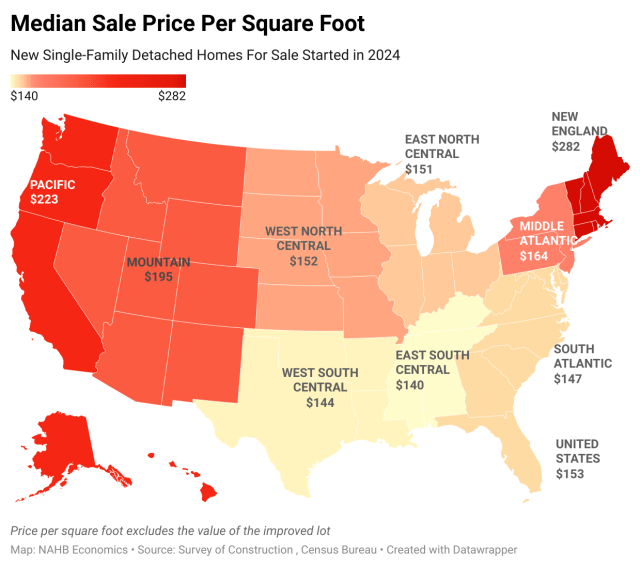
Median square foot prices for new single-family detached (SFD) homes started in 2024 grew modestly, according to NAHB’s analysis of the latest Survey of Construction (SOC) data. For custom, or contractor-built, homes, the median price was $166 per square foot of floor space1, up slightly from $162 in 2023. For spec starts, after excluding record-high improved lot values, the median was $153 per square foot of floor area, inching up from $150 a year earlier. There is still notable regional variation in square footage prices. In New England, after excluding lot values, half of the spec homes started in 2024 had prices exceeding $282 per square foot. In the East South Central division, the median was $133, representing the most affordable prices per square foot.Contract prices of custom homes do not include the value of an improved lot, as these homes are built on the owner’s land (with either the owner or a contractor acting as a general contractor). Consequently, contract prices are typically reported as lower than the sale prices of spec homes. To make the comparison more meaningful, the cost of lot development is excluded from sale prices in this analysis. The recent modest square foot price changes marked a sharp decline from the double-digit price hikes that characterized home building in the post-pandemic environment. As recently as 2022, increases in square foot prices of new SFD homes were approaching 20%, more than doubling the historically high U.S. inflation rate of 8%. The deceleration for median square foot prices reflects slower growth in building material prices and home building wages in 2024. The shifts towards cost-effective methods, such as building homes on slabs rather than with full or partial basements, also contributed to moderating the increases in square foot prices.In the for-sale market, the New England division registered the highest and fastest-rising median square foot prices. Half of the new for-sale SFD homes started here in 2024 were sold at prices exceeding $282 per square foot of floor area, paid on top of some of the most expensive lot values in the nation. The Pacific division came in second, with median prices of $223 per square foot. The most economical SFD spec homes were started in the South region, where the median sales price per square foot was below the national median of $153. The East South Central division is home to the least expensive for-sale homes. Half of all for-sale SFD homes started in the division in 2024 registered a square foot price of $140 or lower, paid on top of the most economical lot values in the country. The other two divisions in the South— South Central and South Atlantic—registered median prices of $144 and $147 per square foot, ranking them the second- and third-lowest medians in the nation. Because square foot prices in this analysis exclude the cost of developed lots, highly variable land values cannot account for regional differences in square footage prices. However, overly restrictive zoning, stricter building codes, and higher regulatory costs undoubtedly lead to higher per-square-foot prices. Regional differences in home types, common features, and construction materials also contribute to price variations. In the South, for example, lower square foot prices partially reflect a less frequent regional occurrence of costly new home features like basements. In the custom home market, new contractor-built SFD homes in the Northeast were more expensive to build. Half of custom SFD homes started in New England in 2024 registered prices greater than $190 per square foot of floor area. In the neighboring Middle Atlantic, the median custom home price was similarly high at $188 per square foot. The East North Central division came in close third, with a median of $186 per square foot of floor space. The East South Central and West South Central divisions are home to the most economical custom homes started in 2024, with half of the new custom homes registering prices at or below $129 and $138 per square foot of floor space, respectively. The remaining division in the South region — South Atlantic — recorded slightly higher median square foot contract prices of $155, still below the national median of $166. In the West, the Mountain division registered noticeable declines in square foot prices over the last two years, erasing a substantial portion of the post-pandemic double-digit annual hikes. Half of the custom SFD homes started here in 2024 had prices of $169 per square foot or higher. The corresponding median price in the neighboring Pacific was $167 per square foot. In comparison, during the post-pandemic home building boom, the median crossed the $200 mark for homes started in 2022 in the Mountain Division. Typically, when excluding improved lot values, contractor-built custom homes are more expensive per square foot than for-sale homes. Over the last two decades, this custom home premium averaged slightly above 9%, suggesting that new custom home buyers are not only willing to wait longer to move into a new home but also pay extra for pricier features and materials. However, these custom home premiums (see the chart below) largely disappeared in the post-pandemic environment marked by supply chain disruptions, soaring building materials costs, and home prices hitting new highs each month. In the last two years, the custom home premium returned to historic norms, indicating that the post-pandemic trend has reversed, and custom home buyers are once again willing to pay more for higher-end features and materials. The NAHB estimates in this post are based on the Survey of Construction (SOC) data. The survey information comes from interviews with builders and owners of the selected new houses. The reported prices are medians, meaning that half of all builders reported higher square foot prices, and the other half reported prices lower than the median. While the reported median prices cannot reflect the price variability within a division, and even less so within a metro area, they, nevertheless, highlight the regional differences in square foot prices. For the square footage statistics, the SOC uses all completely finished floor space, including space in basements and attics with finished walls, floors, and ceilings. This does not include a garage, carport, porch, unfinished attic, utility room, or any unfinished area of the basement. Discover more from Eye On Housing Subscribe to get the latest posts sent to your email.

Square Foot Prices Moderate in 20242025-10-02T08:19:47-05:00

About My Work

Phasellus non ante ac dui sagittis volutpat. Curabitur a quam nisl. Nam est elit, congue et quam id, laoreet consequat erat. Aenean porta placerat efficitur. Vestibulum et dictum massa, ac finibus turpis.

Recent Works

Recent Posts