

House Price Appreciation by State and Metro Area: Third Quarter 2025

2025-12-03T11:16:53-06:00

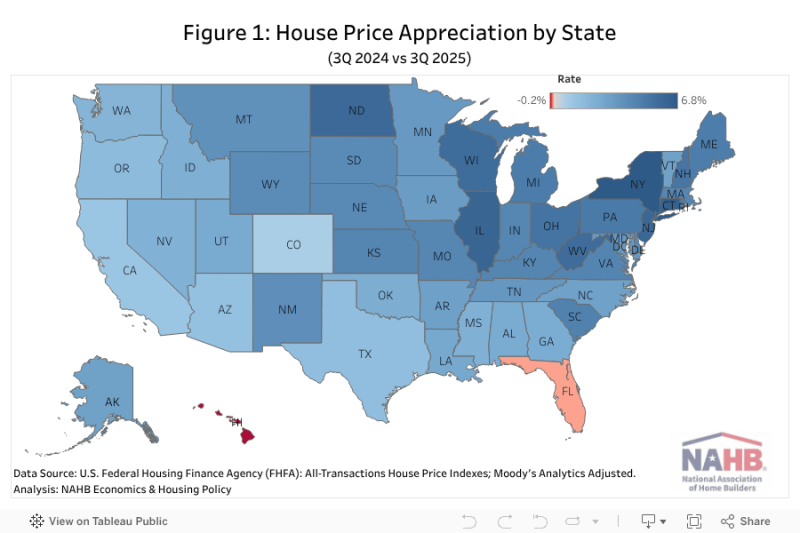
House prices continued to rise in the third quarter of 2025, though the pace of growth slowed as elevated mortgage rates, affordability challenges, and persistent economic uncertainty weighed on consumer demand. After several years of rapid growth, Hawaii and 38 metro areas saw house price declines this quarter, highlighting significant regional variations in market conditions. Nationally, according to the quarterly all-transactions House Price Index (HPI) released by the Federal Housing Finance Agency (FHFA), U.S. house prices rose 3.3% in the third quarter of 2025, compared to the same period in 2024. This represents the slowest year-over-year price appreciation since 2013, indicating a cooling in the housing market following a decade of robust price growth. The FHFA’s all-transactions HPI tracks average price changes based on repeat sales and refinancings of the same single-family properties. It offers insights not only at the national level but also across states and metropolitan areas. Between the third quarter of 2024 and the third quarter of 2025, 48 states and the District of Columbia experienced positive year-over-year (YoY) house price appreciation, with gains ranging from 0.6% to 6.8%. Hawaii was the only state to record a decline, while Florida posted no growth. New York led all states with a 6.8% gain, followed by Connecticut with a 6.5% gain and Illinois with a 6.2% gain. On the opposite end, Colorado posted the lowest house price appreciation at 0.6%. Notably, out of all 50 states and the District of Columbia, 29 states exceeded the national YoY growth rate of 3.3%. However, on a quarterly basis, home price appreciation decelerated in 45 states compared to the second quarter of 2025, highlighting a broad-based deceleration in the housing market. House price growth also varied widely across U.S. metro areas, ranging from a 7.8% decline to a 16.0% increase year-over-year. Punta Gorda, FL recorded the steepest drop, while Farmington, NM posted the strongest gains over the previous four quarters. In the third quarter of 2025, 34 metro areas, in reddish color on the map above, experienced negative house price growth, while 351 metro areas posted increases. Since the onset of the COVID-19 pandemic, house prices have surged nationally. Between the first quarter of 2020 and the third quarter of 2025, house prices climbed 54.9% nationwide, with more than half of metro areas exceeding this rate. However, 226 metro areas have seen varying degrees of decline from their post-COVID peaks, ranging from -0.1% to -12.7%. The map below presents the top ten and bottom ten markets for house price appreciation over the past five years. Among all the metro areas, house price appreciation ranged from 18.3% to 88.4%. Knoxville, TN topped the list with the highest house price appreciation, while Odessa, TX posted the lowest appreciation, ending Lake Charles, LA’s five-quarter run at the bottom.
House Price Appreciation by State and Metro Area: Third Quarter 20252025-12-03T11:16:53-06:00

Where Renters and Owners Face the Highest Cost Burdens

2025-11-24T11:16:25-06:00

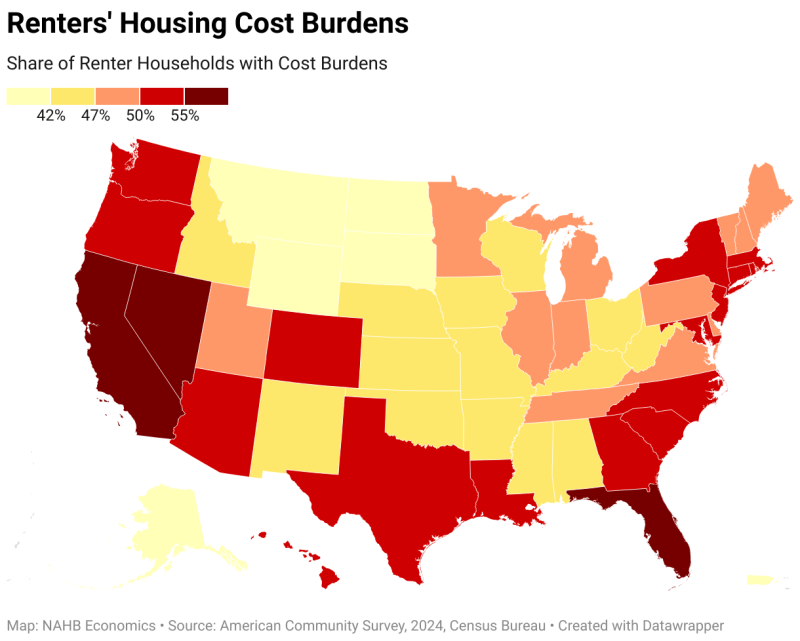
The housing affordability crisis continues to disproportionately affect renters, with more than half of renter households experiencing high-cost burdens — i.e., paying 30% or more of their income on rent and utilities. At the same time, current home owners, buoyed by significant home equity gains and locked in by below-market mortgage rates, are in a more advantageous financial position to weather the growing affordability crisis. According to the latest 2024 American Community Survey (ACS), more than half of all renter households (50.3%), or 23.2 million, are burdened by housing costs. Among home owners, this share is less than a quarter (24.3%) representing 21 million households. As a result, states and counties with higher shares of renters in their housing markets are more likely to have higher overall shares of households with cost burdens. Geographically, Florida, Nevada, and California have the largest concentration of cost-burdened renters. In Florida, 60% of all renters pay more than 30% of their income on rent and utilities. In Nevada, the share is 57%, and in California, 55% of renters experience housing cost burdens. Even in states with comparatively low renter cost-burden rates—such as South Dakota, Alaska, and North Dakota—more than one-third of renters still spend 30% or more of their income on housing. For home owners, cost-burden rates are generally lower, but the geographic pattern mirrors that of renters. California, Florida, and several Northeastern states report the highest shares of cost-burdened home owners. California faces the most severe affordability challenges, with one in three owners paying more than 30% of their income for housing. Florida and Hawaii follow closely, with 31% of existing home owners struggling to afford their homes. At the opposite end of the spectrum, nine states in the Midwest and South report that fewer than 20% of homeowners are cost-burdened. West Virginia and North Dakota have the lowest rates, at just 16%.

Where Renters and Owners Face the Highest Cost Burdens2025-11-24T11:16:25-06:00

Builders Stay Cautious as Single-Family Permits Weaken

2025-10-15T08:16:46-05:00

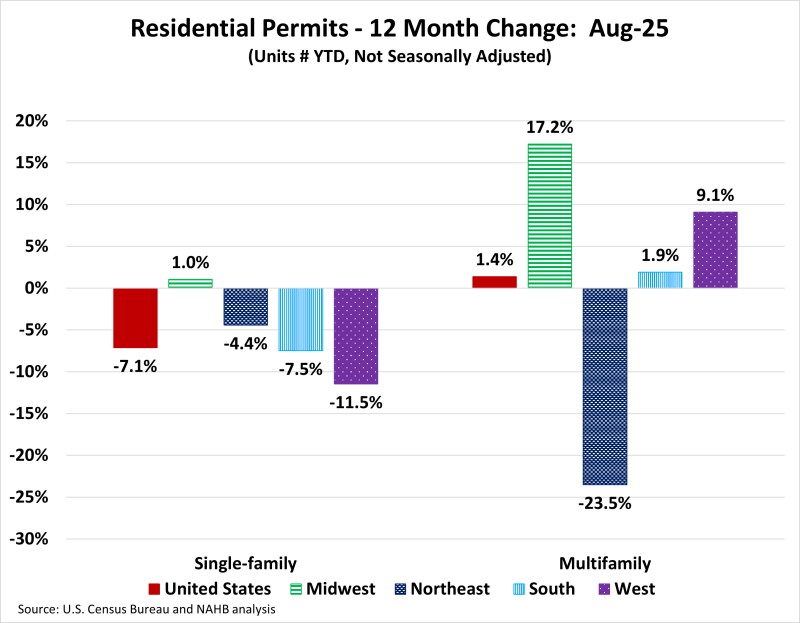
In August, single-family permit activity softened, reflecting caution among developers amid persistent economic headwinds. This trend has been consistent for eight continuous months. On the multifamily front, permitting also cooled in August but remains in the positive territory. While single-family continues to bear the brunt of affordability headwinds, the multifamily space is showing tentative signs of rebalancing. Over the first eight months of 2025, the total number of single-family permits issued year-to-date (YTD) nationwide reached 637,096. On a year-over-year (YoY) basis, this is a decline of 7.1% over the August 2024 level of 685,923. For multifamily, the total number of permits issued nationwide reached 330,617. This is 1.4% higher compared to the August 2024 level of 326,080. HBGI analysis indicates that this growth for multifamily development has been concentrated in lower density areas and among smaller builders. Year-to-date ending in August, single-family permits were up in one out of the four regions. The Midwest posted a minor increase of 1.0%. The Northeast was 4.4% lower, the South was down by 7.5%, and the West was down by 11.5% in single-family permits during this time. For multifamily permits, three out of the four regions posted increases. The Midwest was up by 17.2%, the West was up by 9.1%, and the South was up by 1.9%, Meanwhile, the Northeast declined steeply by 23.5%, driven by the New York-Newark-Jersey City, NY-NJ MSA which declined by 34.0%. Between August 2025 YTD and August 2024 YTD, 12 states posted an increase in single-family permits. The range of increases spanned 21.2% in Hawaii to 2.5% in Indiana. The remaining 38 states and the District of Columbia reported declines in single-family permits with New Mexico reporting the steepest decline of 35.1%. The ten states issuing the highest number of single-family permits combined accounted for 62.5% of the total single-family permits issued. Texas, the state with the highest number of single-family permits, issued 101,850 permits over the first eight months of 2025; this is a decline of 8.2% compared to the same period last year. The second highest state, Florida, decreased by 11.7%, while the third highest, North Carolina, posted a decline of 3.9%. Between August 2025 YTD and August 2024 YTD, 31 states and the District of Columbia recorded growth in multifamily permits, while 19 states recorded a decline. Mississippi (+113.2%) led the way with a sharp rise in multifamily permits from 250 to 533, while Maryland had the largest decline of 45.8% from 4,383 to 2,374. The ten states issuing the highest number of multifamily permits combined accounted for 60.0% of the multifamily permits issued. Over the first eight months of 2025, Florida, the state with the highest number of multifamily permits issued, experienced an increase of 20.0%. Texas, the second-highest state in multifamily permits, saw an increase of 1.5%. California, the third largest multifamily issuing state, increased by 10.1%. At the local level, below are the top ten metro areas that issued the highest number of single-family permits. For multifamily permits, below are the top ten local areas that issued the highest number of permits. Discover more from Eye On Housing Subscribe to get the latest posts sent to your email.

Builders Stay Cautious as Single-Family Permits Weaken2025-10-15T08:16:46-05:00

About My Work

Phasellus non ante ac dui sagittis volutpat. Curabitur a quam nisl. Nam est elit, congue et quam id, laoreet consequat erat. Aenean porta placerat efficitur. Vestibulum et dictum massa, ac finibus turpis.

Recent Works

Recent Posts