

Number of Bathrooms in New Single-Family Homes in 2024

2025-12-04T09:15:50-06:00

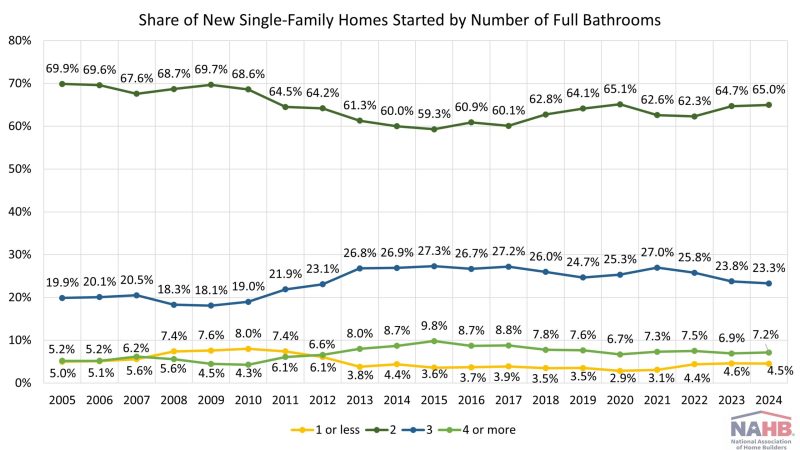
Single-family homes started in 2024 typically had two full bathrooms, according to the U.S. Census Bureau’s Annual Survey of Construction. Homes with three full bathrooms continued to have the second largest share of starts at around 23%. Meanwhile, both homes with four full bathrooms or more and homes with one bathroom or less made up under ten percent of homes started. A full bathroom, as defined by the Bureau, is one that has a washbasin, a toilet and either a bathtub or shower, or a combination of a bathtub and shower. In 2024, 65.0% of new single-family homes started in 2024 had two full bathrooms, marking  the second consecutive year that this share has increased.  The share of single-family starts with three full bathrooms fell for the third straight year, down to 23.3%, while the share of single-family starts with four or more bathrooms increased to 7.2%. For starts with one full bathroom or less, the share fell to 4.5%. Across the U.S., the East South Central division had the highest share, 71.6%, of new single-family starts having two full bathrooms. No other division had above a 70% share. The Census division with the lowest share was the Middle Atlantic, with 52.0% of new single-family starts reporting two full bathrooms. Starts in Middle Atlantic division were far more likely to have 4 full bathrooms or more, at 20.2%, more than double any other division in terms of share. Half-Bathrooms Most new single-family homes started in 2024 had no half-bathrooms at 53.7%. Following closely is the share of new single-family homes with one half-bathroom at 44.9%. New single-family starts with two or more half-bathrooms had a small share of 1.4% in 2024.  A half bathroom contains a toilet, bathtub, or shower, but not all facilities to be classified as a full bathroom. Half-bathrooms are historically more prevalent in the New England Census division as compared to the other eight divisions. In 2024, 64.0% of new single-family homes started in the New England division had at least one half-bathroom. The lowest share occurred in the Pacific division, where only 38.3% of starts had at least one half-bathroom.

Number of Bathrooms in New Single-Family Homes in 20242025-12-04T09:15:50-06:00

Non-Conventional Financing for New Home Sales Loses Ground in 2024

2025-10-20T09:15:39-05:00

Nationwide, the share of non-conventional financing for new home sales accounted for 31% of the market per NAHB analysis of the 2024 Census Bureau Survey of Construction (SOC) data. This is 1.7 percentage point lower than the 2023 share of 32.4%. As in previous years, conventional financing dominated the market at 69.3% of sales, higher than the 2023 share of 67.6%. Non-conventional forms of financing (as opposed to conventional mortgage loans) include loans insured by the Federal Housing Administration (FHA), VA-backed loans, cash purchases and other types of financing such as the Rural Housing Service, Habitat for Humanity, loans from individuals, or state or local government mortgage-backed bonds. The reliance on non-conventional forms of financing varied across the United States, with its share at almost 40% in the East North Central division but only 24% of new single-family home starts in the South Atlantic division. Nationwide, cash purchases were the majority share of non-conventional financing of new home purchases, accounting for 13% of the market share, slightly down from 14% in 2012. However, a NAHB survey based on builders reported that for 2024, all-cash sales were a higher share at 22%. Meanwhile, the Census reported FHA-backed loans accounted for 11% in 2024, whereas in 2023, they had a 12%market share. The share of VA-backed loans was at 4% market share in 2024, while Other Financing was 3% of market share. Regionally, cash financing held the highest share in the East North Central division, where 27% of all homes started were purchased with cash. Cash purchases led non-conventional financing in five out of nine census regions with27% in East North Central, 23% in New England, 21% in East South Central, 16% in Middle Atlantic, and 15% in West North Central. FHA-backed loans accounted for the majority of all non-conventional financing in the West South Central division, accounting for 20% homes started. In New England, very few homes used FHA-backed loans at just _%, along with the East South Central division at just 1% of homes started. VA-backed loans were most used in the West North Central division, accounting for 10% of non-conventional forms of financing. Notably, in New England, only 1% of the homes started used VA-backed loans in 2024. Other financing such as the Rural Housing Service, Habitat for Humanity, loans from individuals, state or local government mortgage-backed bonds were highest in the East South Central division where it was collectively 14% of market share, while the Mountain division reported the lowest share at 1%. Discover more from Eye On Housing Subscribe to get the latest posts sent to your email.

Non-Conventional Financing for New Home Sales Loses Ground in 20242025-10-20T09:15:39-05:00

Builders Stay Cautious as Single-Family Permits Weaken

2025-10-15T08:16:46-05:00

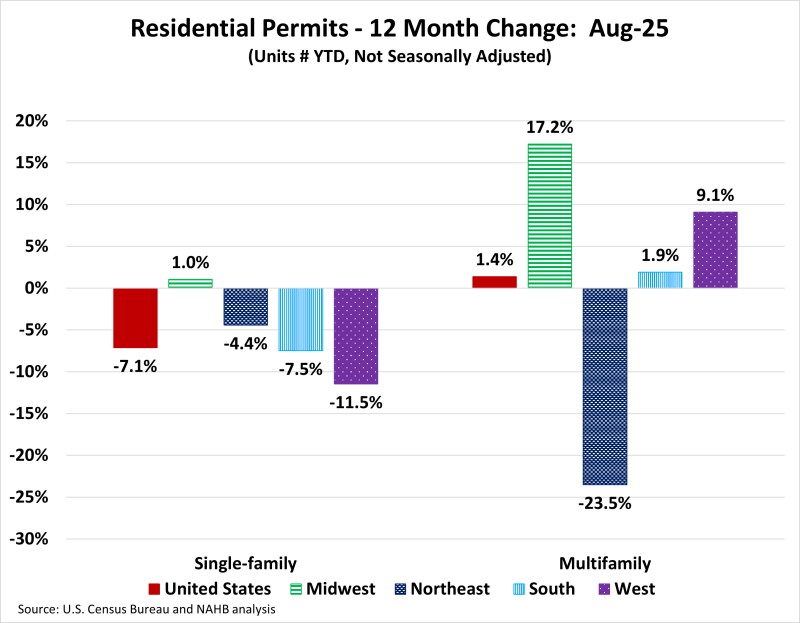
In August, single-family permit activity softened, reflecting caution among developers amid persistent economic headwinds. This trend has been consistent for eight continuous months. On the multifamily front, permitting also cooled in August but remains in the positive territory. While single-family continues to bear the brunt of affordability headwinds, the multifamily space is showing tentative signs of rebalancing. Over the first eight months of 2025, the total number of single-family permits issued year-to-date (YTD) nationwide reached 637,096. On a year-over-year (YoY) basis, this is a decline of 7.1% over the August 2024 level of 685,923. For multifamily, the total number of permits issued nationwide reached 330,617. This is 1.4% higher compared to the August 2024 level of 326,080. HBGI analysis indicates that this growth for multifamily development has been concentrated in lower density areas and among smaller builders. Year-to-date ending in August, single-family permits were up in one out of the four regions. The Midwest posted a minor increase of 1.0%. The Northeast was 4.4% lower, the South was down by 7.5%, and the West was down by 11.5% in single-family permits during this time. For multifamily permits, three out of the four regions posted increases. The Midwest was up by 17.2%, the West was up by 9.1%, and the South was up by 1.9%, Meanwhile, the Northeast declined steeply by 23.5%, driven by the New York-Newark-Jersey City, NY-NJ MSA which declined by 34.0%. Between August 2025 YTD and August 2024 YTD, 12 states posted an increase in single-family permits. The range of increases spanned 21.2% in Hawaii to 2.5% in Indiana. The remaining 38 states and the District of Columbia reported declines in single-family permits with New Mexico reporting the steepest decline of 35.1%. The ten states issuing the highest number of single-family permits combined accounted for 62.5% of the total single-family permits issued. Texas, the state with the highest number of single-family permits, issued 101,850 permits over the first eight months of 2025; this is a decline of 8.2% compared to the same period last year. The second highest state, Florida, decreased by 11.7%, while the third highest, North Carolina, posted a decline of 3.9%. Between August 2025 YTD and August 2024 YTD, 31 states and the District of Columbia recorded growth in multifamily permits, while 19 states recorded a decline. Mississippi (+113.2%) led the way with a sharp rise in multifamily permits from 250 to 533, while Maryland had the largest decline of 45.8% from 4,383 to 2,374. The ten states issuing the highest number of multifamily permits combined accounted for 60.0% of the multifamily permits issued. Over the first eight months of 2025, Florida, the state with the highest number of multifamily permits issued, experienced an increase of 20.0%. Texas, the second-highest state in multifamily permits, saw an increase of 1.5%. California, the third largest multifamily issuing state, increased by 10.1%. At the local level, below are the top ten metro areas that issued the highest number of single-family permits. For multifamily permits, below are the top ten local areas that issued the highest number of permits. Discover more from Eye On Housing Subscribe to get the latest posts sent to your email.

Builders Stay Cautious as Single-Family Permits Weaken2025-10-15T08:16:46-05:00

About My Work

Phasellus non ante ac dui sagittis volutpat. Curabitur a quam nisl. Nam est elit, congue et quam id, laoreet consequat erat. Aenean porta placerat efficitur. Vestibulum et dictum massa, ac finibus turpis.

Recent Works

Recent Posts