
August Private Residential Construction Spending Edges Higer 

2025-11-17T11:14:28-06:00

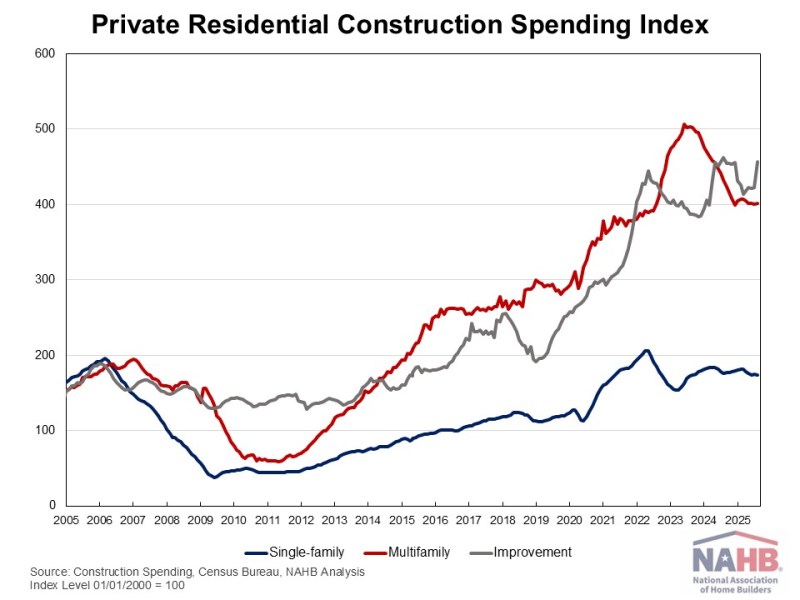
Private residential construction spending inched up 0.8% in August, continuing steady growth since June 2025. This modest increase was primarily driven by more spending on multifamily construction and home improvements. However, total spending was 2% lower than a year ago, as the housing sector continues to navigate the economic uncertainty stemming from ongoing tariff concerns and elevated mortgage rates.  According to the latest U.S. Census construction spending data, single-family construction spending slipped 0.4% in August, in line with the soft builder sentiment reflected in the August NAHB/Wells Fargo Housing Market Index (HMI). Compared to a year ago, single-family construction spending decreased by 1.1%. Improvement spending (remodeling) posted a solid 8.2% gain for the month, but it remained 1.3% lower than in August 2024. The remodeling sector continues to show resilience, supported by strong homeowner equity and persistent demand for home improvements. Meanwhile, multifamily construction spending rose 0.2% in August, marking a pause in the downward trend that began in mid-2023. Compared to a year earlier, multifamily spending was down 7.1%.   The NAHB construction spending index is shown in the graph below. The index illustrates how   spending on single-family construction has slowed since early 2024 under the pressure of elevated interest rates and concerns over building material tariffs. Multifamily construction spending growth has also slowed down after the peak in July 2023. Improvement spending has also been weakening since the beginning of 2025.  Spending on private nonresidential construction was down 4% over a year ago. The annual private nonresidential spending decrease was primarily driven by a $20 billion drop in manufacturing construction spending, followed by a $11 billion decrease in commercial construction spending.

August Private Residential Construction Spending Edges Higer 2025-11-17T11:14:28-06:00

The International Builders’ Show: The Leading Economic Forecast Event of the Year 

2025-11-04T10:16:35-06:00

Every year, NAHB and other industry experts and economists bring their latest insights to the NAHB International Builders’ Show® (IBS). For 2026, IBS offers an unparalleled lineup of IBS Education sessions that cover every sector of the housing industry: single-family, multifamily, remodeling, design trends, and building materials.   The Builders’ Show in 2026 is in Orlando, February 17 – 19. This is the only event where you’ll find all these speakers and sessions at one conference:  The Outlook: 2026 Housing & Economic Forecast (Super Session)   Tuesday, February 17 | 2:15 – 3:45 PM   This IBS Super Session is hosted by our very own Chief Economist, Robert Dietz, as well as Chief Economist of Realtor.com, Danielle Hale, and Chief Economist of Zonda, Ali Wolf. Not only does this session give you the chance to hear from these three nationally recognized economists, but it also gives you a complete overview of the housing economy.   2026 Multifamily Market Outlook  Tuesday, February 17 | 10:00 – 11:00 AM   Danushka Nanayakkara-Skillington, NAHB AVP of Forecasting & Analysis, and Selma Hempp, Chief Economist of Cotality, host a deep dive into multifamily housing. Explore the construction pipeline, financing challenges, rent growth, and more. Join the discussion for an exclusive forecast of where the multifamily sector is headed.   Remodeling by the Numbers: Market Outlook & Business Benchmarks for 2026  Wednesday, February 18 | 8:15 – 9:15 AM  Featuring NAHB Economist Eric Lynch, as well as remodeling expert Alan Hanbury, learn what key indicators and trends are shaping the home improvement industry and where it is headed. Compare how your business is doing with exclusive benchmarks on profit margins, operating costs, and more with exclusive findings from the NAHB ‘Remodelers’ Cost of Doing Business’ study.   Home Trends, Buyer Preferences & Most Likely Features for 2026  Wednesday, February 18 | 10:00 – 11:00 AM  Explore the latest research on the home and community features buyers want most in this session led by NAHB AVP of Survey Research, Rose Quint and architect and industry thought-leader Donald Ruthroff. Discover what trends are shaping new home designs, including how preferences shift by price– point. See these trends in action, illustrated through award-winning designs from recent Best in American Living Awards™ (BALA) winners.  Building Materials in Flux: Pricing Trends, Trade Dynamics & Supply Chain  Wednesday, February 18 | 2:15 – 3:15 PM  Gain timely insights into the ever-evolving trending issue of building materials, hosted by NAHB Director of Tax and Trade, Jesse Wade, custom builder and industry leader Don Dabbert, and industry expert and analyst Nishu Sood from John Burns Research and Consulting. Learn how key building materials like lumber are affected by tariffs and other international trade dynamics. Explore what’s driving material costs and availability, and how global and domestic supply chains are adapting.    Register Now   To attend IBS Education sessions, you must register for an Expo+Education Pass.  Seating for sessions is on a first-come, first-served basis. So, register for an IBS Expo+Education Pass and then mark these sessions on your calendar. For more information on all that IBS has to offer, please visit BuilderShow.com. We hope to see you there!   Discover more from Eye On Housing Subscribe to get the latest posts sent to your email.

The International Builders’ Show: The Leading Economic Forecast Event of the Year 2025-11-04T10:16:35-06:00

Shorter Apartment Construction Time in 2024

2025-10-06T09:14:42-05:00

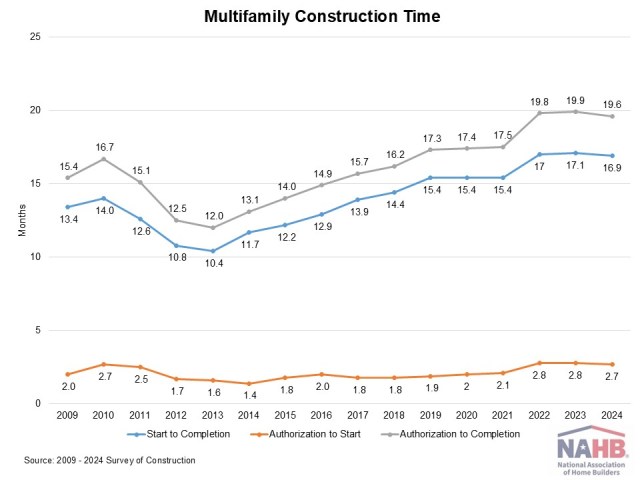
The average time needed to complete construction of a multifamily building after obtaining authorization edged down in 2024, according to the 2024 Survey of Construction (SOC) from the Census Bureau. On average, it took 19.6 months from permit to completion, about 0.3 months shorter than in 2023. While construction timelines remain lengthy, this modest decline occurred despite the industry continuing to grapple with a shortage of skilled labor. The average time to build multifamily homes varies with the number of units in the building. In general, the more units, the longer the construction time. In 2024, buildings with 20 or more units took the longest, 22.1 months, to build after obtaining authorization. By contrast, 2-to-4-unit buildings were finished the fastest, averaging 15.3 months. Mid-sized projects fell in between, with 10-to-19-unit buildings averaging 19.2 months and 5-to-9-unit buildings averaging 19.1 months. Year-over-year changes show a mixed pattern. Completion times for 2-to-4-unit buildings shortened by 2.3 months, while 10-to-19-unit projects took 2.3 months longer. The biggest increase occurred for 5-to-9-unit buildings, which required 2.2 more months to complete than in 2023. The 2024 SOC data also show a significant regional variation in the average construction duration of multifamily buildings. The Northeast had the longest time from authorization to completion at 23.4 months, followed by the West at 19.9 months, and then the South with 18.5 months. The shortest permit-to-completion period happened in the Midwest with 17.3 months. Discover more from Eye On Housing Subscribe to get the latest posts sent to your email.

Shorter Apartment Construction Time in 20242025-10-06T09:14:42-05:00

NAHB HBGI:  Relative Gains for Smaller Markets, Particularly for Multifamily

2025-09-02T09:21:24-05:00

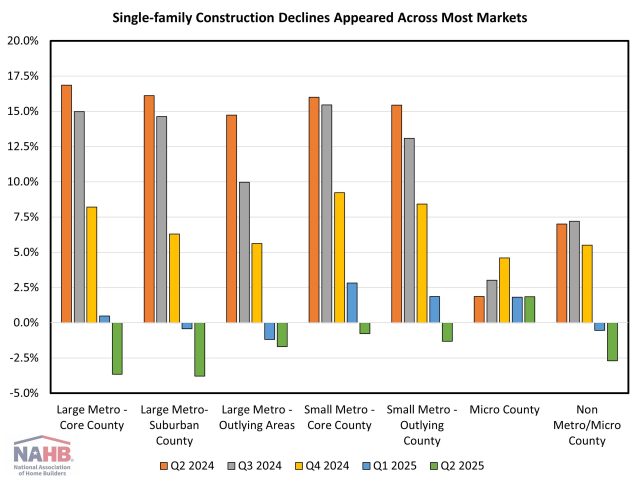
Single-family construction declined in the second quarter of 2025 for almost all tracked markets, according to the NAHB Home Building Geography Index (HBGI). Meanwhile, multifamily construction continued to expand in low population density markets, which have shown remarkable strength due to for-sale affordability challenges. The HBGI tracks single-family and multifamily permits across seven population density delineated geographies in the United States. Single-Family Home Building Among the HBGI markets, growth in the second quarter of 2025 was only registered in micro counties, which increased 1.8% year-over-year on a four-quarter moving average basis (4QMA). Most markets reported declines, with the largest occurring in large metro suburban counties, posting a decline of 3.8%. The drop in growth across the markets remains high, as five markets had single-family growth near 15% just one year ago. In terms of market share, single-family construction’s largest geography was small metro core county areas, representing 29.3% of single-family construction. The smallest single-family construction market remained non metro/micro county areas, with a 4.3% market share. As the largest declines in single-family construction over the past year occurred in large metro areas, smaller population and less densely populated counties have gained single-family construction market share. The combined market share of these smaller areas (excluding large metro areas), reached its highest level since the first quarter of 2023 (50.3%), marking 50.2% in the second quarter. Multifamily Home Building The largest gains for multifamily construction occurred in small metro outlying counties, growing 22.1% (4QMA) in the second quarter. This was the first time that small metro outlying counties had the largest gain among geographies since the second quarter of 2022, when it rose 29.6%. The largest decline was in large metro core counties declining 12.3%. The market share of multifamily construction for smaller markets has continued to climb since the pandemic. The loss in market share for large metro core counties, which continues to make up the bulk of multifamily construction, has mostly been absorbed by small metro core counties. The market share for small metro core counties is up 4.3 percentage points from the first quarter of 2020 to 24.9%. If this trend continues, small metro core counties could overtake large metro suburban counties for the second highest market share in the multifamily construction market as the gap between the two continues to shrink. The second quarter of 2025 HBGI data along with an interactive HBGI map can be found at http://nahb.org/hbgi. Discover more from Eye On Housing Subscribe to get the latest posts sent to your email.

NAHB HBGI:  Relative Gains for Smaller Markets, Particularly for Multifamily2025-09-02T09:21:24-05:00

Multifamily Absorption Rises in the Second Quarter

2025-08-29T08:21:31-05:00

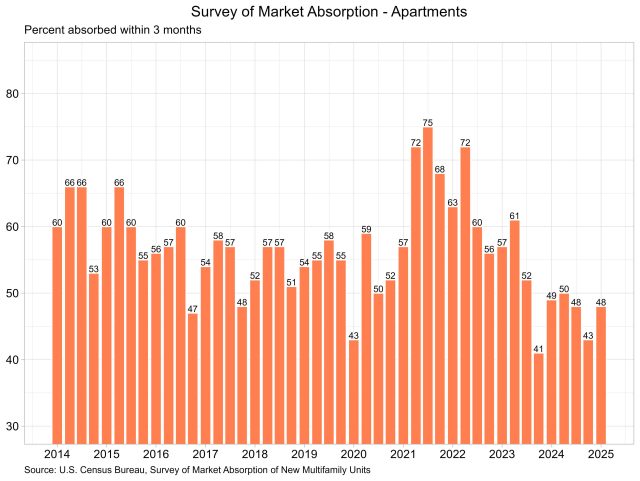
The percentage of new apartment units that were absorbed within three months after completion rose in the second quarter, according to the Census Bureau’s latest release of the Survey of Market Absorption of New Multifamily Units (SOMA). The survey covers new units in multifamily residential buildings with five or more units. The number of new multifamily units completed fell for the second consecutive quarter, down to the lowest level since the fourth quarter of 2023. Apartments The percentage of apartments absorbed within three months has fallen significantly from its peak of 75% in the third quarter of 2021, as shown in the graph above. Currently, the rate stands at 48%, meaning that 48% of the 98,520 units completed in the first quarter were rented within three months of completion. The median asking rent in the second quarter was $1,920, up 12.3% from $1,710 a year ago. This marks the second consecutive quarter of record high asking rent in the SOMA survey. Along with the three-month absorption rate and completions, SOMA also reports absorption rates at six, nine, and twelve months after completion. For apartments completed six months ago (124,300 units), 70% have been absorbed into the market. Of the 143,400 apartments completed nine months ago, 81% have been absorbed. For those completed twelve months ago (118,700 units), 91% have been absorbed into the multifamily market. Condominiums and Cooperative Units The three-month absorption rate for new condominiums and cooperative units fell four percentage points to 66%. Total completions of new condominiums and cooperative units, according to the SOMA, fell in the first quarter from 2,902 to 2,639. Completions of these units peaked in the second quarter of 2018 at 7,996 and have steadily fallen since then. Discover more from Eye On Housing Subscribe to get the latest posts sent to your email.

Multifamily Absorption Rises in the Second Quarter2025-08-29T08:21:31-05:00

Most Home Builders are Small Businesses

2025-08-27T08:27:22-05:00

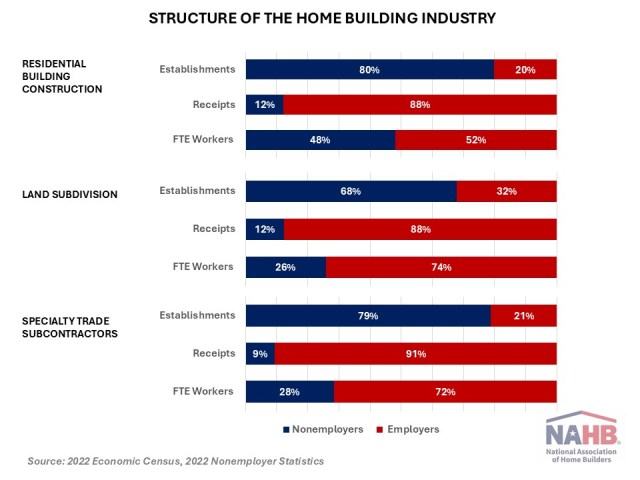
Despite historically low self-employment rates and the rising market share of top ten builders, residential construction remains an industry dominated by independent entrepreneurs, with nearly 80% of home builders and specialty trade contractor firms being self-employed independent contractors. Even among firms with paid employees, the industry continues to be dominated by small businesses, with 63% of homebuilders and two out of three specialty trade contractors generating less than one million dollars in total business receipts. The new estimates are based on the 2022 Economic Census and Nonemployer Statistics data.1The Economic Census covers several construction subsectors that comprise the home building industry: Residential Building Construction (RBC) – Single-family general contractors (except for-sale builders) – Multifamily general contractors (except for-sale builders) – New housing for-sale builders Residential Remodelers Land Subdivision (or land developers) Specialty Trade Contractors (STC) The 2022 statistics show that the majority of residential construction businesses are self-employed independent contractors.  There are over 813,000 nonemployer firms in residential building construction (RBC), accounting for close to 80% of all establishments. In land subdivision, more than 9,000 independent contractors account for 68% of land subdivision firms.  Over 1.9 million specialty trade independent contractors make up 79% of all STC establishments. These nonemployer firms also account for almost half of the full-time employees (FTE) in residential building construction, 26% in land subdivision, and 28% in STC.  Most of these self-employed mom-and-pop firms are very small, with annual receipts averaging under $103,000 for residential building construction, and under $70,000 for specialty trade contractors. Self-employed independent contractors in land subdivision average around $288,000 in annual business receipts. As a result, these nonemployer firms make up only 12% of all sales and receipts generated by residential building construction and land subdivision, and 9% of specialty trade contractors’ revenue. Among residential construction businesses with paid employees, remodeling, land subdivision, and specialty trade subcontractors (STC) companies tend to be smaller.  Three out of four remodeling establishments, 63% of land developers, and 59% of STC companies generate under $1 million in receipts.   Home builders are typically somewhat larger, with about 45% of companies reporting annual sales over $1 million. Among homebuilders, multifamily general contractors tend to be the largest. However, the Census Bureau did not disclose the number of the largest (with revenue over $100 million) and smallest (with revenue under $100K) multifamily and single-family custom builders in 2022. As a result, the revenue spectrum for MF and SF contractors is incomplete and is presented in a separate chart.  Multifamily contractors are typically larger compared to single-family contractors and for-sale builders (who build on land they own and control). Ten percent of multifamily contractors reported annual sales between $10 million and 25 million, and an additional 11% earned between $25 million and $100 million in 2022.   Under the most recent U.S. Small Business Administration (SBA) size standards, the vast majority of residential construction companies qualify as small businesses. The most recent small business size limits for all types of builders are $45 million, $34 million for land subdivision, and $19 million for specialty trade contractors. By these standards, almost all remodelers and single-family contractors, and at least 98% of land developers, and 96% of specialty trade contractors, easily qualify as small businesses.  The Economic Census, like many other federal statistics programs, collects data only on establishments with payroll employees. The Nonemployer Statistics Program by the Census Bureau collects annual data for businesses that have no paid employees, including the number of businesses and total receipts by industry, which largely come from the IRS. Discover more from Eye On Housing Subscribe to get the latest posts sent to your email.

Most Home Builders are Small Businesses2025-08-27T08:27:22-05:00

Multifamily Missing Middle Trends

2025-08-25T12:14:48-05:00

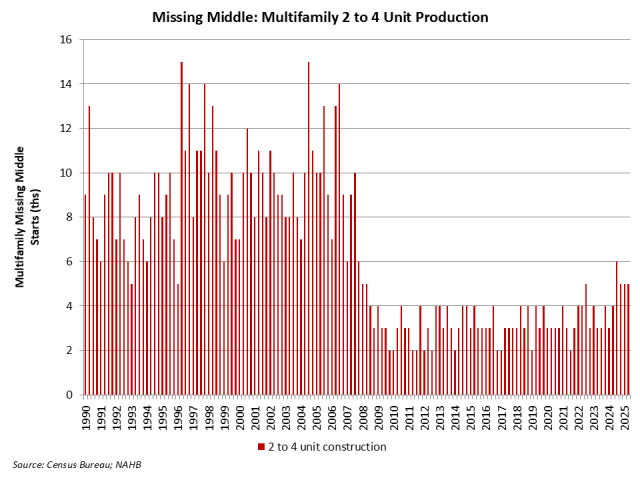
The missing middle construction sector includes development of medium-density housing, such as townhouses, duplexes and other small multifamily properties. The multifamily segment of the missing middle (apartments in 2- to 4-unit properties) has generally disappointed since the Great Recession. For the second quarter of 2025, there were 5,000 2- to 4-unit housing unit construction starts. This represents a small increase relative to the second quarter of 2024. Over the last four quarters this type of construction totaled 21,000 units, up 50% over the four quarters prior to that period (14,000). As a share of all multifamily production, 2- to 4-unit development was just 4% of total multifamily development for the second quarter. This remains lower than recent historic trends. From 2000 to 2010, such home construction made up a little less than 11% of total multifamily construction. Construction of the missing middle has clearly lagged during the post-Great Recession period and will continue to do so without zoning reform focused on light-touch density. But recent gains offer hope for additional housing supply for these kind of homes. Discover more from Eye On Housing Subscribe to get the latest posts sent to your email.

Multifamily Missing Middle Trends2025-08-25T12:14:48-05:00

Multifamily Built-for-Rent Share

2025-08-25T08:15:28-05:00

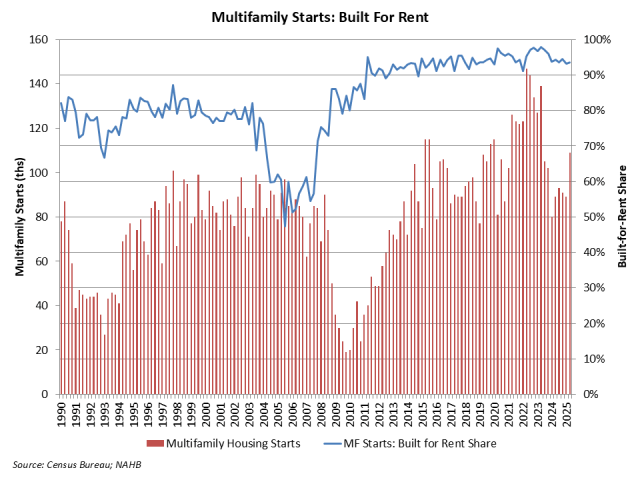
According to NAHB analysis of quarterly Census data, the count of multifamily, for-rent housing starts increased during the second quarter of 2025. For the quarter, 109,000 multifamily residences started construction. Of this total, 102,000 were built-for-rent. This built-for-rent total was 21% higher than the second quarter of 2024. The market share of rental units of multifamily construction starts was 94% for the second quarter. A historical low market share of 47% for bult-for-rent multifamily construction was set during the third quarter of 2005, during the condo building boom. An average share of 80% was registered during the 1980-2002 period. For the second quarter, there were 7,000 multifamily condo unit construction starts, an increase from a year ago. An elevated rental share of multifamily construction is holding typical apartment size below levels seen during the pre-Great Recession period. However, according to the second quarter 2025 data, the average square footage of multifamily construction starts increased to 1,077 square feet. The median increased to 1,092 square feet. Multifamily unit size is tending higher as the market captures priced-out buyers from the single-family for-sale market. Discover more from Eye On Housing Subscribe to get the latest posts sent to your email.

Multifamily Built-for-Rent Share2025-08-25T08:15:28-05:00

About My Work

Phasellus non ante ac dui sagittis volutpat. Curabitur a quam nisl. Nam est elit, congue et quam id, laoreet consequat erat. Aenean porta placerat efficitur. Vestibulum et dictum massa, ac finibus turpis.

Recent Works

Recent Posts