

Mortgage Rates Continue to Trend Lower in November

2025-12-05T10:19:10-06:00

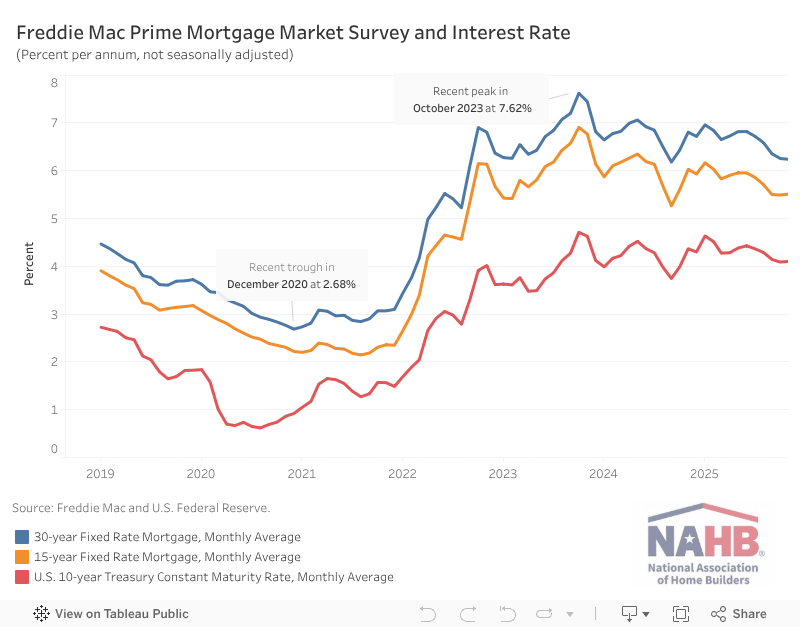
The average mortgage rate in November continued to trend lower to its lowest level in over a year. According to Freddie Mac, the 30-year fixed-rate mortgage averaged 6.24% in November, 2 basis points (bps) lower than in October. Meanwhile, the 15-year rate increased 3 bps to 5.51%. Both the 30-year and 15-year rates remain lower than a year ago, dropping by 57 bps and 52 bps year-over-year, respectively. The 10-year Treasury yield, a key benchmark for long-term borrowing, averaged 4.09% in November– a 3-basis point increase from the previous month. The spread between the 30-year fixed mortgage rate and the 10-year Treasury remains somewhat elevated at 215 basis points, well above the roughly 150-180 basis points seen in a stable market. While the spread has narrowed from the wide gap in 2023, it continues to reflect ongoing market uncertainty, keeping mortgage rates higher than their historical relationship to 10-year Treasury yields. Falling mortgage rates have shown some impact on housing activity. Mortgage application activity continues to strengthen, led by increases in adjustable-rate mortgages and refinancing applications. Additionally, existing home sales rose to an eight-month high in October. There is no data available for new home sales in October due to the government shutdown.
Mortgage Rates Continue to Trend Lower in November2025-12-05T10:19:10-06:00

Unchanged Lending Conditions for Residential Mortgages in Third Quarter

2025-11-13T08:14:35-06:00

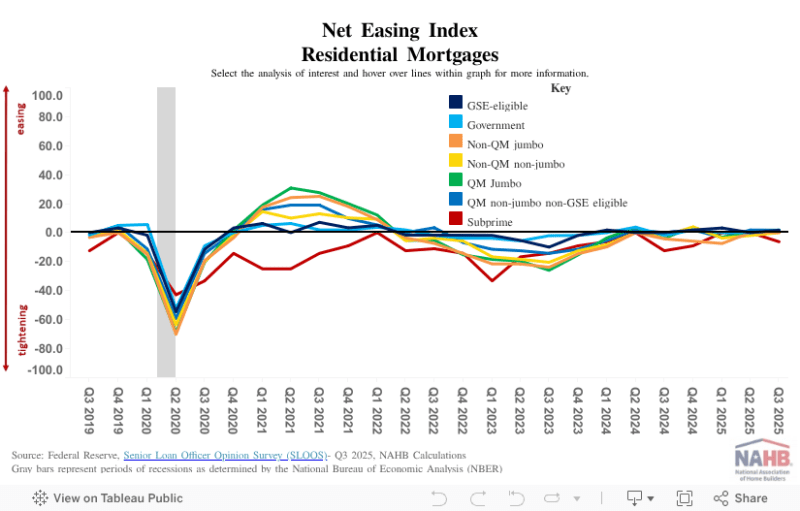
Lending standards for most types of residential mortgages were essentially unchanged, according to the recent release of the Senior Loan Officer Opinion Survey (SLOOS). For commercial real estate (CRE) loans, lending standards for construction & development were modestly tighter, while multifamily was essentially unchanged.  Demand for both CRE categories was essentially unchanged for the quarter.  Two weeks ago, the Federal Reserve eased its key short-term interest rate (i.e., Federal Funds) by 25 basis points for the second consecutive meeting, establishing an upper bound of 4.00%.  While the causal link between the Federal Funds rate and the 30-year fixed rate mortgage is minimal, these cuts will have a more tangible impact for private home builders through lower rates on acquisition, development, & construction (AD&C) loans.  Roughly 60% of single-family starts are built by private builders. With pressure from both sides of their dual mandate as the job market cools and inflation remains sticky, NAHB is forecasting a measured approach from the Fed when it comes to further rate cuts next year. Residential Mortgages In the third quarter of 2025, four of seven residential mortgage loan categories saw a positive net easing index for lending conditions with an additional two recording a neutral reading (i.e., 0).  Only subprime loans experienced tighter lending conditions, as evidenced by a negative value (-6.3).  Nevertheless, based on the Federal Reserve classification of any reading between -5.0 and +5.0 as “essentially unchanged,” all but subprime fell within this range. Five of the seven residential mortgage loan categories reported stronger demand in the third quarter of 2025, with the strongest demand coming from Government, GSE-eligible, and Qualified Mortgage (QM) non-jumbo, non-GSE eligible loans.  Non-QM jumbo was essentially unchanged for the quarter, while subprime loans were the only category to experience weaker demand, which has been the case since Q3 of 2020. Commercial Real Estate (CRE) Loans For the CRE loan categories, construction & development loans registered a net easing index of -6.6 for the third quarter of 2025, indicating modestly tighter credit conditions.  For multifamily loans, the net easing index was -1.6, or essentially unchanged.  Both categories of CRE loans show tightening of lending conditions (i.e., net easing indexes below zero) since Q2 2022.  However, the tightening has become less defined recently for multifamily, with its net easing index essentially unchanged (i.e., between -5.0 and +5.0) for four consecutive quarters. The net percentage of banks reporting stronger demand was -4.9% for construction & development loans, with a negative number indicating weaker demand.  For multifamily, demand was neutral (i.e., 0) in the third quarter of 2025, with the same number of banks that reported weaker demand as those who reported stronger demand.  However, demand for CRE loans within both categories has experienced unchanged conditions (i.e., between -5.0% and +5.0%).

Unchanged Lending Conditions for Residential Mortgages in Third Quarter2025-11-13T08:14:35-06:00

Adjustable-Rate Mortgage Applications Rise 

2025-11-12T13:14:21-06:00

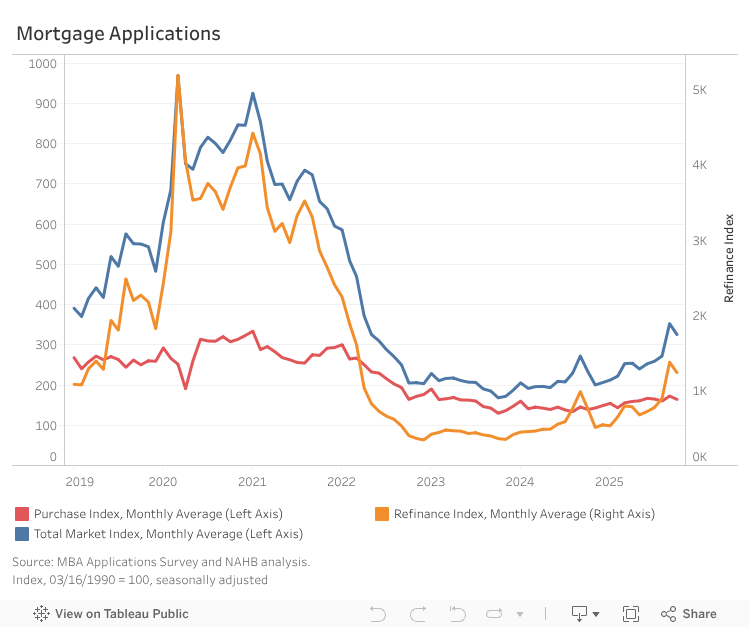
All types of mortgage activity rose on a year-over-year basis in October, supported by recent declines in interest rates. Notably, adjustable-rate mortgage (ARM) applications more than doubled from a year ago, and refinancing activity continued to strengthen.  The Mortgage Bankers Association’s (MBA) Market Composite Index, a measure of total mortgage application volume, fell 7.7% from September on a seasonally adjusted basis but was 39.0% higher than a year ago.  The average contract interest rate for 30-year fixed mortgages fell 5.4 basis points to 6.37%, the lowest in over a year. Following a strong increase in September, refinancing activity in October dropped 10% month over month, while purchase applications decreased 4.8%. Compared to a year ago, purchase and refinance applications were up 18.1% and 63.0%, respectively.  By loan type, fixed-rate mortgage applications decreased 7% from September but were 34% higher year-over-year. Adjustable-rate mortgage applications dropped 13% month-over-month, yet surged 116.5% from a year earlier, following a 124% annual gain in September. As a result, ARMs accounted for 9.44% of total applications in October, one of the highest shares in the past three years.  The average loan size across all mortgages was $408,000, down 3% from the previous month. The average purchase loan size remained steady at $437,000, while the average refinance loan size declined 6% to $385,000. For adjustable-rate mortgages, the average loan size fell 5% to $938,000, compared to a 2% decline for fixed-rate mortgages to $353,000. 

Adjustable-Rate Mortgage Applications Rise 2025-11-12T13:14:21-06:00

Lowest Mortgage Rates in Over a Year in October 

2025-10-31T12:14:39-05:00

Average mortgage rates in October trended downward to the lowest rates in over a year. According to Freddie Mac, the 30-year fixed-rate mortgage averaged 6.25% in October, 10 basis points (bps) lower than September. Meanwhile, the 15-year rate declined just 1 bp to 5.49%. Both the 30-year and 15-year rates remain lower than a year ago, dropping by 17 bps and 11 bps year-over-year, respectively.   The 10-year Treasury yield, a key benchmark for long-term borrowing, averaged 4.09% in October – a 5-basis point decrease from the previous month. Markets priced in rate cuts from the Fed at the start of the month, resulting in relatively unchanged rates following the announcement of a 25 bps cut to the federal funds rate on October 29th.  Falling mortgage rates have shown some small impacts on housing activity. According to the latest Mortgage Bankers Association (MBA) report, mortgage application activity strengthened, with refinancing applications rising and purchase applications also increasing. Additionally, existing home sales rose to a seven-month high in September. There is no data available for new home sales in September due to the government shutdown.  Looking forward, the industry faces a bifurcated market characterized by a weakening job market and elevated inflation. Additionally, there are wildcard factors such as the upcoming Supreme Court case regarding the legality of recent tariffs and lack of economic data. As a result, the vote at the December Fed meeting will be difficult to predict.   Discover more from Eye On Housing Subscribe to get the latest posts sent to your email.
Lowest Mortgage Rates in Over a Year in October 2025-10-31T12:14:39-05:00

Refinancing Activity Surges in September

2025-10-08T10:21:02-05:00

Refinancing activity surged in September, marking the largest monthly increase since the COVID-era of ultra-low interest rates. This increase followed mortgage rates dropping below 6.5% for the first time since October 2024 in anticipation of rate cuts that ultimately materialized. ­­­ The Mortgage Bankers Association’s (MBA)1 Market Composite Index, a measure of total mortgage application volume, rose 29.7% from August on a seasonally adjusted basis and was 29.6% higher than a year ago, the sharpest monthly gain since 2020. The average contract interest rate for 30-year fixed mortgages fell 27 basis points to 6.42%, the lowest in one year. Amid lower borrowing costs, homeowners seized the opportunity to refinance, driving a 54.2% increase in refinancing activity. Purchase applications also increased 7.7% month-over-month. Compared to a year ago, purchase and refinance applications were up 18.6% and 39.8%, respectively. Lower rates are unlocking activity in the housing market, reflected by these increases in mortgage activity. Alongside the jump in refinancing activity, the average refinance loan size increased 22.3% to $410,000, the largest monthly increase since the MBA began tracking in 2011. These coincided with one another, as homeowners with larger loans were the first to take advantage of these lower rates. Purchase loan sizes also increased 1.6% over the month to $436,000, and adjustable-rate mortgage (ARM) loans increased 4.0% to $984,000. The average loan amount across all loan types increased 9.2% to $423,000. The MBA posts weekly mortgage activity data; this analysis averages the weekly data to a monthly frequency. Discover more from Eye On Housing Subscribe to get the latest posts sent to your email.

Refinancing Activity Surges in September2025-10-08T10:21:02-05:00

Weaker Demand for Residential Mortgages in Second Quarter

2025-08-08T09:31:35-05:00

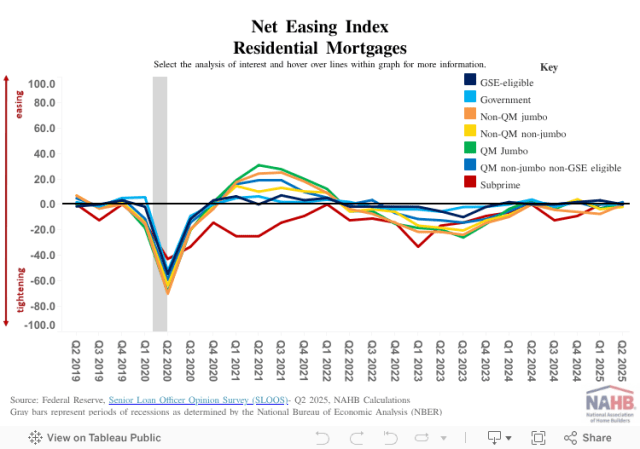
In the second quarter of 2025, overall demand for residential mortgages was weaker, while lending standards for most types of residential mortgages were essentially unchanged1, according to the recent release of the Senior Loan Officer Opinion Survey (SLOOS).  For commercial real estate (CRE) loans, lending standards for construction & development were modestly tighter, while demand was moderately weaker. However, for multifamily loans within the CRE category, lending conditions and demand were essentially unchanged for the third consecutive quarter.  Last week, the Federal Reserve left its monetary policy stance (i.e., Federal Funds rate) unchanged for the fifth consecutive meeting, with Chairman Jerome Powell indicating in his statement that the Fed “is attentive to the risks to both sides of its dual mandate [maximum employment and inflation at the rate of 2%]” and the “uncertainty about the economic outlook remains elevated”.  NAHB is still forecasting two interest rate cuts before the end of 2025. Residential Mortgages In the second quarter of 2025, five of seven residential mortgage loan categories saw a neutral net easing index (i.e., 0) for lending conditions.  Only Qualified Mortgage (QM) non-jumbo non-GSE eligible loans experienced easing, as evidenced by a positive2 value (+1.8). Meanwhile, the only loans to experience tightening were non-QM non-jumbo loans at -2.0.  Nevertheless, based on the Federal Reserve classification of any reading between -5 and +5 as “essentially unchanged,” all seven categories fell within this range. All residential mortgage loan categories reported at least modestly weaker demand in the second quarter of 2025, except for QM-jumbo which was essentially unchanged for the second consecutive quarter.  Most notably, non-QM non-jumbo (-22.0%) and subprime (-20.0%) loans experienced significantly weaker demand during the quarter.  The net percentage of banks reporting stronger demand for most of the residential mortgage loan categories has been negative for at least four years. Commercial Real Estate (CRE) Loans Across CRE loan categories, construction & development loans recorded a net easing index of -9.7 for the second quarter of 2025, indicating modestly tighter credit conditions.  For multifamily loans, the net easing index was -4.8, or essentially unchanged.  Both categories of CRE loans show tightening of lending conditions (i.e., net easing indexes below zero) since Q2 2022.  However, the tightening has become less defined recently for multifamily, with its net easing index essentially unchanged (i.e., between -5.0 and +5.0) for three consecutive quarters. The net percentage of banks reporting stronger demand was -11.3% for construction & development loans and -3.2% for multifamily loans, with negative numbers indicating weakening demand.  Like the trend for lending conditions, demand for multifamily loans has experienced unchanged conditions (i.e., between -5.0% and +5.0%) for three straight quarters. The Federal Reserve uses the following descriptors when analyzing results from the survey which will be used, in principle, within this blog post as well: – “Remained basically unchanged” means that the change or actual reading is greater than or equal to 0 and less than or equal to 5 percent. – “Modest” means that the change or actual reading is greater than 5 and less than or equal to 10 percent. – “Moderate” means that the change or actual reading is greater than 10 and less than or equal to 20 percent. – “Significant” means that the change or actual reading is greater than 20 and less than or equal to 50 percent. – “Major” means that the change or actual reading is greater than or equal to 50 percent.A value above zero (i.e., positive) indicates that lending conditions are easing while a value below zero (i.e., negative) indicates that lending conditions are tightening. Discover more from Eye On Housing Subscribe to get the latest posts sent to your email.

Weaker Demand for Residential Mortgages in Second Quarter2025-08-08T09:31:35-05:00

About My Work

Phasellus non ante ac dui sagittis volutpat. Curabitur a quam nisl. Nam est elit, congue et quam id, laoreet consequat erat. Aenean porta placerat efficitur. Vestibulum et dictum massa, ac finibus turpis.

Recent Works

Recent Posts