
About 7% of New Homes Are Teardowns

2025-12-01T10:15:52-06:00

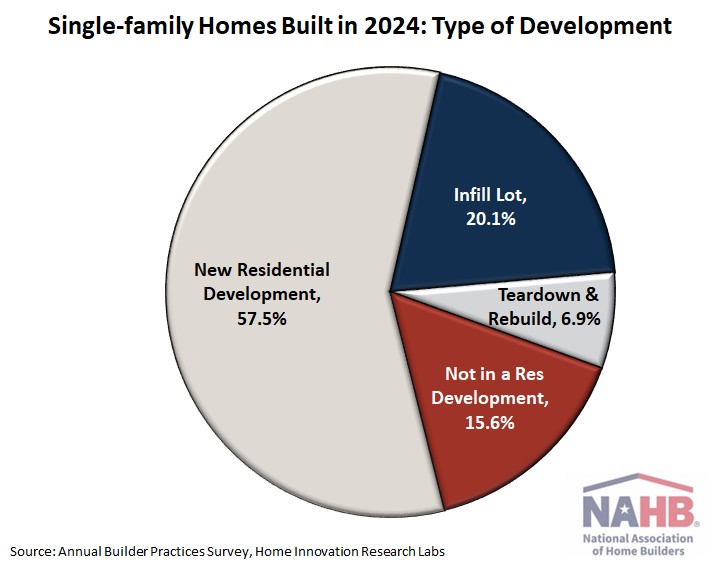
In 2024, 6.9% of new single-family detached homes were teardowns (structures torn down and rebuilt in older neighborhoods), and another 20.1% were built on infill lots in older neighborhoods, according to the latest Builder Practices Survey (BPS) conducted by Home Innovation Research Labs. The BPS places new homes in one of four development categories. In addition to teardown and infill, the categories include “new residential development” and ”not in a residential development.” Homes built in a new residential development (i.e., subdivisions) are by far the most common type.  There is a moderate amount of geographic variation in the teardown share. At the high end, over one in ten single-family homes were built on a lot where a structure had to be torn down in three of the nine Census Divisions: 15.0% in New England, 13.2% in the Pacific, and 10.1% in the East South Central. At the low end, the teardown share was only 4.8% in the South Atlantic.   Nationally, homes built in older neighborhoods, but without tearing down another structure first, were nearly three times as common as teardowns. Again, however, there is geographic variation. Infill development accounted for over 30% of single-family homes in New England (38.0%) and the Middle Atlantic states (32.4%) but accounted for under 10% in the West South Central (9.7%) and Mountain (9.3%) divisions.
About 7% of New Homes Are Teardowns2025-12-01T10:15:52-06:00

Share of New Homes with Decks Edges Lower

2025-11-25T13:16:13-06:00

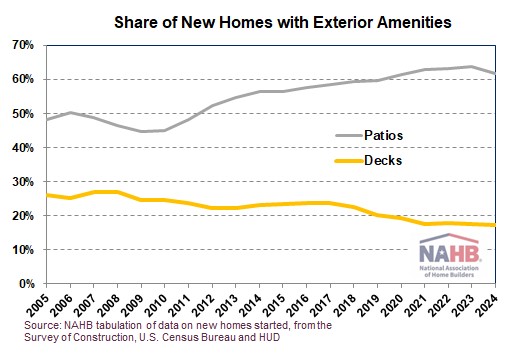
The share of new homes with decks edged down from 17.6% in 2023 to a new all-time low of 17.4% in 2024, according to NAHB tabulation of data from the HUD/Census Bureau Survey of Construction (SOC). Over the longer term, the share of new homes with decks has been declining steadily since reaching a peak of 27.0% in 2007 and 2008. Amidst that decline, the share of new homes with patios has been trending upward, from under 50% to over 60% (despite a minor reversal of the upward trend in 2024). From the re-design of the SOC in 2005 through 2024, the correlation between the percentages of new homes with patios and decks is -0.85, indicating that patios and decks are functioning as substitutes over time—i.e., as patios become more common, they are crowding out decks. Decks and patios appear to be substitutes across the U.S. On the single-family homes started in 2024, decks tended to be more common where patios were comparatively rare. For example, only 14% of the homes in the New England Census Division included patios, while a high of 69% included decks. Conversely, 82% of new homes included patios in the West South Central, while only 3% included decks. Across all nine divisions, the correlation between the percentages of new homes with decks and patios was -0.77. Even so, decks remain relatively popular on new homes in some parts of the country. In addition to New England, over 30% of new homes came with decks in the West North Central (46%), Middle Atlantic (34%) and East South Central (31%) divisions. Moreover, in the latest edition of  What Home Buyers Really Want, 79% of recent and prospective home buyers rated a deck as an essential or desirable feature. Additional detail on the characteristics of new-home decks is available from the Annual Builder Practices Survey (BPS) conducted by Home Innovation Research Labs. Nationally, the 2025 BPS report (based on homes built in 2024) shows that the average size of a deck on a new single-family home is 278 square feet. Across Census Divisions, the average ranges from a low of 163 square feet in the West South Central to a high of 422 square feet in the Mountain division. Beyond size, there continue to be strong geographic differences in builders’ choice of deck materials. On a square foot basis, treated wood is the most popular choice in the New England, South Atlantic, East South Central, and Mountain divisions. In the Middle Atlantic, East North Central, and West North Central, composite material predominates. In the Pacific Division, builders use concrete more than any other material, while in the West South Central there is a roughly even split between treated wood and concrete. Of course, decks can be—and often are—added after the home itself is built. In the fourth-quarter 2024 survey for the NAHB/Westlake Royal Remodeling Market Index, decks ranked seventh among 22 listed remodeling projects, cited as a common job by 23% of the professional remodelers who responded to the survey.

Share of New Homes with Decks Edges Lower2025-11-25T13:16:13-06:00

Where Renters and Owners Face the Highest Cost Burdens

2025-11-24T11:16:25-06:00

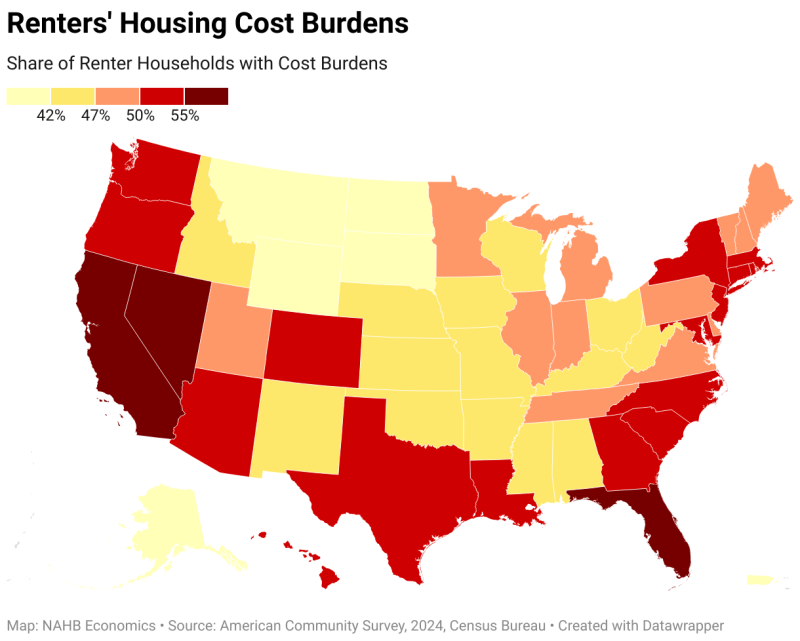
The housing affordability crisis continues to disproportionately affect renters, with more than half of renter households experiencing high-cost burdens — i.e., paying 30% or more of their income on rent and utilities. At the same time, current home owners, buoyed by significant home equity gains and locked in by below-market mortgage rates, are in a more advantageous financial position to weather the growing affordability crisis. According to the latest 2024 American Community Survey (ACS), more than half of all renter households (50.3%), or 23.2 million, are burdened by housing costs. Among home owners, this share is less than a quarter (24.3%) representing 21 million households. As a result, states and counties with higher shares of renters in their housing markets are more likely to have higher overall shares of households with cost burdens. Geographically, Florida, Nevada, and California have the largest concentration of cost-burdened renters. In Florida, 60% of all renters pay more than 30% of their income on rent and utilities. In Nevada, the share is 57%, and in California, 55% of renters experience housing cost burdens. Even in states with comparatively low renter cost-burden rates—such as South Dakota, Alaska, and North Dakota—more than one-third of renters still spend 30% or more of their income on housing. For home owners, cost-burden rates are generally lower, but the geographic pattern mirrors that of renters. California, Florida, and several Northeastern states report the highest shares of cost-burdened home owners. California faces the most severe affordability challenges, with one in three owners paying more than 30% of their income for housing. Florida and Hawaii follow closely, with 31% of existing home owners struggling to afford their homes. At the opposite end of the spectrum, nine states in the Midwest and South report that fewer than 20% of homeowners are cost-burdened. West Virginia and North Dakota have the lowest rates, at just 16%.

Where Renters and Owners Face the Highest Cost Burdens2025-11-24T11:16:25-06:00

Which Local Markets Track National Trends the Most: 2024 Multifamily MAI

2025-11-07T11:15:55-06:00

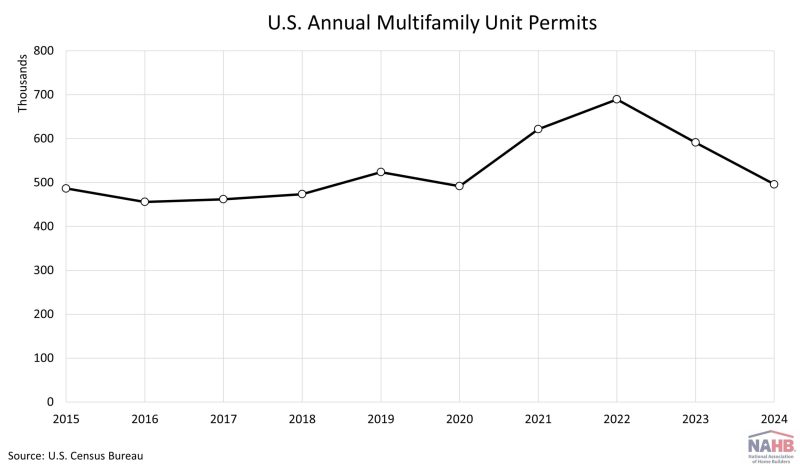
Following the release of the 2024 single-family MAI last week, the National Association of Home Builders developed the Multifamily Market Association Index (MAI) to measure how closely multifamily building permits in metro areas follow national patterns. By comparing local and national trends, the MAI helps industry leaders and forecasters better understand and predict housing market activity. Nationally, multifamily permits displayed little variation over the second half of the 2010s. Permit levels began growing significantly during the pandemic and peaked at nearly 700,000 in 2022. However, both 2023 and 2024 reported declines, with 2024 having 496,000 units permitted, closer to pre-2020 levels. The MAI uses 2015-2024 multifamily permit data to create five- and ten-year correlations for each metropolitan statistical area (MSA), showing their similarity to national patterns. The five- and ten-year correlations are then averaged, with more weight given to the five-year correlation. The resulting correlation coefficient ranges from negative one to positive one, indicating the strength and direction of the relationship between local and national trends. The MSA that had the highest associations with the national trend was Clarksville, TN-KY with a correlation of 0.97, while the MSA that recorded the lowest association with the national trend was College Station-Bryan, TX. The scatter plot below illustrates the linear relationship between these MSAs and the national trend. For example, when national permit levels rose near 700,000, Clarksville (positive correlation) also had relatively high permit levels of around 2,500. At the same time, College Station-Bryan (negative correlation) had relatively low permits of about 230. Of the 387 metro areas included in the multifamily MAI, the average correlation is 0.17. In total, 241 MSAs had a correlation greater than zero, and 145 MSAs had less than zero. One MSA had an average correlation of zero (Morgantown, WV), with no multifamily permits in the last five years. A positive correlation is expected as MSAs in total accounted for almost 95% of all multifamily permits in the U.S. on average between 2015 and 2024. A complete list of the MSA correlations is found here and shown on the map below. Additionally, below are the top ten and bottom ten in terms of the Multifamily MAI. Discover more from Eye On Housing Subscribe to get the latest posts sent to your email.

Which Local Markets Track National Trends the Most: 2024 Multifamily MAI2025-11-07T11:15:55-06:00

Laundry Room Locations in New Homes and Apartments, 2024 

2025-11-03T11:16:15-06:00

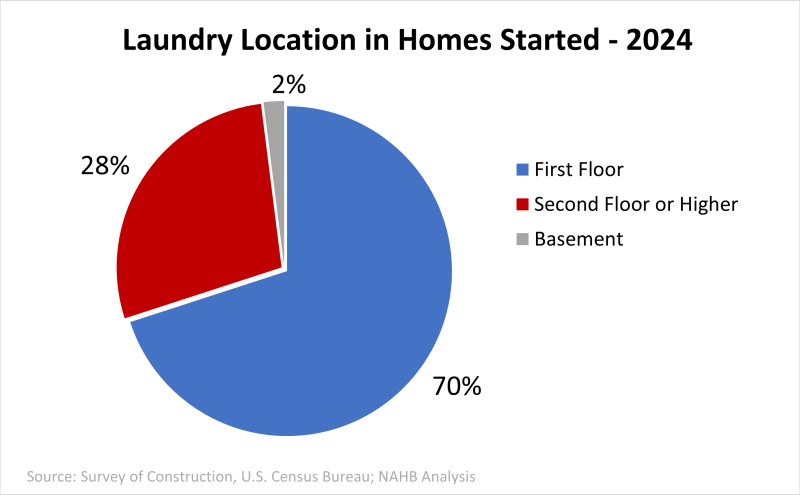
In 2024, most new single-family homes included laundry connections on the first floor (70%), according to the Census Bureau’s Survey of Construction. The first floor is also where most customers prefer to have the laundry, as shown in Chapter 2 of What Home Buyers Really Want.      The second floor was the next most common location, accounting for 28% of new single-family homes, while laundry areas in the basement accounted for just 2%. The share of new homes with laundry in any other location was negligible.  Across all Census Divisions, the first floor remains the most common location for laundry, even in regions where two-story homes are more prevalent. Nevertheless, some regional differences exist. In the West South Central division, 91% of homes had a laundry area on the first floor, compared to just 51% in the Pacific division. Meanwhile, a second-floor laundry was most popular in the Pacific division at 46%, and least common in the West South Central at 8%.  Not surprisingly, laundry connections in basements are more common in areas of the country where basements themselves are more common: primarily in the northern regions. The West North Central division led with 14% of homes featuring a basement laundry, followed by New England at 9%. These two divisions are also among the few where most new homes include a full or partial basement.   Among age-restricted homes, where accessibility and main-level living are key design priorities, 93% featured laundry on the first floor.  Multifamily Laundry Trends For multifamily units completed in 2024, 88% of apartments included an individual laundry, while 12% offered shared or no laundry facilities. This share has remained relatively stable since 2015, reflecting continued renter demand for in-unit laundry.  Regionally, the Northeast has the highest shared or no laundry facilities percentage at 33%. In contrast, shared or no laundry facilities remained far less common elsewhere: 3% in the Midwest, 4% in the South, and 9% in the West.  The pattern extends to the built-for-rent (BFR) segment, where 88% of units had an individual laundry, unchanged from the prior two years. In contrast, built-for-sale multifamily units saw a decrease—from 92% with individual laundry in 2023 to 81% in 2024—suggesting a possible shift toward more affordable condo projects, which are more likely to include shared facilities.  Discover more from Eye On Housing Subscribe to get the latest posts sent to your email.

Laundry Room Locations in New Homes and Apartments, 2024 2025-11-03T11:16:15-06:00

Which Local Markets Track National Trends the Most: 2024 Single-Family MAI

2025-10-30T09:17:46-05:00

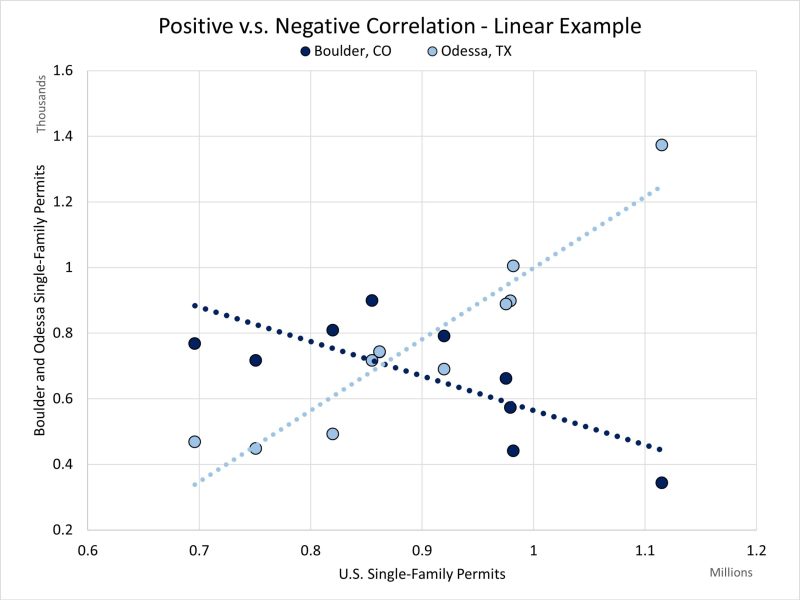
The National Association of Home Builders developed the Single-Family Market Association Index (MAI) to measure how closely single-family building permits in metro areas follow national patterns. By comparing local and national trends, the MAI helps industry leaders and forecasters better understand and predict housing market activity. The MAI uses 2015-2024 single permit data to create five- and ten-year correlations for each metropolitan statistical area (MSA), showing their similarity to national patterns. The five- and ten-year correlations are then averaged, with more weight given to the five-year correlation. The resulting correlation coefficient ranges from negative one to positive one, indicating the strength and direction of the relationship between local and national trends. The MSA that had one of the highest associations with the national trends was Odessa, Texas with a correlation of 0.97. Meanwhile, Boulder, Colorado, a similarly sized MSA, had the most negative correlation of -0.81. The scatter plot below illustrates the linear relationship between these MSAs and the national trend. For example, when national permit levels rose toward 1.1 million, Odessa (positive correlation) also has relatively high permit levels of around 1,400. At the same time, Boulder (negative correlation) has relatively low permits, below 400. Of the 387 metro areas included in the single-family MAI, the average correlation is 0.43. In total, 342 MSAs had a correlation greater than zero, and 45 MSAs had less than zero. A positive correlation is expected as MSAs in total accounted for almost 90% of all single-family permits in the U.S. on average between 2015 and 2024. A complete list of the MSA correlations is found here and shown on the map below. The MSA that most closely followed the national permit trend was San Antonio-New Braunfels, TX. Strong association was present throughout the South region. The West and Northeast regions are where many MSAs show weak association with the national permit trend. Below are tables of the top ten highest and lowest associated MSAs. A release of the Multifamily MAI will be followed in another post shortly. Discover more from Eye On Housing Subscribe to get the latest posts sent to your email.

Which Local Markets Track National Trends the Most: 2024 Single-Family MAI2025-10-30T09:17:46-05:00

Two-Story Foyer Trend Stabilize in 2024

2025-10-27T11:17:19-05:00

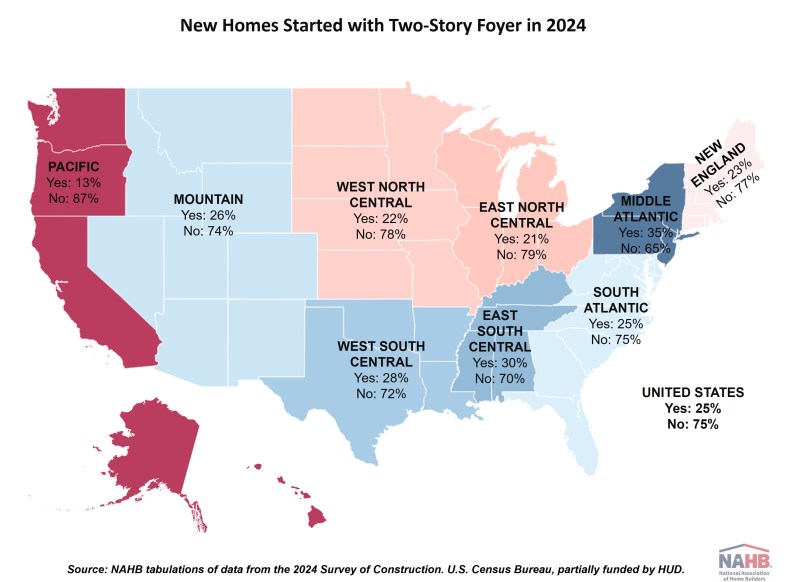
In 2024, nearly a quarter of new homes were built with a two-story foyer, virtually unchanged from 2023, according to data obtained from the Census Bureau’s Survey of Construction (SOC) and tabulated by NAHB. The market share of two-story foyers has been generally trending downward over the past eight years, with most new single-family homes being built without a two-story foyer nationally and regionally.   According to the Census, a two-story foyer is defined as the entranceway inside the front door of a house and has a ceiling that is at the level of the second-floor ceiling. In the United States, the share of new homes with two-story foyers slightly fell from 24.9% to 24.6% in 2024, the lowest level since NAHB began tracking this data in 2017. This feature is often considered energy-inefficient and is seen as undesirable by both builders and buyers. The declining trend is in line with NAHB’s What Home Buyer’s Really Want, in which recent and prospective buyers rated their preference for 18 specialty rooms. The study found that two-story entry foyers was one of the least desired specialty rooms, with 32% buyers likely to reject a potential home with this feature, and only 13% seeing it as an essential/must-have feature. Though the national decline continued, regional patterns were mixed compared to the broader declines seen in 2023. Three of the nine divisions saw a decline in 2024, including the West North Central, West South Central, and Pacific. The West North Central division reversed the notable increase seen in 2023, decreasing from 26.9% to 21.5%. Meanwhile, shares in both the West South Central and Pacific fell to their lowest levels since NAHB began tracking this data in 2017. Meanwhile, shares of two-story foyers rose in the other six divisions. New England rebounded from 17.5% to 23.2%, after declining in 2023. The Middle Atlantic continued its upward trend reaching 35.3%, the highest share since 2017. The East South Central and Mountain divisions also posted solid gains, increasing by 3.6 and 3.5 percentage points respectively. The South Atlantic and East North Central divisions saw modest increases, remaining relatively stable in 2024. Discover more from Eye On Housing Subscribe to get the latest posts sent to your email.

Two-Story Foyer Trend Stabilize in 20242025-10-27T11:17:19-05:00

Inflation Picks Up in September

2025-10-24T11:18:25-05:00

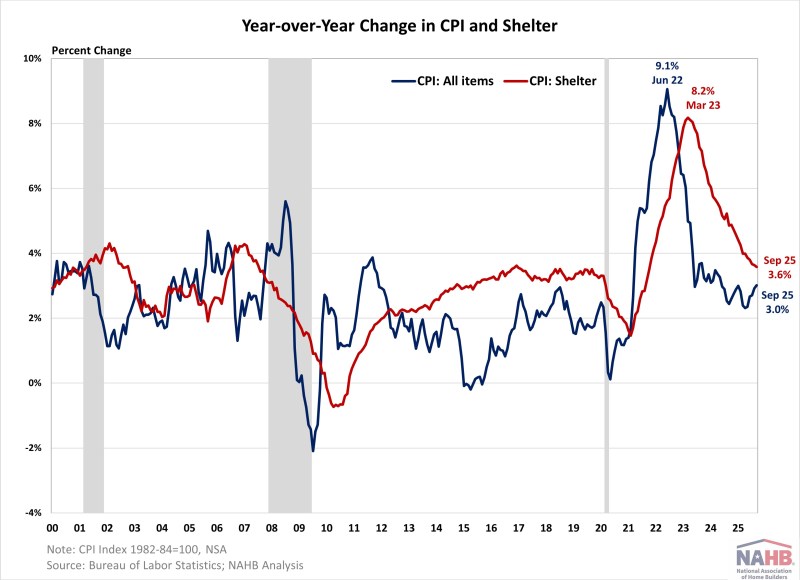
Inflation increased in September to the fastest pace since the start of the year, showing tariff pressure on prices continues to materialize gradually, according to the Bureau of Labor Statistics (BLS) latest report. This month’s data collection was completed prior to the government shutdown but was published this week in order to provide next year’s Social Security cost-of-living adjustments. Meanwhile, shelter inflation remained unchanged from last month and continued its downward trend, though it remains higher than pre-pandemic levels. Though inflation is likely to remain elevated this year, the Fed is expected to continue easing given signs of labor market weakening. The housing market’s sensitivity to interest rates suggests rate cuts could help ease the affordability crisis and support housing supply even as builders continue to face supply-side challenges. During the past twelve months, on a non-seasonally adjusted basis, the Consumer Price Index (CPI) rose by 3.0% in September, the highest reading since January 2025. Excluding the volatile food and energy components, the “core” CPI increased by 3.0% over the past twelve months. A large portion of the “core” CPI is the housing shelter index, which increased 3.6% over the year, the lowest reading since October 2021. Meanwhile, the component index of food rose by 3.1%, and the energy component index increased by 2.8%. On a monthly basis, the CPI rose by 0.3% in September (seasonally adjusted), after a 0.4% increase in August. The “core” CPI increased by 0.2% in September, after a 0.3% increase in August. The price index for a broad set of energy sources rose by 1.5% in September, as declines in natural gas (-1.2%) and electricity (-0.5%) were offset by increases in gasoline (+4.1%) and fuel oil (+0.6%). Meanwhile, the food index rose by 0.2%, after a 0.5% increase in August. The index for food away from home increased by 0.1%, and the index for food at home rose by 0.3%. The index for gasoline (+4.1%) replaced shelter as the largest contributor to the overall monthly increase in all-items index. Other top contributors that rose in September included indexes for shelter (+0.2%), airline fares (+2.7%), recreation (+0.4%), household furnishings and operations (+0.4%) as well as apparel (+0.7%). Meanwhile, the index for motor vehicle insurance (-0.4%), used cars and trucks (-0.4%) and communication (-0.2%) were among the few major indexes that decreased over the month. The index for shelter, which makes up more than 40% of the “core” CPI, rose by 0.2% in September, following a 0.4% increase last month. The index for owners’ equivalent rent (OER) rose by 0.1% and index for rent of primary residence (RPR) increased by 0.2% over the month. NAHB constructs a “real” rent index to indicate whether inflation in rents is faster or slower than core inflation. It provides insight into the supply and demand conditions for rental housing. When inflation in rents is rising faster than core inflation, the real rent index rises and vice versa. The real rent index is calculated by dividing the price index for rent by the core CPI (to exclude the volatile food and energy components). In September, the Real Rent Index remained unchanged. Over the first nine months of 2025, the average monthly growth rate remained flat at 0.0%, slower than the average of 0.1% in 2024. Discover more from Eye On Housing Subscribe to get the latest posts sent to your email.

Inflation Picks Up in September2025-10-24T11:18:25-05:00

Existing Home Sales Increase in September

2025-10-23T11:22:33-05:00

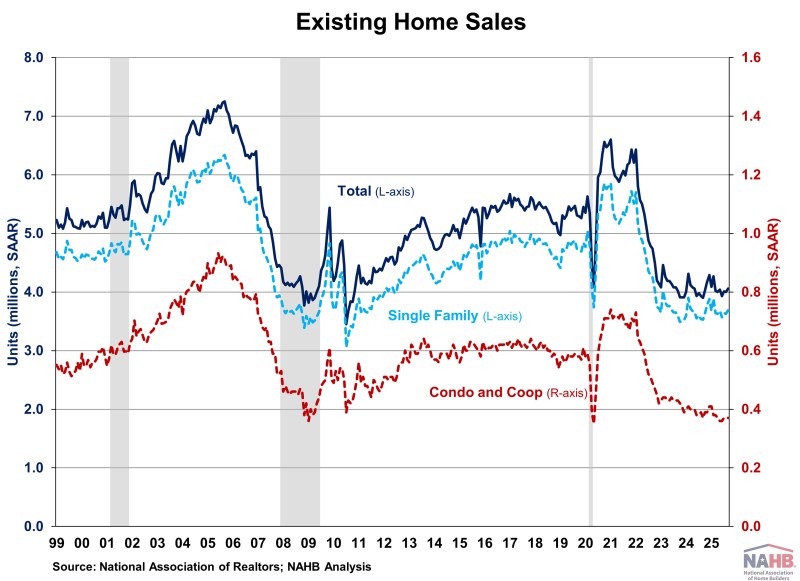
Existing home sales rose to a seven-month high in September as mortgage rates eased and inventory improved, according to the National Association of Realtors (NAR). Resale inventory matched to the highest level since May 2020, though it remained below pre-pandemic levels.  Mortgage rates hovered between 6.5% and 7% earlier this year due to ongoing economic and tariff uncertainty. However, rates recently fell below 6.5% for the first time this year as the Fed resumed rate cuts at its September meeting. Last week, the average mortgage rate decreased to a nearly one-year low of 6.27%. With additional rate cuts expected in coming months, lower mortgage rates and improved inventory should bring more buyers and sellers into the market. Total existing home sales, including single-family homes, townhomes, condominiums, and co-ops, rose 1.5% to a seasonally adjusted annual rate of 4.06 million in September. On a year-over-year basis, sales were 4.1% higher than a year ago. The existing home inventory level was 1.55 million units in September, up 1.3% from August and up 14.0% from a year ago. At the current sales rate, September unsold inventory sits at a 4.6-months’ supply, unchanged from July and August but up from 4.2-months in September 2024. Inventory between 4.5 to 6 month’s supply is generally considered a balanced market. Homes stayed on the market for a median of 33 days in September, up from 31 days last month and 28 days in September 2024. The first-time buyer share was 30% in September, up from 28% in August and 26% from a year ago. The September all-cash sales share was 30% of transactions, up from 28% in August but unchanged from a year ago. All-cash buyers are less affected by changes in interest rates. The September median sales price of all existing homes was $415,200, up 2.1% from last year. This marks the 27th consecutive month of year-over-year increases. The median condominium/co-op price in September was down 0.6% from a year ago at $360,300.  Recent gains for home inventory will put downward pressure on resale home prices in most markets in 2025. Geographically, three of the four regions saw an increase in existing home sales in September, with an increase of 5.5% in the West, 2.1% in the Northeast, and 1.6% in the South. Meanwhile, sales in the Midwest fell 2.1%. On a year-over-year basis, sales were up in the South (6.9%), Northeast (4.3%) and the Midwest (2.2%), while sales were unchanged in the West. The Pending Home Sales Index (PHSI) is a forward-looking indicator based on signed contracts. The PHSI rose from 71.8 to 74.7 in August, suggesting lower mortgage rates are bringing more buyers back into the market. On a year-over-year basis, pending sales were 3.8% higher than a year ago, according to the National Association of Realtors’ data. Discover more from Eye On Housing Subscribe to get the latest posts sent to your email.

Existing Home Sales Increase in September2025-10-23T11:22:33-05:00

About My Work

Phasellus non ante ac dui sagittis volutpat. Curabitur a quam nisl. Nam est elit, congue et quam id, laoreet consequat erat. Aenean porta placerat efficitur. Vestibulum et dictum massa, ac finibus turpis.

Recent Works

Recent Posts