

Existing Home Sales Rise in October

2025-11-20T12:17:28-06:00

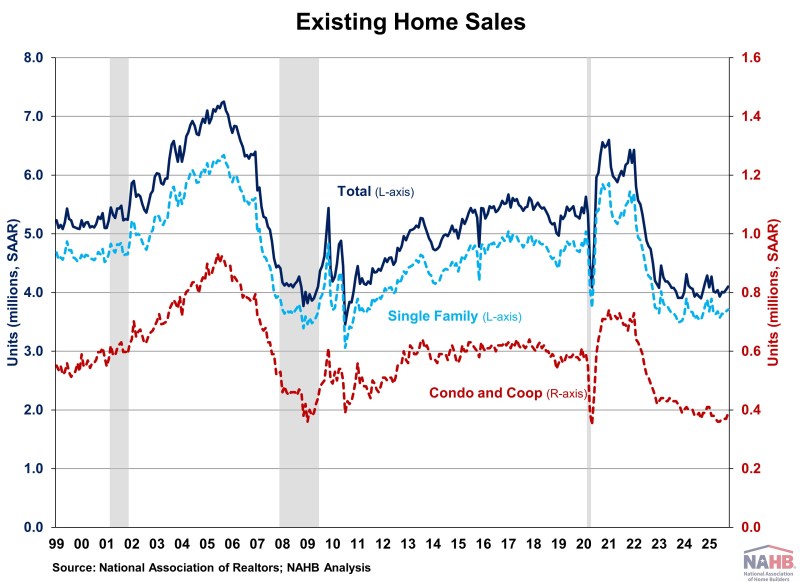
Existing home sales rose to an eight-month high in October as buyers took advantage of lower mortgage rates, according to the National Association of Realtors (NAR). Resale inventory improved from a year ago but remained below pre-pandemic levels. Relatively tight supply continued to push home prices higher and challenge housing affordability. These affordability pressures vary by region, with first-time buyers in the Northeast facing limited inventory, while buyers in the West struggle with elevated home prices. Mortgage rates hovered between 6.5% and 7% earlier this year due to economic and tariff uncertainty. However, with the Fed resuming rate cuts in September, mortgage rates have fallen gradually. As of October 30th, the average mortgage rate decreased to 6.17%, the lowest in over a year. With additional rate cuts expected in coming months, lower mortgage rates and improved inventory should bring more buyers and sellers into the market. Total existing home sales, including single-family homes, townhomes, condominiums, and co-ops, rose 1.2% to a seasonally adjusted annual rate of 4.10 million in October, the highest level since February. On a year-over-year basis, sales were 1.7% higher than a year ago. The existing home inventory level was 1.52 million units in October, down 0.7% from September but up 10.9% from a year ago. At the current sales rate, October unsold inventory sits at a 4.4-months’ supply, down from 4.5-months in September but up from 4.1-months in October 2024. Inventory between 4.5 to 6 months’ supply is generally considered a balanced market. Homes stayed on the market for a median of 34 days in October, up from 33 days last month and 29 days in October 2024. The first-time buyer share was 32% in October, up from 30% in September and 27% from a year ago. The October all-cash sales share was 29% of transactions, down from 30% in September but up from 27% a year ago. All-cash buyers are less affected by changes in interest rates. The October median sales price of all existing homes was $415,200, up 2.1% from last year. This marks the 28th consecutive month of year-over-year increases. The median condominium/co-op price in October was up 0.9% from a year ago at $363,700.  Recent gains for home inventory will put downward pressure on resale home prices in most markets in 2025. Existing home sales in October were mixed across the four major regions. Sales rose in the Midwest (5.3%) and South (0.5%), fell in the West (-1.3%), and remained unchanged in the Northeast. On a year-over-year basis, sales were up in the Northeast (4.3%), South (2.8%) and Midwest (2.1%), while down in the West (-2.6%). The Pending Home Sales Index (PHSI) is a forward-looking indicator based on signed contracts. The PHSI remained unchanged at 74.8 in September, suggesting job market concerns kept buyers on the sideline despite mortgage rates near one-year lows. On a year-over-year basis, pending sales were 0.9% lower than a year ago, according to the National Association of Realtors’ data.

Existing Home Sales Rise in October2025-11-20T12:17:28-06:00

Non-Conventional Financing for New Home Sales Loses Ground in 2024

2025-10-20T09:15:39-05:00

Nationwide, the share of non-conventional financing for new home sales accounted for 31% of the market per NAHB analysis of the 2024 Census Bureau Survey of Construction (SOC) data. This is 1.7 percentage point lower than the 2023 share of 32.4%. As in previous years, conventional financing dominated the market at 69.3% of sales, higher than the 2023 share of 67.6%. Non-conventional forms of financing (as opposed to conventional mortgage loans) include loans insured by the Federal Housing Administration (FHA), VA-backed loans, cash purchases and other types of financing such as the Rural Housing Service, Habitat for Humanity, loans from individuals, or state or local government mortgage-backed bonds. The reliance on non-conventional forms of financing varied across the United States, with its share at almost 40% in the East North Central division but only 24% of new single-family home starts in the South Atlantic division. Nationwide, cash purchases were the majority share of non-conventional financing of new home purchases, accounting for 13% of the market share, slightly down from 14% in 2012. However, a NAHB survey based on builders reported that for 2024, all-cash sales were a higher share at 22%. Meanwhile, the Census reported FHA-backed loans accounted for 11% in 2024, whereas in 2023, they had a 12%market share. The share of VA-backed loans was at 4% market share in 2024, while Other Financing was 3% of market share. Regionally, cash financing held the highest share in the East North Central division, where 27% of all homes started were purchased with cash. Cash purchases led non-conventional financing in five out of nine census regions with27% in East North Central, 23% in New England, 21% in East South Central, 16% in Middle Atlantic, and 15% in West North Central. FHA-backed loans accounted for the majority of all non-conventional financing in the West South Central division, accounting for 20% homes started. In New England, very few homes used FHA-backed loans at just _%, along with the East South Central division at just 1% of homes started. VA-backed loans were most used in the West North Central division, accounting for 10% of non-conventional forms of financing. Notably, in New England, only 1% of the homes started used VA-backed loans in 2024. Other financing such as the Rural Housing Service, Habitat for Humanity, loans from individuals, state or local government mortgage-backed bonds were highest in the East South Central division where it was collectively 14% of market share, while the Mountain division reported the lowest share at 1%. Discover more from Eye On Housing Subscribe to get the latest posts sent to your email.

Non-Conventional Financing for New Home Sales Loses Ground in 20242025-10-20T09:15:39-05:00

About My Work

Phasellus non ante ac dui sagittis volutpat. Curabitur a quam nisl. Nam est elit, congue et quam id, laoreet consequat erat. Aenean porta placerat efficitur. Vestibulum et dictum massa, ac finibus turpis.

Recent Works

Recent Posts