

Location, Location, Location: How Place and Neighborhood Shape Home Values

2025-11-18T10:14:57-06:00

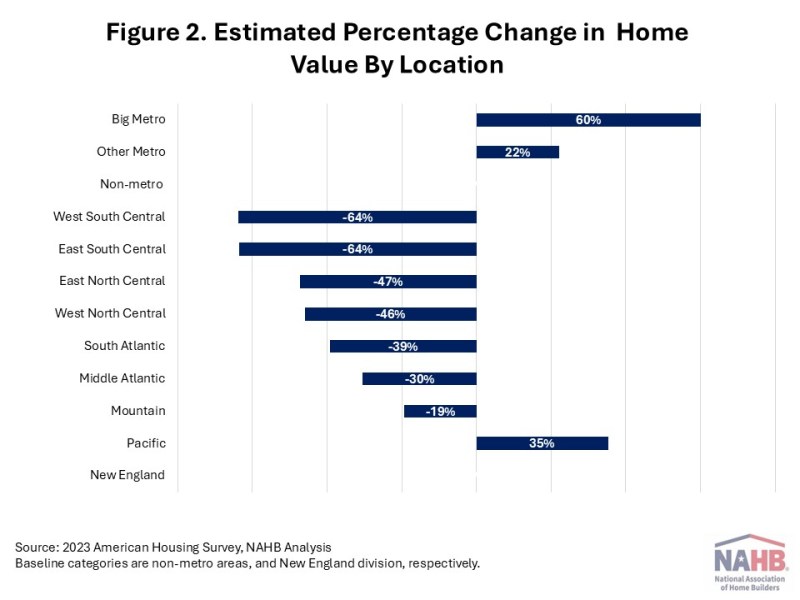
The value of a single-family home depends not only on its physical features but also on its location and neighborhood context. In this second part of our two-part series, we examine how geography and neighborhood quality further influence single-family detached home values across the United States. Not surprisingly, location remains one of the strongest drivers of home values (Figure 2). Homes in a big metropolitan area are valued 60% higher than comparable homes in non-metro areas, while those in smaller or midsized metro areas are 22% more. Home values also vary significantly across Census Divisions. Using New England as the baseline, homes in the Pacific Divisions, including Alaska, California, Hawaii, Oregon, and Washington, are valued around 35% higher values on average. By contrast, homes in the rest of the divisions show substantially lower values relative to New England. Homes in the East South Central and West South Central divisions are more than 60% lower in value, while those in the Middle Atlantic are about 30% lower. In the East North Central and West North Central Divisions, home values are roughly 47% and 46% lower, respectively. Homes in the South Atlantic are 39% lower, and those in the Mountain Division are about 19% lower. People are willing to pay a premium for a better neighborhood. This analysis shows that a higher overall neighborhood quality rating, measured on a 1 to 10 scale, contributes about a 2% increase in home value for every 1-point rise (Figure 3). For example, moving from a neighborhood rated 5 to one rated 7 could increase your home value by 4%. On the other end, the impact of specific negative conditions is substantial (Figure 4). Homes located near abandoned or vandalized buildings have 17% lower values. Additionally, the presence of visible trash nearby reduces home values by 8%. Improving the broader neighborhood environment could have as much impact on the final home value as upgrades inside the home. Please click here to be redirected to the full special study.
Location, Location, Location: How Place and Neighborhood Shape Home Values2025-11-18T10:14:57-06:00

What Home Features Add the Most Value?

2025-11-17T08:16:03-06:00

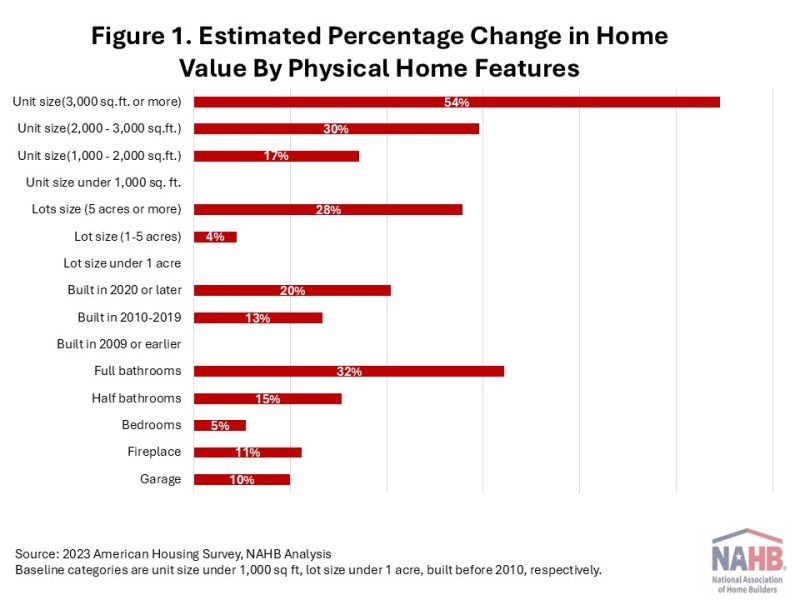
The value of a single-family home is shaped by many factors, but its physical features remain among one of the most influential. Using the latest 2023 American Housing Survey (AHS), this study focuses on which home features genuinely boost single-family detached home values and by how much. Key findings show that the overall square footage of the home and the number of bathrooms stand out as especially strong value drivers, while other features such as the number of bedrooms and the presence of amenities also play a role. In this first part of our two-part blog series, we focus on the physical features of single-family homes. The second part will explore how location and neighborhood quality further influence home values across the United States. Home size is one of the strongest value drivers in today’s housing market, as shown in Figure 1. Compared with smaller homes under 1,000 sq. ft., homes between 1,000 and 2,000 sq. ft. are valued about 17% higher. Moving up to homes between 2,000-3,000 sq. ft. increases value by around 30%, while homes with 3,000 sq. ft. or more adds 55% more to the market value.  These effects are measured after accounting for differences in region, age of structure, and other key features. While both the number of bathrooms and bedrooms contribute to single-family home values, the number of bathrooms has a larger impact. Each additional full bathroom increases home value by approximately 32%, compared to about 5% for an additional bedroom, holding the square footage and other features constant. Even a half bathroom brings meaningful returns, adding an estimated 15%. The age of the home is also a contributing factor to the final market value, even after accounting for other features and neighborhood conditions. Compared to homes built before 2010, homes built between 2010 and 2019 have 13% higher values, and homes built after 2020 are valued 19% higher. These premiums likely reflect improvements in energy efficiency, insulation, and modern building systems that are appealing to more buyers. Other amenities also bring solid returns, like garages, fireplaces, and centralized air conditioning. Garages add around 10% to home value; Besides a protected parking space, garages offer the flexibility for additional storage or turning it into a workshop/hobby space.  Having a fireplace can add value to a home, increasing its value by around 10%. It is appealing to some home buyers, as it not only provides a cozy ambiance, but also could reduce heating costs in some regions. Centralized AC adds about 7% to home value nationwide, but its impact varies across the divisions. In the South, including the South Atlantic, East South Central, and West South divisions, centralized AC adds 23%, 40%, and 48% more values, respectively. Please click here to be redirected to the full special study.

What Home Features Add the Most Value?2025-11-17T08:16:03-06:00

About My Work

Phasellus non ante ac dui sagittis volutpat. Curabitur a quam nisl. Nam est elit, congue et quam id, laoreet consequat erat. Aenean porta placerat efficitur. Vestibulum et dictum massa, ac finibus turpis.

Recent Works

Recent Posts