

The Fed Cuts amid Partly Cloudy Conditions

2025-10-29T14:19:05-05:00

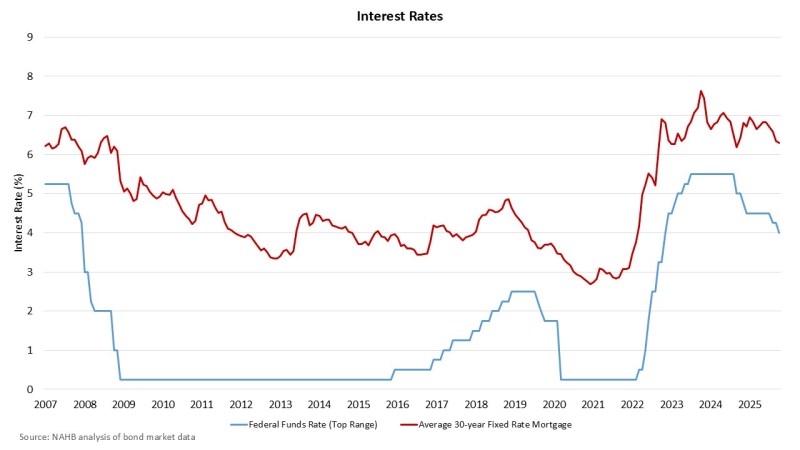
With the government shutdown limiting the quantity of economic data available to markets and policymakers, the central bank’s Federal Open Market Committee (FOMC) enacted a widely anticipated 25 basis point cut for the short-term federal funds rate. This marks the second consecutive cut this Fall, and the move decreases the policy rate to an upper rate of 4.25%. Reflecting that the market anticipated this policy move, long-term rates were relatively unchanged after the FOMC announcement. There were two dissenters to today’s decision, with new Fed Governor Miran voting no (preferring a larger 50 basis point reduction). Kansas City Fed President Schmid also voted no, but wanted no federal funds rate reduction. Chair Powell noted that there were “strongly differing” views at this meeting with respect to December policy action, with a possibility of no further cuts before the end of the year. Commenting on current economic conditions, the FOMC statement noted that “economic activity has been expanding at a moderate pace.” In his press conference, Chair Powell noted that activity in the housing market remains “weak.” As a justification for monetary policy easing, the FOMC stated that “job gains have slowed this year.” On the other side of the policy mandate, the Fed specified that “inflation has moved up since earlier in the year and remains somewhat elevated.” In a nod to some short-term liquidity concerns, the Fed also stated that it will conclude its quantitative tightening (QT) or balance sheet reduction program on December 1st. The Fed’s balance sheet has declined by more than $2.2 trillion during the course of this round of QT. However, the Fed will continue to allow mortgage-backed securities (MBS) to mature but reinvest those funds into Treasuries, which will allow the Fed to reduce net holdings of MBS while holding the size of the total balance sheet relatively constant. The Fed may also, in the future, reduce long-duration holdings in favor or more short-term debt. This presents a mixed view of possible impacts on mortgage interest rates from balance sheet actions. Current macro indicators, limited by data availability, present a cloudy or mixed picture. Layoffs are increasing. The two-year Treasury rate remains below the federal funds rate, suggesting ongoing tight policy. However, inflation remains above the Fed’s 2% target, stock and asset values continue to rise, and there are positive economic expectations from tax changes like expensing for business investment. Tariffs were not mentioned in the today’s statement, although Fed Governor Waller’s view that tariff impacts on domestic prices are likely to be one-off impacts has received more attention among market analysts and monetary policymakers. With respect to housing supply, in contrast to movement for long-term rates, the reduction of the federal funds rate will have a direct, beneficial effect on interest rates for acquisition, development and construction (AD&C) loans, the key financing channel for private builders who build more than 60% of single-family homes. This will reduce lending costs for builders across the nation and enable more attainable supply. Going forward, if labor market conditions continue to weaken, the Fed will continue to ease – at some point. However, future cuts are likely to be more hotly debated given the current rate of inflation. Chair Powell noted that there is “no risk free path for policy” in this kind of environment. Amid bifurcated market signals and economic conditions (particularly with respect to differentiated high income and low income consumer spending patterns), the vote at the December meeting will be contested. And the ongoing lack of data may cause the Fed to move more slowly as a precaution. Discover more from Eye On Housing Subscribe to get the latest posts sent to your email.
The Fed Cuts amid Partly Cloudy Conditions2025-10-29T14:19:05-05:00

The Fed Cuts and Projects More Easing to Come

2025-09-17T15:15:58-05:00

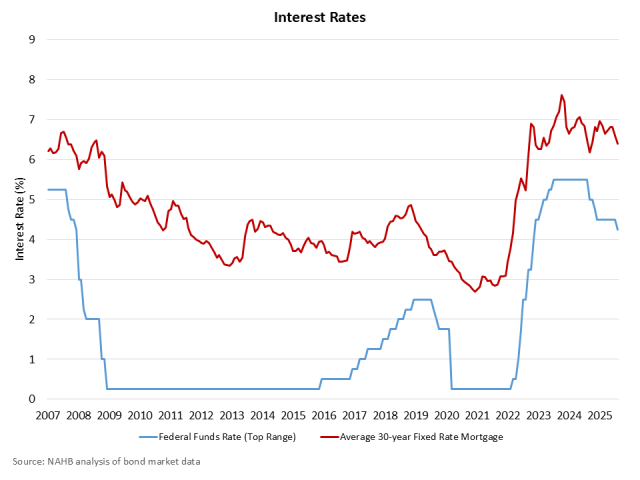
After a monetary policy pause that began at the start of 2025, the Federal Reserve’s monetary policy committee (FOMC) voted to reduce the short-term federal funds rate by 25 basis points at the conclusion of its September meeting. This move decreased the target federal funds rate to an upper rate of 4.25%. Economically, the cut is justified given signs of a softening labor market and moderate inflation readings. However, Chair Powell characterized today’s easing as a “risk management cut,” rather than one driven by fundamental changes in the economic outlook. NAHB is forecasting another 75 basis points of easing in the coming quarters, with 25 of that total coming before the end of the calendar year. The Fed announced no changes to its ongoing balance sheet reduction policy. While the Fed is easing on the short-end of the yield curve, the ongoing quantitative tightening (QT) program is still exerting upward pressure on mortgage interest rates and is partially responsible for the elevated spread of mortgage rates over the 10-year Treasury rate. The Fed’s balance sheet has contracted from almost $9 trillion in May 2022 to $6.6 trillion in September. A hypothetical slowing of QT for mortgage-backed securities would reduce mortgage interest rates, perhaps by 25 basis points. The Fed summarized current economic conditions as follows: “Recent indicators suggest that growth of economic activity moderated in the first half of the year. Job gains have slowed, and the unemployment rate has edged up but remains low. Inflation has moved up and remains somewhat elevated.” The FOMC statement also indicated that uncertainty about the outlook remains “elevated.” Given the size of recent employment revisions, it might be worth noting that both the outlook and some of the current data reporting is uncertain. Chair Powell noted in his press conference that activity in the housing market remains “weak,” consistent with recent data for the home building sector. He also noted that “housing was at the center monetary policy.” Powell once again noted that a housing shortage exists that lies beyond monetary policy, alluding to the challenges builders face from issues like regulatory cost burdens. The September FOMC policy decision was expected by markets, given recent communication from the Fed, including Chair Powell’s remarks at the Jackson Hole monetary policy conference. For this reason, much of the effect of today’s decision was already priced into long-term interest rates, including a decline for the average of the 30-year fixed rate mortgage. This rate has declined by 20 basis points to 6.35% over the last month, per Freddie Mac. In fact, the 10-year Treasury rate barely moved in response to today’s announcement. A growing risk for long-term rates, including mortgage rates, comes from federal government debt and deficits. In contrast to movement for long-term rates, the reduction of the federal funds rate will have a direct, beneficial effect on interest rates for acquisition, development and construction loans, the key financing channel for private builders who build more than 60% of single-family homes. This will reduce lending costs for builders across the nation and enable more attainable supply. There was considerably more internal drama entering today’s FOMC decision. Besides marking a resumption of Fed easing, today’s meeting featured newly installed Fed Governor Stephen Miran and the participation of embattled Governor Lisa Cook. It is worth noting that Miran was the only dissenter at today’s meeting. Instead of voting for a 25-basis point cut, Miran preferred a 50-basis point reduction. That said, today’s decision featured less division among the FOMC voting members than some analysts expected, which is a positive with respect to the Fed’s independence. A revised Summary of Economic Projections (SEP) was also published today. The SEP provides a view of Fed Governors’ and Federal Reserve Bank Presidents’ outlook for economic conditions, inflation expectations and future monetary policy actions (only 12 of the 19 SEP respondents are voting members at each meeting). While there was little dissension in today’s FOMC policy decision, the SEP reveals considerable disagreement for the outlook. Seven SEP respondents projected no additional cuts for the remainder of the year. Twelve projected more cuts. The median projection suggests two more rate cuts for 2025. One respondent, most likely Governor Miran, provided an outlook of five more 25 basis point cuts before the end of 2025. On a median basis, the Fed sees weaker economic growth ahead. The SEP reports a 1.6% GDP growth rate (measuring the 4th quarter to 4th quarter change) for 2025, 1.8% in 2026 and 1.9% in 2027. The SEP projection reports only small increase in the unemployment rate, with a peak rate ahead of 4.5% ahead. For the median SEP respondent, the economy is not seen as reaching the target 2% core CPE inflation rate until 2028. It is worth noting that prior editions of the SEP also saw this target as effectively two years away. Nonetheless, while taking longer than previously expected, the otherwise declining trend for expected inflation in the years ahead suggests the Fed sees any possible tariff effects on inflation will be one-off or otherwise limited, as Governor Waller in particular has explained. Overall, today’s decision was widely expected. Much of the benefit of today’s easing was already priced into long-term interest rates, but the rate cut will benefit business loan finance conditions. Further, additional rate cuts lie ahead, although as Chair Powell noted, “policy is not on a pre-set course.” Future Fed actions will depend on incoming data and the evolving policy environment. Discover more from Eye On Housing Subscribe to get the latest posts sent to your email.
The Fed Cuts and Projects More Easing to Come2025-09-17T15:15:58-05:00

Mortgage Rates Move Lower, Hitting 10-Month Low

2025-08-28T14:15:42-05:00

Average mortgage rates in August continued their steady decline and are now at their lowest rate since last November. According to Freddie Mac, the 30-year fixed-rate mortgage averaged 6.59%, 13 basis points (bps) lower than July. Meanwhile, the 15-year rate declined 15 bps to 5.71%. Compared to a year ago, the 30-year rate is higher by 9 basis points (bps), and the 15-year rate is marginally higher by 3 bps. The 10-year Treasury yield, a key benchmark for long-term borrowing, averaged 4.29% in August – an 8 bps decrease from the previous month. Yields moved unevenly during the month: initially declining, then rising following July’s inflation report that noted an acceleration in core inflation. Long-term yields subsequently retreated following Federal Reserve Chair Jerome Powell’s Jackson Hole speech last Friday, where he signaled possible rate cuts. Powell noted that the downside risk to employment is on the rise while inflation expectations are well-anchored around the Fed’s longer-run target of 2%. Recently, President Trump sought to fire Federal Reserve Governor Lisa Cook, alleging she submitted fraudulent information on mortgage applications. Cook has since filed a lawsuit to block her dismissal, arguing that the president lacks authority to remove a Fed governor without cause. The case underscores ongoing concerns about the central bank’s independence from political influence. Separately, former Federal Reserve Governor Adriana Kugler resigned earlier this month to return to academia, creating a vacancy on the Board of Governors for the President to fill. Both Cook and Kugler were nominated by President Joe Biden. Discover more from Eye On Housing Subscribe to get the latest posts sent to your email.

Mortgage Rates Move Lower, Hitting 10-Month Low2025-08-28T14:15:42-05:00

Powell Appears to Signal Rate Cuts Due to Evolving Circumstances

2025-08-22T12:19:40-05:00

While acknowledging that ongoing uncertainty complicates policymaking, Federal Reserve Chair Powell gave a mostly green light for monetary policy easing in September, following a policy pause that has lasted since the end of last year. Noting that inflation remains elevated, Powell stated that “the balance of risks appears to be shifting.” In particular, the central bank chair noted that downside risks for the labor market are rising. The implication of this observation is that easing is in view for monetary policy given the Fed’s dual mandate of maintaining both price stability and full employment. Markets expect a cut in September. Powell detailed an important point for the housing demand, that the labor market has avoided large job losses due to policy tightening and the economy has shown “resilience.” The Fed chair also indicated that inflation pressure is now in the data from tariffs, including a rise in goods prices. However, Powell articulated the view that while tariffs can affect the price level, that effect may not be a persistent impact on inflation and therefore can be consistent with near-term easing of monetary policy. He stated, “…the effects will be short-lived – a one-time shift in the price level.” However, he also warned that “one-time” does not mean all at once and that the effects of tariffs will materialize over an adjustment period. Moreover, while not addressed in today’s comments, some of the pressure from tariffs is being relaxed as trade deals are arranged and de-escalations of some trade tensions are undertaken. This morning’s action by Canada to drop most retaliatory trade actions against the U.S. is a good example, as is the ongoing discussions with China to achieve a fairer, more sustainable trading relationship. Powell repeated that housing-related inflation remains on a downward trend. I would add for emphasis that softening of housing market data (including home price weakness that will indirectly affect inflation data) is a dovish sign for future monetary policy given that housing has been the major source of inflation for the last two years. Summarizing the current data and the monetary policy outlook, Powell concluded his analysis with commentary suggesting a shift in the Fed’s policy stance to easing (perhaps as a preventative cut), while still tied to data: “In the near term, risks to inflation are tilted to the upside, and risks to employment to the downside—a challenging situation. When our goals are in tension like this, our framework calls for us to balance both sides of our dual mandate. Our policy rate is now 100 basis points closer to neutral than it was a year ago, and the stability of the unemployment rate and other labor market measures allows us to proceed carefully as we consider changes to our policy stance. Nonetheless, with policy in restrictive territory, the baseline outlook and the shifting balance of risks may warrant adjusting our policy stance. Monetary policy is not on a preset course. FOMC members will make these decisions, based solely on their assessment of the data and its implications for the economic outlook and the balance of risks. We will never deviate from that approach.“ Chair Powell’s comments also emphasize the importance of central bank independence. Politicizing monetary policy would introduce a future inflation premium into the bond market, resulting in reduced investor demand and some additional upward pressure on long-term interest rates, including mortgage rates. Today’s speech also addressed the Fed’s policy framework, including “flexible average inflation targeting” and the central bank’s 2% target for inflation. Powell committed to the 2% target. While this commitment is important for institutional credibility and bond market confidence, some economists, including myself, question the appropriateness of 2% as a target given U.S. economic and productivity growth. Would, as a theoretical question, a 2.5% inflation target in a period of declining birth rates and rising technological change unanchor inflation expectations for investors? This is an important question for future monetary policymaking. Nonetheless, today’s speech suggests, and the market expects, that the Fed will resume monetary policy easing at its September meeting. Discover more from Eye On Housing Subscribe to get the latest posts sent to your email.

Powell Appears to Signal Rate Cuts Due to Evolving Circumstances2025-08-22T12:19:40-05:00

Weaker Demand for Residential Mortgages in Second Quarter

2025-08-08T09:31:35-05:00

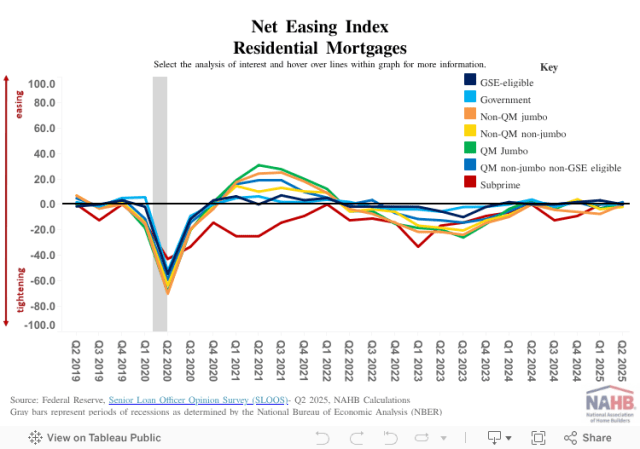
In the second quarter of 2025, overall demand for residential mortgages was weaker, while lending standards for most types of residential mortgages were essentially unchanged1, according to the recent release of the Senior Loan Officer Opinion Survey (SLOOS).  For commercial real estate (CRE) loans, lending standards for construction & development were modestly tighter, while demand was moderately weaker. However, for multifamily loans within the CRE category, lending conditions and demand were essentially unchanged for the third consecutive quarter.  Last week, the Federal Reserve left its monetary policy stance (i.e., Federal Funds rate) unchanged for the fifth consecutive meeting, with Chairman Jerome Powell indicating in his statement that the Fed “is attentive to the risks to both sides of its dual mandate [maximum employment and inflation at the rate of 2%]” and the “uncertainty about the economic outlook remains elevated”.  NAHB is still forecasting two interest rate cuts before the end of 2025. Residential Mortgages In the second quarter of 2025, five of seven residential mortgage loan categories saw a neutral net easing index (i.e., 0) for lending conditions.  Only Qualified Mortgage (QM) non-jumbo non-GSE eligible loans experienced easing, as evidenced by a positive2 value (+1.8). Meanwhile, the only loans to experience tightening were non-QM non-jumbo loans at -2.0.  Nevertheless, based on the Federal Reserve classification of any reading between -5 and +5 as “essentially unchanged,” all seven categories fell within this range. All residential mortgage loan categories reported at least modestly weaker demand in the second quarter of 2025, except for QM-jumbo which was essentially unchanged for the second consecutive quarter.  Most notably, non-QM non-jumbo (-22.0%) and subprime (-20.0%) loans experienced significantly weaker demand during the quarter.  The net percentage of banks reporting stronger demand for most of the residential mortgage loan categories has been negative for at least four years. Commercial Real Estate (CRE) Loans Across CRE loan categories, construction & development loans recorded a net easing index of -9.7 for the second quarter of 2025, indicating modestly tighter credit conditions.  For multifamily loans, the net easing index was -4.8, or essentially unchanged.  Both categories of CRE loans show tightening of lending conditions (i.e., net easing indexes below zero) since Q2 2022.  However, the tightening has become less defined recently for multifamily, with its net easing index essentially unchanged (i.e., between -5.0 and +5.0) for three consecutive quarters. The net percentage of banks reporting stronger demand was -11.3% for construction & development loans and -3.2% for multifamily loans, with negative numbers indicating weakening demand.  Like the trend for lending conditions, demand for multifamily loans has experienced unchanged conditions (i.e., between -5.0% and +5.0%) for three straight quarters. The Federal Reserve uses the following descriptors when analyzing results from the survey which will be used, in principle, within this blog post as well: – “Remained basically unchanged” means that the change or actual reading is greater than or equal to 0 and less than or equal to 5 percent. – “Modest” means that the change or actual reading is greater than 5 and less than or equal to 10 percent. – “Moderate” means that the change or actual reading is greater than 10 and less than or equal to 20 percent. – “Significant” means that the change or actual reading is greater than 20 and less than or equal to 50 percent. – “Major” means that the change or actual reading is greater than or equal to 50 percent.A value above zero (i.e., positive) indicates that lending conditions are easing while a value below zero (i.e., negative) indicates that lending conditions are tightening. Discover more from Eye On Housing Subscribe to get the latest posts sent to your email.

Weaker Demand for Residential Mortgages in Second Quarter2025-08-08T09:31:35-05:00

About My Work

Phasellus non ante ac dui sagittis volutpat. Curabitur a quam nisl. Nam est elit, congue et quam id, laoreet consequat erat. Aenean porta placerat efficitur. Vestibulum et dictum massa, ac finibus turpis.

Recent Works

Recent Posts