
September Jobs Report Highlights a Cooling but Still Growing Labor Market

2025-11-20T12:16:21-06:00

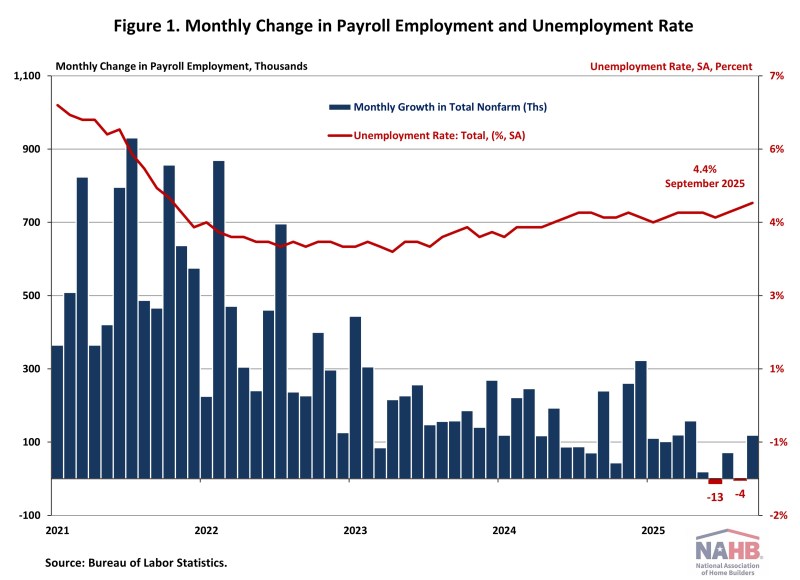
The long-delayed September jobs report revealed that the U.S. economy added 119,000 jobs while the unemployment rate climbed to its highest level in nearly four years. Combined with downward revisions to previous months, this month’s data indicates a slowing of the U.S. labor market, though one that is still expanding. With the October jobs report cancelled due to the government shutdown and November’s report not scheduled for release until December 16, this September report now stands as the Federal Reserve’s final look at labor market conditions before its December meeting. In September, wages grew at a 3.8% pace year over year, matching August’s increase. Wage growth has been outpacing inflation for nearly two years, which typically occurs as productivity increases. National Employment The September jobs report was delayed by more than six weeks due to the federal government shutdown. According to the long-awaited Employment Situation Summary reported by the Bureau of Labor Statistics (BLS), total nonfarm payroll employment rose by 119,000 in September, following a downwardly revised loss of 4,000 jobs in August. August’s growth was revised down by 26,000, from an initial estimate of +22,000 to -4,000, marking the second month of negative job growth since January 2010. July’s job growth was revised down by 7,000, from +79,000 to +72,000. Combined, the revisions erased 33,000 jobs from previously reported figures. Through September, monthly job growth in 2025 has averaged 76,000, a significant slowdown compared to the 168,000 monthly average gain for 2024. The unemployment rate rose to 4.4% in September, its highest level in nearly four years. The number of persons unemployed rose by 219,000 and the number of persons employed increased by 251,000. Meanwhile, the labor force participation rate—the proportion of the population either looking for a job or already holding a job—edged up by 0.1 percentage points to 62.4%. This remains below its pre-pandemic level of 63.3% recorded at the beginning of 2020. Among prime working-age individuals (aged 25 to 54), the participation rate remained steady at 83.7%, the highest level since October 2024. In September, employment gains were seen in health care (+43,000), food services and drinking places (+37,000), and social assistance (+14,000), while the transportation and warehousing sector and the federal government experienced job losses. Federal government employment fell by 3,000 positions in September and has now shed a total of 97,000 positions since peaking in January 2025. The BLS notes that “employees on paid leave or receiving ongoing severance pay are counted as employed in the establishment survey.” Construction Employment Employment in the overall construction sector increased by 19,000 in September, after three consecutive months of job losses. Within the industry, residential construction added 3,100 jobs, while non-residential construction gained 16,300 positions. Residential construction employment now stands at 3.3 million in September, including 954,000 workers employed by builders and remodelers and 2.4 million residential specialty trade contractors. The six-month moving average of job gains for residential construction remains negative at -3,767 per month, reflecting losses in four of the past six months for May through August 2025. Over the last 12 months, residential construction has seen a net loss of 44,900 jobs, marking the fifth consecutive annual decline since September 2020. Since the low point following the Great Recession, residential construction has gained 1,340,000 positions. In September, the unemployment rate for construction workers jumped to 5.1% on a seasonally adjusted basis. The unemployment rate for construction workers has remained at a relatively lower level, after reaching 15.3% in April 2020 due to the housing demand impact of the COVID-19 pandemic.

September Jobs Report Highlights a Cooling but Still Growing Labor Market2025-11-20T12:16:21-06:00

Employment Loss and Post-COVID Recovery Across U.S. Metro Areas

2025-11-12T08:15:10-06:00

In April 2020, total payroll employment in the United States fell by an unprecedented 20.5 million, following a loss of 1.4 million in March, as the COVID-19 pandemic brought the economy to a sudden halt. The unemployment rate surged by 10.4 percentage points to 14.8% in April. It was the highest rate effectively since the Great Depression. Tracking the labor market impact is critical for understanding the follow-on effect on home building activity during the last five years. As people stayed at home and businesses shut down under government directives, millions of Americans lost their jobs. Initial unemployment insurance claims soared to 2.9 million during the week of March 21, 2020. For the following 19 consecutive weeks, more than one million Americans filed for unemployment each week, totaling roughly 50.9 million claims over just five months. While the national labor market suffered an unprecedented collapse in both speed and depth, the effects varied significantly across U.S. metro areas. Local economies experience dramatically different outcomes depending on their industrial composition, the feasibility of remote work, and the strictness of local public health restrictions. A map of metro areas across the United States reveals striking variations in employment losses from February 2020 to the pandemic’s employment trough. Nonfarm employment payrolls declined by anywhere from 5% to 35% across 393 metro areas. Kahului-Wailuku, Hawaii, experienced the steepest job losses, with employment plummeting by 35%. This metro area’s deep dependence on tourism and hospitality, particularly in accommodation and food services, left it vulnerable to travel restrictions and widespread shutdown. Similarly, Atlantic City-Hammonton, New Jersey, as a prime tourism destination, was devastated by pandemic-related closures. By May 2020, its total employment dropped 34% from the February 2020 level. Some metro areas experienced major setbacks tied to their dominant industries. In Elkhart-Goshen, Indiana, as the heart of the U.S. RV manufacturing industry, employment plunged 34% as production ground to a halt. At the other end of the spectrum, Logan, UT-ID, recorded the mildest downturn, with a relatively modest 5% employment drop, reflecting a more resilient local economy. In sheer numbers, New York-Newark-Jersey City, New York-New Jersey saw the largest employment losses in the nation, shedding nearly 2 million jobs, or about 20% of its pre-pandemic workforce. Los Angeles–Long Beach–Anaheim, California, followed closely, losing 1.1 million jobs, about 17% of its February 2020 level. Despite the historic scale of these losses, the U.S. labor market rebounded faster than many anticipated. Within just 26 months, overall employment had fully recovered, surpassing its February 2020 level to reach 152.4 million by June 2022. Yet, as with the initial losses, the recovery varied widely across metro areas. By August 2025, 93 of the 393 metro areas had still not regained their pre-pandemic employment levels. Lake Charles, Louisiana, remains the slowest to recover, with employment at only 87% of its February 2020 level. The region’s setbacks have been compounded by multiple disasters—COVID-19, followed by Hurricanes Laura and Delta in 2020—that disrupted both infrastructure and labor markets. Kankakee, Illinois (92% recovered), and Weirton–Steubenville, West Virginia–Ohio (93%), also lagged, highlighting how recovery can be delayed by structural and regional challenges. In contrast, many other metro areas have not only recovered but expanded beyond their pre-pandemic employment levels. As of August 2025, 300 metro areas have fully rebounded, with some even booming. Wildwood–The Villages, Florida, leads the nation with employment reaching 127% of its February 2020 level, followed by St. George, Utah, at 125%. Notably, the areas that suffered the sharpest employment declines in 2020 did not necessarily experience the slowest recoveries. Las Vegas–Henderson–North Las Vegas, Nevada, for instance, lost 277,900 jobs, about 26% of its workforce, but has rebounded strongly, reaching 109% of its pre-pandemic employment. By contrast, Enid, Oklahoma, which lost just 1,600 jobs, remains slightly below its February 2020 level, still 2% short of full recovery. The story of employment loss and recovery across U.S. metro areas underscores the uneven geography of the COVID-19 economy. The resilience of local economies has since reshaped the post-pandemic landscape, revealing not only where recovery has taken root but also where it remains incomplete. And of course, the health of local labor markets has important impacts on the status of local home building and remodeling conditions.

Employment Loss and Post-COVID Recovery Across U.S. Metro Areas2025-11-12T08:15:10-06:00

Remodelers on the Rise: How Renovation is Reshaping Residential Construction

2025-11-10T08:18:08-06:00

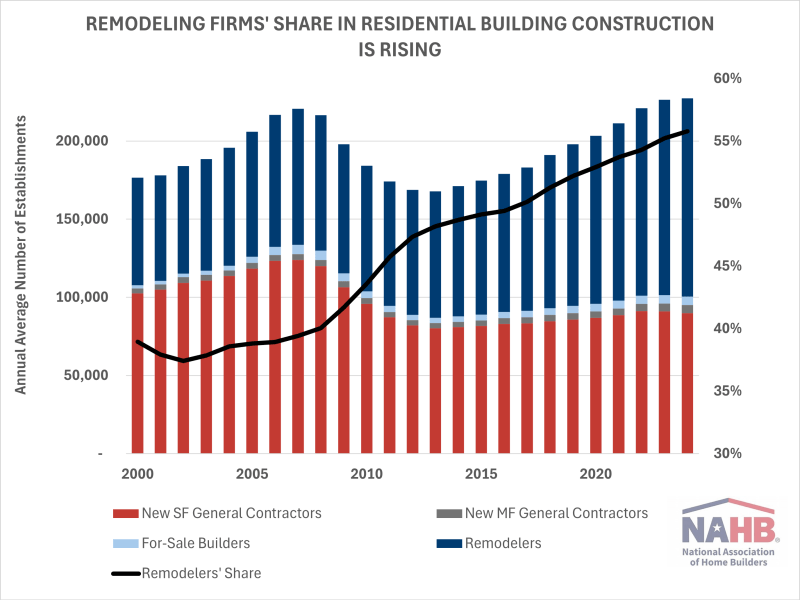
As the nation’s housing stock continues to age and new homes remain out of reach for many buyers, remodeling is capturing a growing share of the residential construction market, both in terms of the number of firms and employment. With most U.S. households unable to afford new construction, renovation has become a more practical and cost-effective alternative to improve housing conditions, driving demand on the consumer side. On the supply side, many home builders undertake remodeling projects to grow their business. NAHB’s analysis of the quarter-century of Quarterly Census of Employment and Wages (QCEW) data suggests that the rise of remodelers is a sustained structural shift rather than a temporary post-pandemic surge. Remodeling Firms’ Share in Residential Construction is RisingOver the past 25 years, the number of remodeling establishments has nearly doubled—from fewer than 69,000 in 2000 to more than 128,000 in the first quarter of 2025. Remodelers now represent over half (56%) of all residential building construction (RBC) establishments. By contrast, during the mid-2000s housing boom, remodelers’ share consistently hovered around 38–39%, when the market was dominated by home builders, including new single-family and multifamily general contractors as well as speculative (spec) home builders. Although the remodeling sector was not immune to the 2008 housing crash, its losses were modest compared to the contraction of home building. Between 2007 and 2012, the number of remodeling establishments fell by 8%, while roughly one-third of home builders went out of business. As a result, the remodeler’s share of the RBC sector rose sharply after the crash, reaching 46% in 2011, and has continued to climb steadily ever since. During the post-pandemic housing boom, driven by low mortgage rates, the rise of remote work, and a renewed demand for larger living spaces, both remodelers and home builders experienced solid growth. However, remodelers expanded their ranks at a faster pace, with their share of RBC firms climbing to 54% by 2022. Less sensitive to fluctuations in mortgage rates than home builders, remodelers have continued to grow even amid a series of aggressive Federal Reserve rate hikes that sharply increased the cost of home purchases and slowed new construction. As of 2024, remodeling firms account for 56% of all RBC establishments. Remodeling Employment Share in RBC is Rising In the overall construction industry, which encompasses residential and non-residential building construction, as well as heavy/civil engineering construction, land subdivision, and specialty trade contractors, it is the latter that dominate the overall sector employment. However, the government employment surveys cannot identify what portion of subcontractors’ business is devoted to remodeling. As a result, RBC is the subsector that allows tracking the remodeling trends best. The analysis of employment trends in residential building construction reveals a similar pattern, with remodelers generating a rising number and share of jobs, largely at the expense of single-family general contractors. As of 2024, the remodeling sector accounted for almost half (49%) of RBC workers. In contrast, during the housing boom of the mid-2000s, only 30% of payroll employees worked for remodelers, while single-family general contractors employed 63% of the RBC workforce. The shift is even more pronounced within the production (nonsupervisory) workforce of the RBC industry.  More than half (51.2%) of these skilled craftsmen now work for remodeling firms, compared with roughly 30% in the early 2000s, according to NAHB’s analysis of historical data from the Bureau of Labor Statistics’ Current Employment Statistics (CES) survey. Multifamily general contractors, who subcontract out most of their construction work, account for a smaller share of home building jobs but have also gained ground. Fueled by strong multifamily activity in 2022–2023, their share of RBC employment grew to 5% by 2024. For-sale builders account for an additional 6%. The typical remodeling firm remains small, averaging between 3 and 4 employees per establishment, comparable to levels observed during the mid-2000s housing boom. This stability suggests that the overall rise in remodeling employment stems primarily from the creation of new firms or the reclassification of home builders shifting toward renovation work as remodelers. It is likely that, as market conditions change, some home builders, particularly smaller single-family general contractors, pivot toward renovation projects to stay and grow their business. The remodeling sector’s lower barriers to entry, smaller upfront investments compared to new construction, and fewer regulatory hurdles make the transition easier. As more companies view remodeling as their primary activity and revenue source, more will be reclassified as remodeling establishments in the official data reporting. This is because data collection in the U.S. is guided by the North American Industry Classification System (NAICS). Under NAICS, a company self-classifies and chooses the industry code that best captures its primary activity. In some surveys, such as the Economic Census, the Census Bureau emphasizes revenue sources as a primary metric for categorizing businesses. The steadily rising number of remodelers and the jobs they create underscores that renovation has become the reliable engine driving growth in the residential construction sector.

Remodelers on the Rise: How Renovation is Reshaping Residential Construction2025-11-10T08:18:08-06:00

Construction Labor Market Softens

2025-09-30T10:20:27-05:00

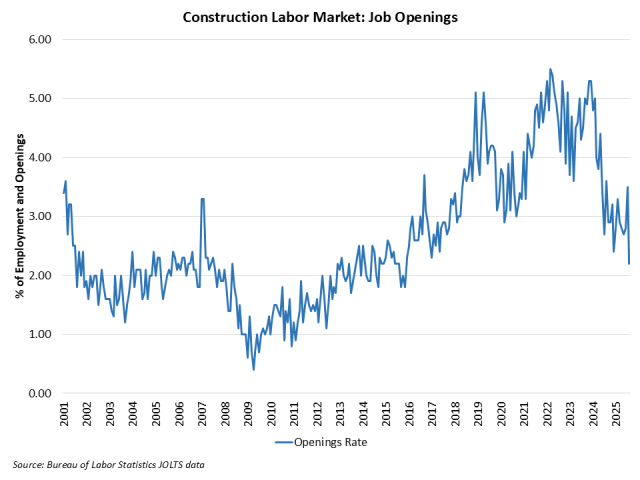
The count of open, unfilled positions in the construction industry decreased in August, per the Bureau of Labor Statistics Job Openings and Labor Turnover Survey (JOLTS). The decline occurred as home building weakened in 2025. The number of open jobs for the overall economy was effectively unchanged, increasing from 7.21 million in July to 7.23 million in August. The August reading was notably lower than the 7.65 million estimate from a year ago and reflects an overall cooling of the U.S employment market. Previous NAHB analysis indicated that this number had to fall below 8 million on a sustained basis for the Federal Reserve to move forward on interest rate reductions. With estimates remaining below 8 million for national job openings, the Fed, in theory, should be able to cut further in 2025. The number of open construction sector jobs decreased from a revised 303,000 level in July to 188,000 in August. This marks a notable decline of open, unfilled construction jobs from that registered a year ago (304,000). The chart below notes the declining trend that has been in place for unfilled construction jobs since the Fed raised the federal funds rate as home building weakened. The construction job openings rate declined to 2.2% in August, lower than the 3.6% estimated a year ago. The layoff rate in construction declined to 2.2% in August. The quits rate edged higher to 1.8% in August. Discover more from Eye On Housing Subscribe to get the latest posts sent to your email.

Construction Labor Market Softens2025-09-30T10:20:27-05:00

Job Growth Slowed in August

2025-09-05T10:15:54-05:00

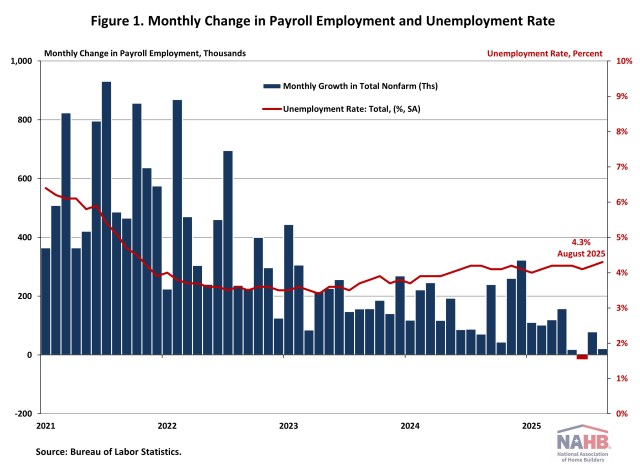
Job growth slowed sharply in August, and the unemployment rate rose to its highest level in nearly four years. The latest jobs report, along with downward revisions to previous months’ data, indicates a continued cooling in the U.S. labor market. This softening trend is likely to increase pressure on the Federal Reserve to consider an interest rate cut at its upcoming September meeting. In August, wage growth slowed. Year-over-year, wages grew at a 3.7% rate, down 0.2 percentage points from the previous month. Despite the deceleration, wage growth has been outpacing inflation for nearly two years, which typically occurs as productivity increases. National Employment According to the Employment Situation Summary reported by the Bureau of Labor Statistics (BLS), total nonfarm payroll employment showed little change in August, with a modest gain of 22,000 jobs. June’s job growth was revised down by 27,000, from an initial estimate of +14,000 to -13,000, making the first negative monthly job growth since January 2010. July’s job growth was revised up by 6,000, from 73,000 to 79,000. Combined, the revisions erased 21,000 jobs from previously reported figures. So far in 2025, monthly job growth has averaged 75,000, a significant slowdown compared to the 168,000 monthly average gain for 2024. The unemployment rate rose to 4.3% in August, its highest level in nearly four years. The August increase in the unemployment rate reflected the increase in the number of persons unemployed (+148,000) and the increase in the number of persons employed (+288,000). Meanwhile, the labor force participation rate—the proportion of the population either looking for a job or already holding a job—edged up by 0.1 percentage points to 62.3%. This remains below its pre-pandemic level of 63.3% recorded at the beginning of 2020. Among prime working-age individuals (aged 25 to 54), the participation rate rose by 0.3 percentage points to 83.7%, the highest level since October 2024. In August, employment continued to trend up in health care (+31,000) and in social assistance (+16,000), while employment in federal government, mining, wholesale trade, and manufacturing sectors experienced job losses. Federal government employment declined by 15,000 jobs in August and has now shed a total of 97,000 positions since peaking in January 2025. The BLS notes that “employees on paid leave or receiving ongoing severance pay are counted as employed in the establishment survey.” Construction Employment Employment in the overall construction sector declined by 7,000 in August, marking the third consecutive month of job losses in the industry. Downward revisions to June and July figures further underscore the sector’s ongoing weakness. Within the industry, residential construction lost 6,100 jobs, while non-residential construction employment declined by 1,200 jobs during the month. Residential construction employment now stands at 3.3 million in August, broken down as 954,000 builders and 2.4 million residential specialty trade contractors. The six-month moving average of job gains for residential construction was -4,783 a month, reflecting the five months of job losses recorded over the past six months, specifically in March, May, June, July, and August of 2025. Over the last 12 months, home builders and remodelers experienced a net loss of 26,100 jobs, marking the fourth annual decline since September 2020. Since the low point following the Great Recession, residential construction has gained 1,345,300 positions. In August, the unemployment rate for construction workers rose to 3.9% on a seasonally adjusted basis. The unemployment rate for construction workers has remained at a relatively lower level, after reaching 15.3% in April 2020 due to the housing demand impact of the COVID-19 pandemic. Discover more from Eye On Housing Subscribe to get the latest posts sent to your email.
Job Growth Slowed in August2025-09-05T10:15:54-05:00

Open Construction Jobs Rise in July

2025-09-03T12:15:52-05:00

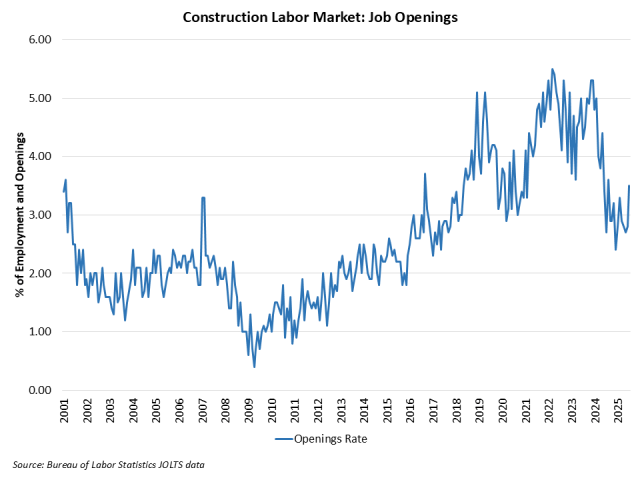
The count of open, unfilled positions in the construction industry increased in July, per the June Bureau of Labor Statistics Job Openings and Labor Turnover Survey (JOLTS) as the national labor market cooled. The number of open jobs for the overall economy decreased from 7.36 million in June to 7.18 million in July. The July reading was notably lower than the 7.50 million estimate from a year ago and reflects an overall cooling of the U.S employment market. Previous NAHB analysis indicated that this number had to fall below 8 million on a sustained basis for the Federal Reserve to move forward on interest rate reductions. With estimates remaining below 8 million for national job openings, the Fed, in theory, should be able to cut further despite a recent pause. There is growing pressure on the Fed to do so. Running counter to the national trend, the number of open construction sector jobs increased from a revised 242,000 level in June to 306,000 in July. This marks an increase of open, unfilled construction jobs than that registered a year ago (229,000). The chart below notes the declining trend that has been in place since the Fed raises the federal funds rate but with the recent uptick for unfilled positions in construction. The construction job openings rate increased to 3.5% in July, higher than the 2.7% estimated a year ago. The layoff rate in construction increased to 2.8% in July, the highest rate since March 2023. The quits rate declined to 0.9% in July, the lowest recorded for the construction sector (data starts in 2000). The construction market appears to have experienced considerable churn in July, with job openings rising, quits very low, and layoffs increasing. Future data will allow for identifying trends. Discover more from Eye On Housing Subscribe to get the latest posts sent to your email.

Open Construction Jobs Rise in July2025-09-03T12:15:52-05:00

About My Work

Phasellus non ante ac dui sagittis volutpat. Curabitur a quam nisl. Nam est elit, congue et quam id, laoreet consequat erat. Aenean porta placerat efficitur. Vestibulum et dictum massa, ac finibus turpis.

Recent Works

Recent Posts