

Single-Family Construction Loan Volume Rises in the Third Quarter

2025-12-02T09:19:00-06:00

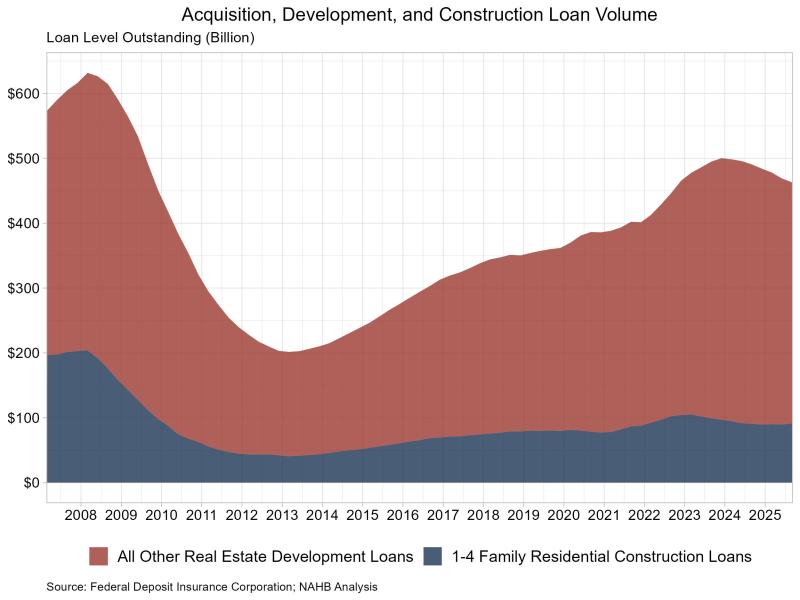
Single-family construction lending picked up in the third quarter, amidst the overall cooling lending environment. Loan balances for 1-4 family construction grew to $91.2 billion in the third quarter, registering the first annual increase in over two years. However, across all acquisition, development and construction (AD&C) loans, the total volume fell for the seventh straight quarter. According to data from the Federal Deposit Insurance Corporation (FDIC), the total level of outstanding AD&C loans fell to $463.0 billion in the third quarter of 2025, down 5.6% from one year ago. This year-over-year decrease was led by a drop in other real estate development loans, which decreased 7% over the year to $371.8 billion. Meanwhile, the volume of 1-4 family residential construction and land development loans rose to $91.2 billion in the third quarter, up 0.5% from one year ago. It is worth noting, the FDIC data represent only the stock of loans, not changes in the underlying flows, so it is an imperfect data source. Nonetheless, lending remains much reduced from years past. The current amount of existing 1-4 family residential AD&C loans now stands 56% lower than the peak level of residential construction lending of $204 billion reached during the first quarter of 2008. Alternative sources of financing, including equity partners, have supplemented this capital market in recent years. Quality Metrics of Construction Loans While the total volume of 1-4 family residential construction loans rose, the volume of loans 30+ days past due or nonaccrual status fell slightly to $1.1 billion over the quarter. As a share of the total 1-4 family residential construction loan volume, this accounts for 1.2%. Breaking this out further, the level of loans 30-89 days past due was $418.1 million, while the volume in nonaccrual status was $593.4 million. The nonaccrual loan status volume increased from $572.4 million in the second quarter and the 30-89 past due fell from $469.2 million. Loans are classified as nonaccrual when one or more of the following conditions apply: the loan is 90 days or more past due on principal or interest (unless it is well-secured and in the process of collection); the bank no longer expects full repayment of principal and interest; or the borrower’s financial condition has significantly deteriorated, warranting cash-basis accounting.
Single-Family Construction Loan Volume Rises in the Third Quarter2025-12-02T09:19:00-06:00

Credit Conditions for Builders Continue to Be Tight

2025-11-14T08:18:46-06:00

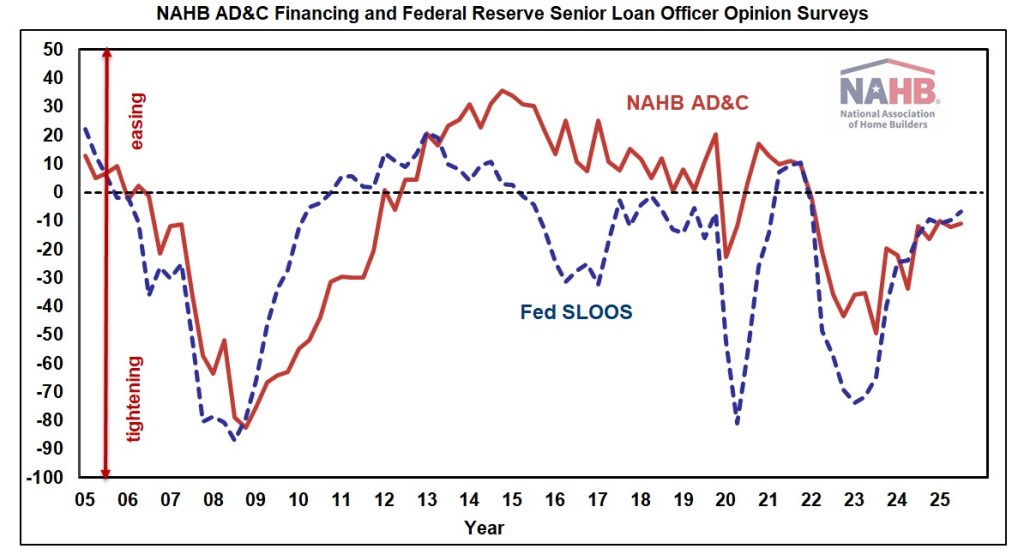
Credit conditions on loans for residential Land Acquisition, Development & Construction (AD&C) were still tightening in the third quarter of 2025, according to NAHB’s quarterly survey on AD&C Financing.  The net easing index derived from the survey posted a reading of -11.0 (the negative number indicating that credit tightened since the previous quarter). This is in reasonably close agreement with the third quarter reading of -6.6 for the similar net easing index produced from the Federal Reserve’s survey of senior loan officers—marking fifteen consecutive quarters of tightening credit conditions reported by both builders and lenders. More details from the Fed’s survey of lenders—including measures of demand and net easing for residential mortgages—appeared in a previous post. According to the NAHB survey, the most common way lenders tightened in the third quarter was by lowering the maximum allowable loan-to-value or loan-to-cost ratio on the loans (cited by 60% of the builders and developers who reported tighter credit). Tied for second place were reducing the amount they are willing to lend, requiring out-of-pocket payment of interest or borrower funding of an interest reserve, and  requiring personal guarantees (cited by 47% each). Results on the cost of credit in the third quarter were mixed. The average contract rate increased from 7.82% to 7.95% on loans specifically for residential land acquisition—but declined on the other three categories of loans tracked in NAHB’s AD&C survey: from 8.04% to 7.68% on loans for land development, from 8.17% to 7.90% on loans for speculative single-family construction, and from 7.95% to 7.90% on loans for pre-sold single-family construction.    Meanwhile, the average initial points charged on the loans increased across the board: from 0.56% to 0.66% on loans for land acquisition, from 0.74% to 0.83% on loans for land development, from 0.72% to 0.74% on loans for speculative single-family construction, and from 0.58% to 0.67% on loans for pre-sold single-family construction. Those combinations of quarter-to-quarter changes caused the effective interest rate (which takes both the contract rate and initial points into account) to increase from 9.95% to 10.15% on loans for land acquisition, but to decline from 11.77% to 10.92% on loans for land development and from 12.82% to 12.04% on loans for speculative single-family construction. The average effective rate on loans for pre-sold single-family construction remained essentially unchanged at 12.74%, compared to 12.73% in the second quarter. Although results on the average effective interest rate were mixed on a quarter-to-quarter basis, the  rate on each of the four types of AD&C loans has declined significantly since peaking somewhere in the period between 2023 Q3 and 2024 Q2. Also in the NAHB AD&C survey, 37% of respondents who built single-family homes during the third quarter of 2025 reported financing some of the construction with a construction-to-permanent (one-time-close) loan made to the ultimate home buyer. On average, 63% of the homes these respondents built were financed this way. More detail on credit conditions for residential builders and developers is available on NAHB’s AD&C Financing Survey web page.

Credit Conditions for Builders Continue to Be Tight2025-11-14T08:18:46-06:00

Unchanged Lending Conditions for Residential Mortgages in Third Quarter

2025-11-13T08:14:35-06:00

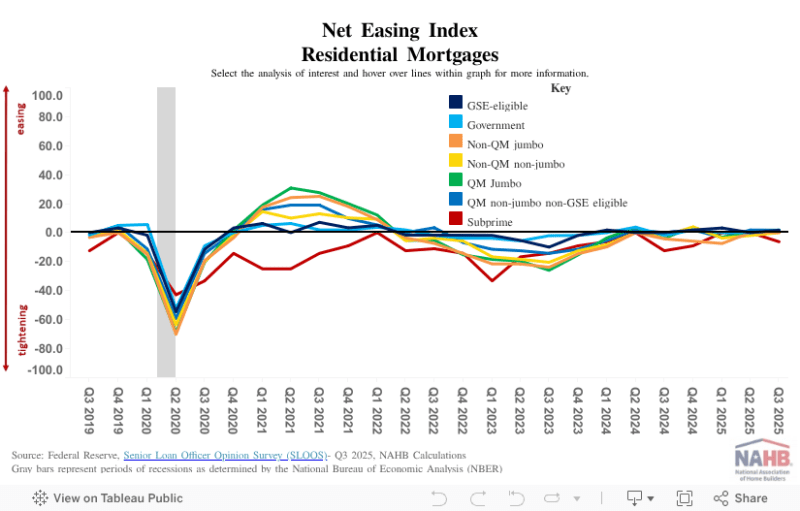
Lending standards for most types of residential mortgages were essentially unchanged, according to the recent release of the Senior Loan Officer Opinion Survey (SLOOS). For commercial real estate (CRE) loans, lending standards for construction & development were modestly tighter, while multifamily was essentially unchanged.  Demand for both CRE categories was essentially unchanged for the quarter.  Two weeks ago, the Federal Reserve eased its key short-term interest rate (i.e., Federal Funds) by 25 basis points for the second consecutive meeting, establishing an upper bound of 4.00%.  While the causal link between the Federal Funds rate and the 30-year fixed rate mortgage is minimal, these cuts will have a more tangible impact for private home builders through lower rates on acquisition, development, & construction (AD&C) loans.  Roughly 60% of single-family starts are built by private builders. With pressure from both sides of their dual mandate as the job market cools and inflation remains sticky, NAHB is forecasting a measured approach from the Fed when it comes to further rate cuts next year. Residential Mortgages In the third quarter of 2025, four of seven residential mortgage loan categories saw a positive net easing index for lending conditions with an additional two recording a neutral reading (i.e., 0).  Only subprime loans experienced tighter lending conditions, as evidenced by a negative value (-6.3).  Nevertheless, based on the Federal Reserve classification of any reading between -5.0 and +5.0 as “essentially unchanged,” all but subprime fell within this range. Five of the seven residential mortgage loan categories reported stronger demand in the third quarter of 2025, with the strongest demand coming from Government, GSE-eligible, and Qualified Mortgage (QM) non-jumbo, non-GSE eligible loans.  Non-QM jumbo was essentially unchanged for the quarter, while subprime loans were the only category to experience weaker demand, which has been the case since Q3 of 2020. Commercial Real Estate (CRE) Loans For the CRE loan categories, construction & development loans registered a net easing index of -6.6 for the third quarter of 2025, indicating modestly tighter credit conditions.  For multifamily loans, the net easing index was -1.6, or essentially unchanged.  Both categories of CRE loans show tightening of lending conditions (i.e., net easing indexes below zero) since Q2 2022.  However, the tightening has become less defined recently for multifamily, with its net easing index essentially unchanged (i.e., between -5.0 and +5.0) for four consecutive quarters. The net percentage of banks reporting stronger demand was -4.9% for construction & development loans, with a negative number indicating weaker demand.  For multifamily, demand was neutral (i.e., 0) in the third quarter of 2025, with the same number of banks that reported weaker demand as those who reported stronger demand.  However, demand for CRE loans within both categories has experienced unchanged conditions (i.e., between -5.0% and +5.0%).

Unchanged Lending Conditions for Residential Mortgages in Third Quarter2025-11-13T08:14:35-06:00

About My Work

Phasellus non ante ac dui sagittis volutpat. Curabitur a quam nisl. Nam est elit, congue et quam id, laoreet consequat erat. Aenean porta placerat efficitur. Vestibulum et dictum massa, ac finibus turpis.

Recent Works

Recent Posts