

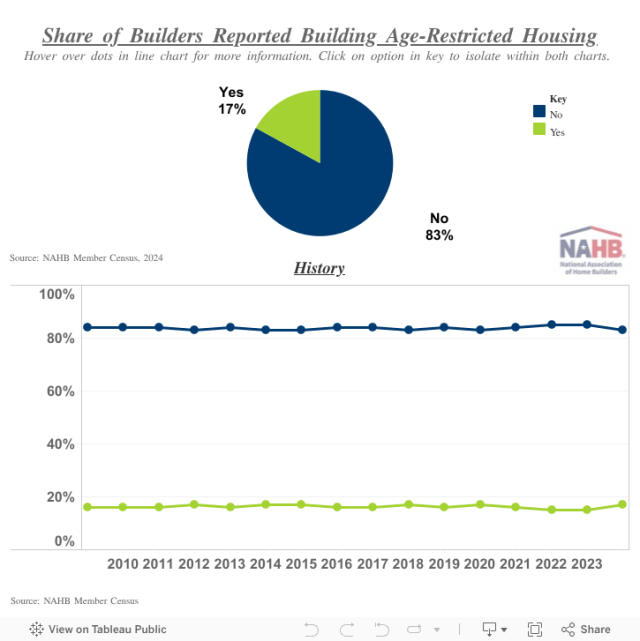
17% of NAHB Builders Built Age-Restricted Housing in 2024

2025-10-02T08:19:50-05:00

Only 17% of NAHB builder members build age-restricted housing for people age 55 or older, according to 2024 Member Census.  This is up two percentage points from the previous year.  However, this share has remained within a narrow band (15%-17%) since the question was added to the member census in 2009.  The likelihood of building age-restricted housing generally increases with the size of the company.  Among builders with 25 or fewer starts in 2024, only 16% to 17% build this type of housing, compared to 36% among those with 100+ starts.  Across business activities, multifamily builders are significantly more likely to build for the 55+ population (44%) than single-family builders (19%) or manufacturers of modular/panelized/log homes (32%). The median age of the U.S. population continues to increase, inching closer to 40.  With more than 30% of the U.S. population over the age of 55,  this growing demographic group will remain a significant segment of the market for years to come. In 2024, 43,000 housing units were started in age-restricted communities, but this is down 16% from the previous year.  For the existing housing stock, aging-in-place remodeling work is a way to satisfy the demands of an older population looking to remain in their homes longer. For more details about NAHB builder members, please visit housingeconomics.com or click here for the full article. Discover more from Eye On Housing Subscribe to get the latest posts sent to your email.
17% of NAHB Builders Built Age-Restricted Housing in 20242025-10-02T08:19:50-05:00

Characteristics of Homes Built in Age-Restricted Communities

2025-09-29T09:19:49-05:00

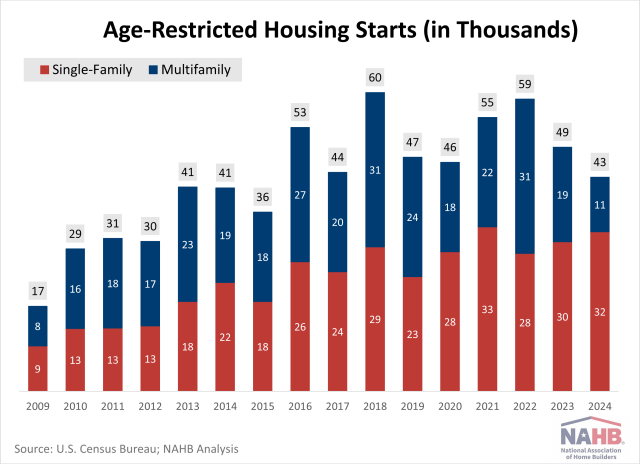
In 2024, approximately 43,000 homes were built in age-restricted communities, representing just over 3% of all housing starts. According to the Census Bureau’s Survey of Construction, roughly three-quarters of these homes (32,000) were single-family units. The remaining 11,000 were multifamily units, which marked the lowest number of age-restricted multifamily starts since 2009. In 2009, during the depths of the housing downturn, builders started only 17,000 homes in age-restricted communities (9,000 single-family and 8,000 multifamily).  The numbers then increased steadily until reaching 60,000 age-restricted starts (roughly evenly split between single-family and multifamily) in 2018. These numbers decreased during the pandemic but rebounded in 2021-2022, almost reaching the peak from 2018. In 2024, the total number of age-restricted home starts decreased by approximately 12% from 2023. This drop came amid a broader slowdown in overall housing starts. While total single-family starts increased by about 7% year-over-year, multifamily starts fell sharply by 25%. A similar trend played out in the age-restricted segment: single-family starts increased, while multifamily starts declined. In terms of market share, age-restricted single-family homes maintained their 3.16% share of all single-family starts, but the share of age-restricted multifamily units fell to 3.11%. Age-restricted single-family homes carried a noticeable price premium in 2024. The median sales price reached $525,000—about 25% higher than the $421,000 median for non-age-restricted homes. While new non-age-restricted home prices held steady compared to the previous year, prices for age-restricted homes rose by 5%. Age-restricted homes tended to be larger, averaging 2,200 square feet versus 2,100 square feet. However, the price per square foot remained elevated at $155.90, compared to $154.30 for non-age-restricted homes. Lot values may help explain part of the price difference. Age-restricted homes were typically built on more expensive lots, with a median value of $62,000 compared to $60,000 for non-age-restricted homes. Despite the higher price, these lots were smaller, averaging 0.16 acres versus 0.20 acres. Additional data from the 2024 SOC reveal that age-restricted homes have distinct characteristics compared to non-age-restricted homes. A higher percentage of age-restricted homes are attached, single-story, and lack a basement. These homes are also more likely to come with patios and porches, but less likely to have decks.  Finally, age-restricted homes are less likely to require a loan and more likely to be purchased for cash, as older home buyers have had longer to accumulate savings and assets (often equity in a previous home) that can be converted into cash. Discover more from Eye On Housing Subscribe to get the latest posts sent to your email.

Characteristics of Homes Built in Age-Restricted Communities2025-09-29T09:19:49-05:00

About My Work

Phasellus non ante ac dui sagittis volutpat. Curabitur a quam nisl. Nam est elit, congue et quam id, laoreet consequat erat. Aenean porta placerat efficitur. Vestibulum et dictum massa, ac finibus turpis.

Recent Works

Recent Posts