
HOAs are on the Rise Again for New Homes

2025-12-08T13:18:27-06:00

From 2009 to 2020, more and more new single-family homes were built within a community or homeowner’s association. During the COVID-19 pandemic, a decade-long trend began to dip but the most recent data shows an upswing again.
HOAs are on the Rise Again for New Homes2025-12-08T13:18:27-06:00

Mortgage Rates Continue to Trend Lower in November

2025-12-05T10:19:10-06:00

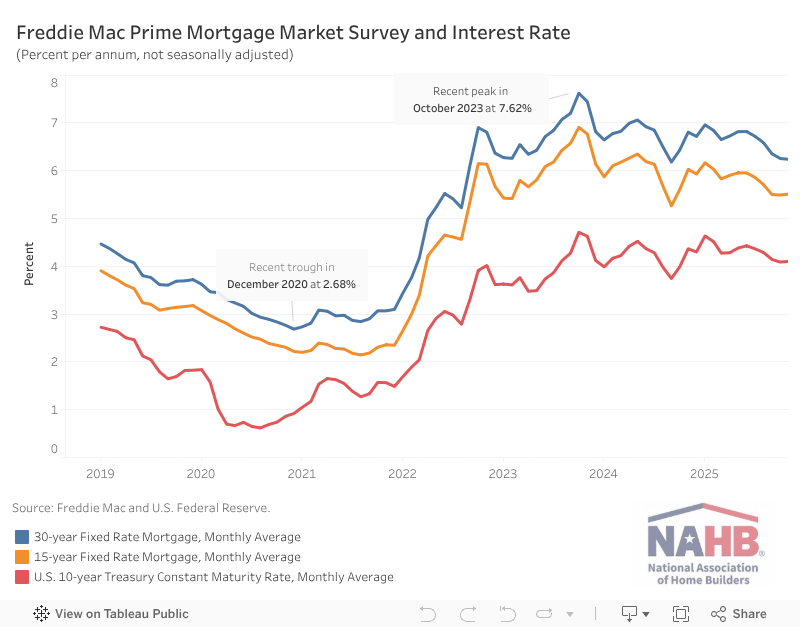
The average mortgage rate in November continued to trend lower to its lowest level in over a year. According to Freddie Mac, the 30-year fixed-rate mortgage averaged 6.24% in November, 2 basis points (bps) lower than in October. Meanwhile, the 15-year rate increased 3 bps to 5.51%. Both the 30-year and 15-year rates remain lower than a year ago, dropping by 57 bps and 52 bps year-over-year, respectively. The 10-year Treasury yield, a key benchmark for long-term borrowing, averaged 4.09% in November– a 3-basis point increase from the previous month. The spread between the 30-year fixed mortgage rate and the 10-year Treasury remains somewhat elevated at 215 basis points, well above the roughly 150-180 basis points seen in a stable market. While the spread has narrowed from the wide gap in 2023, it continues to reflect ongoing market uncertainty, keeping mortgage rates higher than their historical relationship to 10-year Treasury yields. Falling mortgage rates have shown some impact on housing activity. Mortgage application activity continues to strengthen, led by increases in adjustable-rate mortgages and refinancing applications. Additionally, existing home sales rose to an eight-month high in October. There is no data available for new home sales in October due to the government shutdown.

Mortgage Rates Continue to Trend Lower in November2025-12-05T10:19:10-06:00

Top Color Trends for 2026

2025-12-04T13:14:33-06:00

Neutrals and rich, luxurious hues dominate this year's color trends, along with sophisticated greens. Whether you’re helping a client with a bathroom remodel or searching for fresh ideas for a model home, you can use these color trends for inspiration for your next project. Check out the 2026 Colors of the Year.

Top Color Trends for 20262025-12-04T13:14:33-06:00

How IBS 2026 Can Provide a Tech-Focused Strategy for Your Business

2025-12-04T09:14:54-06:00

Technology is no longer optional. Whether in estimating, virtual tours, CRM workflows or jobsite visibility, smart tech is a differentiator for your company. Check out these three key tools at the 2026 NAHB International Builders’ Show® (IBS) in Orlando to help you get a jumpstart on tech for your business in the coming year.

How IBS 2026 Can Provide a Tech-Focused Strategy for Your Business2025-12-04T09:14:54-06:00

Number of Bathrooms in New Single-Family Homes in 2024

2025-12-04T09:15:50-06:00

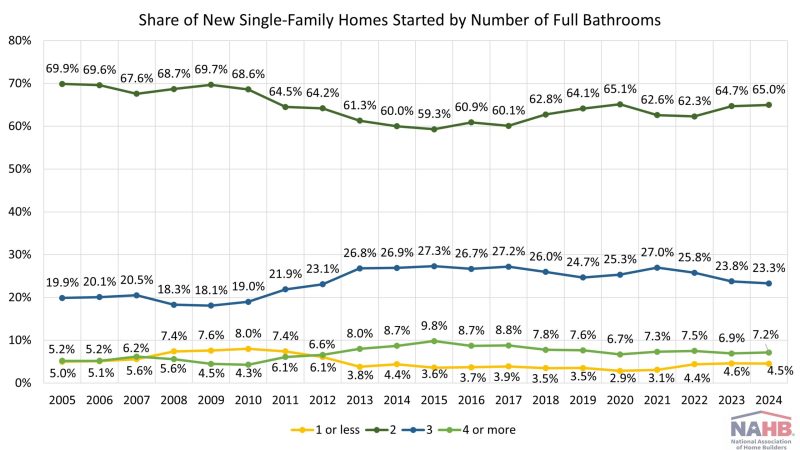
Single-family homes started in 2024 typically had two full bathrooms, according to the U.S. Census Bureau’s Annual Survey of Construction. Homes with three full bathrooms continued to have the second largest share of starts at around 23%. Meanwhile, both homes with four full bathrooms or more and homes with one bathroom or less made up under ten percent of homes started. A full bathroom, as defined by the Bureau, is one that has a washbasin, a toilet and either a bathtub or shower, or a combination of a bathtub and shower. In 2024, 65.0% of new single-family homes started in 2024 had two full bathrooms, marking  the second consecutive year that this share has increased.  The share of single-family starts with three full bathrooms fell for the third straight year, down to 23.3%, while the share of single-family starts with four or more bathrooms increased to 7.2%. For starts with one full bathroom or less, the share fell to 4.5%. Across the U.S., the East South Central division had the highest share, 71.6%, of new single-family starts having two full bathrooms. No other division had above a 70% share. The Census division with the lowest share was the Middle Atlantic, with 52.0% of new single-family starts reporting two full bathrooms. Starts in Middle Atlantic division were far more likely to have 4 full bathrooms or more, at 20.2%, more than double any other division in terms of share. Half-Bathrooms Most new single-family homes started in 2024 had no half-bathrooms at 53.7%. Following closely is the share of new single-family homes with one half-bathroom at 44.9%. New single-family starts with two or more half-bathrooms had a small share of 1.4% in 2024.  A half bathroom contains a toilet, bathtub, or shower, but not all facilities to be classified as a full bathroom. Half-bathrooms are historically more prevalent in the New England Census division as compared to the other eight divisions. In 2024, 64.0% of new single-family homes started in the New England division had at least one half-bathroom. The lowest share occurred in the Pacific division, where only 38.3% of starts had at least one half-bathroom.

Number of Bathrooms in New Single-Family Homes in 20242025-12-04T09:15:50-06:00

Top and Bottom 10 Markets for House Price Appreciation

2025-12-03T15:15:40-06:00

Since the onset of the COVID-19 pandemic, house prices have surged nationally. Between the first quarter of 2020 and the third quarter of 2025, house prices climbed 54.9% nationwide, with more than half of metro areas exceeding this rate. See which markets have seen the biggest increases — and the least.

Top and Bottom 10 Markets for House Price Appreciation2025-12-03T15:15:40-06:00

House Price Appreciation by State and Metro Area: Third Quarter 2025

2025-12-03T11:16:53-06:00

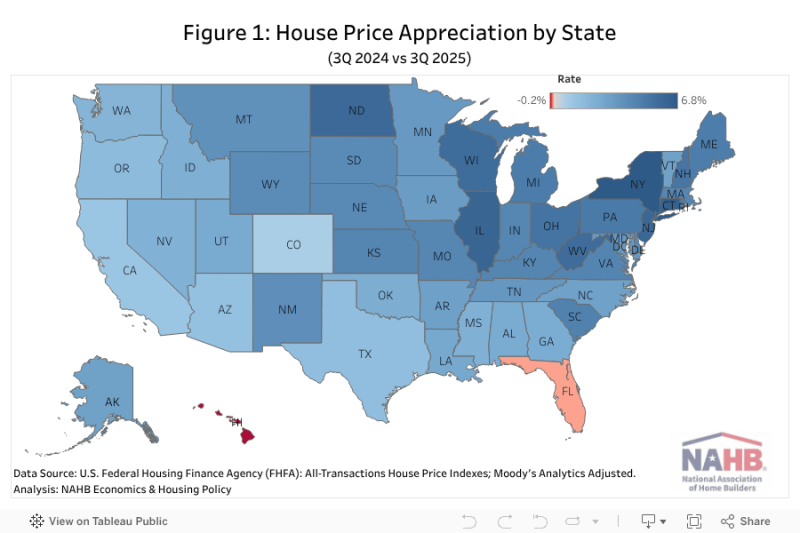
House prices continued to rise in the third quarter of 2025, though the pace of growth slowed as elevated mortgage rates, affordability challenges, and persistent economic uncertainty weighed on consumer demand. After several years of rapid growth, Hawaii and 38 metro areas saw house price declines this quarter, highlighting significant regional variations in market conditions. Nationally, according to the quarterly all-transactions House Price Index (HPI) released by the Federal Housing Finance Agency (FHFA), U.S. house prices rose 3.3% in the third quarter of 2025, compared to the same period in 2024. This represents the slowest year-over-year price appreciation since 2013, indicating a cooling in the housing market following a decade of robust price growth. The FHFA’s all-transactions HPI tracks average price changes based on repeat sales and refinancings of the same single-family properties. It offers insights not only at the national level but also across states and metropolitan areas. Between the third quarter of 2024 and the third quarter of 2025, 48 states and the District of Columbia experienced positive year-over-year (YoY) house price appreciation, with gains ranging from 0.6% to 6.8%. Hawaii was the only state to record a decline, while Florida posted no growth. New York led all states with a 6.8% gain, followed by Connecticut with a 6.5% gain and Illinois with a 6.2% gain. On the opposite end, Colorado posted the lowest house price appreciation at 0.6%. Notably, out of all 50 states and the District of Columbia, 29 states exceeded the national YoY growth rate of 3.3%. However, on a quarterly basis, home price appreciation decelerated in 45 states compared to the second quarter of 2025, highlighting a broad-based deceleration in the housing market. House price growth also varied widely across U.S. metro areas, ranging from a 7.8% decline to a 16.0% increase year-over-year. Punta Gorda, FL recorded the steepest drop, while Farmington, NM posted the strongest gains over the previous four quarters. In the third quarter of 2025, 34 metro areas, in reddish color on the map above, experienced negative house price growth, while 351 metro areas posted increases. Since the onset of the COVID-19 pandemic, house prices have surged nationally. Between the first quarter of 2020 and the third quarter of 2025, house prices climbed 54.9% nationwide, with more than half of metro areas exceeding this rate. However, 226 metro areas have seen varying degrees of decline from their post-COVID peaks, ranging from -0.1% to -12.7%. The map below presents the top ten and bottom ten markets for house price appreciation over the past five years. Among all the metro areas, house price appreciation ranged from 18.3% to 88.4%. Knoxville, TN topped the list with the highest house price appreciation, while Odessa, TX posted the lowest appreciation, ending Lake Charles, LA’s five-quarter run at the bottom.

House Price Appreciation by State and Metro Area: Third Quarter 20252025-12-03T11:16:53-06:00

About My Work

Phasellus non ante ac dui sagittis volutpat. Curabitur a quam nisl. Nam est elit, congue et quam id, laoreet consequat erat. Aenean porta placerat efficitur. Vestibulum et dictum massa, ac finibus turpis.

Recent Works

Recent Posts