

Median Age of Construction Labor Force Holds at 42 

2025-10-21T09:15:17-05:00

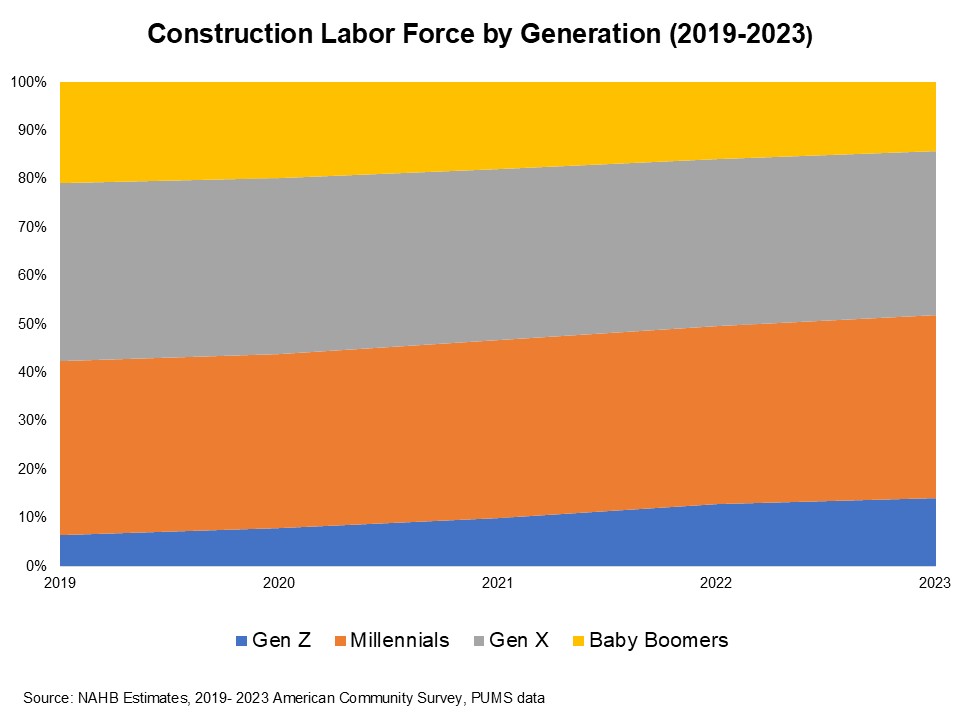
The median age of construction labor force is 42, one year older than a typical worker in the national labor force, according to NAHB analysis of the most recent 2023 American Community Survey (ACS) data. However, more younger people are joining the construction industry. Despite some improvements since the peak of the skilled labor shortage in 2021, attracting skilled labor remains the primary long-term goal for the construction industry.   The median age of construction labor force varies across states. The color coding in the map below tracks the median age of people working in the construction industry.  The state with the oldest median age (46 years old) is Alaska, followed by Connecticut and Maine, where the median age of workers in construction is 45. Construction labor force is younger on average in the central part of the nation. For example, half of all people working in construction in Utah are under 39.  The second data series mapped above is the difference between the median age of workers in construction in each state and the median age of all industry workers. These estimates are reported as the numbers printed on each state. A positive number indicates that on average, people in construction are older than a typical worker in the state labor force. Alaska has the largest difference, where the median age of construction labor force is 6 years higher than the overall median in the state. On the other hand, a negative number indicates the construction labor force is, in general, younger than the state labor force. In Vermont and Delaware, the median age of workers in construction is 2 years younger than the overall median.   Analysis of the age distribution of workers in construction over time reveals that Gen Z, those born between 1997 and 2012, are more likely to enter the construction industry than Millennials, when they were the youngest generation in the labor force. They are drawn to careers in the construction industry due to factors such as new innovations in modern construction technologies, high costs of college education, competitive wages in construction, job security and potential for growth.    Generational shifts are reshaping the construction labor force. The share of Gen Z has more than doubled, increasing from 6.4% in 2019 to 14.1% in 2023, reflecting a growing pipeline of younger workers. Millennials’ share also rose from 35.7% to 37.7% over the same period. In contrast, Gen X declined from 36.6% to 33.7%, while Baby Boomers fell sharply from 20.6% to 14.2% as workers moved to retirement.  The chart below shows that, as of 2023, only about 14.1% of construction labor force were Gen Zers. Around 71% of the construction labor force were Millennials and Gen-Xers, who are considered in their prime working years, compared to 66% in overall labor force. The relative greater share of Gen X construction labor force reveals the current challenge of the labor shortage. Gen X is a smaller generational group than the Baby Boomers. The share of Baby Boomer construction labor force is 14.2%, implying that a substantial portion of the labor force will retire in the near future. Attracting more skilled labor, especially younger generations, remains the primary long-term goal for the construction industry. Discover more from Eye On Housing Subscribe to get the latest posts sent to your email.

Median Age of Construction Labor Force Holds at 42 2025-10-21T09:15:17-05:00

Non-Conventional Financing for New Home Sales Loses Ground in 2024

2025-10-20T09:15:39-05:00

Nationwide, the share of non-conventional financing for new home sales accounted for 31% of the market per NAHB analysis of the 2024 Census Bureau Survey of Construction (SOC) data. This is 1.7 percentage point lower than the 2023 share of 32.4%. As in previous years, conventional financing dominated the market at 69.3% of sales, higher than the 2023 share of 67.6%. Non-conventional forms of financing (as opposed to conventional mortgage loans) include loans insured by the Federal Housing Administration (FHA), VA-backed loans, cash purchases and other types of financing such as the Rural Housing Service, Habitat for Humanity, loans from individuals, or state or local government mortgage-backed bonds. The reliance on non-conventional forms of financing varied across the United States, with its share at almost 40% in the East North Central division but only 24% of new single-family home starts in the South Atlantic division. Nationwide, cash purchases were the majority share of non-conventional financing of new home purchases, accounting for 13% of the market share, slightly down from 14% in 2012. However, a NAHB survey based on builders reported that for 2024, all-cash sales were a higher share at 22%. Meanwhile, the Census reported FHA-backed loans accounted for 11% in 2024, whereas in 2023, they had a 12%market share. The share of VA-backed loans was at 4% market share in 2024, while Other Financing was 3% of market share. Regionally, cash financing held the highest share in the East North Central division, where 27% of all homes started were purchased with cash. Cash purchases led non-conventional financing in five out of nine census regions with27% in East North Central, 23% in New England, 21% in East South Central, 16% in Middle Atlantic, and 15% in West North Central. FHA-backed loans accounted for the majority of all non-conventional financing in the West South Central division, accounting for 20% homes started. In New England, very few homes used FHA-backed loans at just _%, along with the East South Central division at just 1% of homes started. VA-backed loans were most used in the West North Central division, accounting for 10% of non-conventional forms of financing. Notably, in New England, only 1% of the homes started used VA-backed loans in 2024. Other financing such as the Rural Housing Service, Habitat for Humanity, loans from individuals, state or local government mortgage-backed bonds were highest in the East South Central division where it was collectively 14% of market share, while the Mountain division reported the lowest share at 1%. Discover more from Eye On Housing Subscribe to get the latest posts sent to your email.
Non-Conventional Financing for New Home Sales Loses Ground in 20242025-10-20T09:15:39-05:00

Better Growth, Larger Deficits: CBO Fiscal Outlook

2025-10-17T08:16:14-05:00

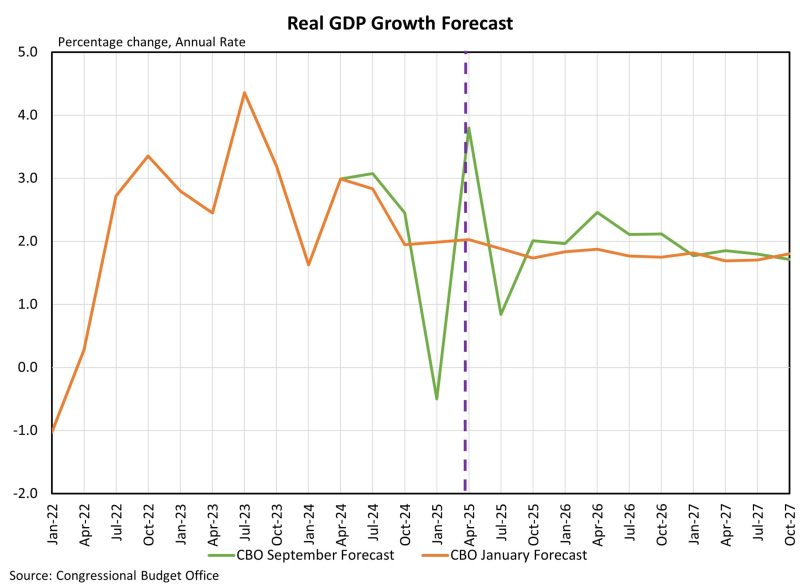
The Congressional Budget Office (CBO) is a key nonpartisan score keeper that measures the effects of policy changes by the Federal Government. With several policy changes since January of this year, including the One Big Beautiful Bill Act (OBBBA), stricter immigration, and higher tariffs, the CBO updated its economic projections through 2028. Primarily, the CBO forecasts higher growth in the coming year with higher deficits also around the corner. The updated CBO view of the economy projects lower GDP growth in 2025 due to negative effects of tariffs. However, this is followed by stronger growth in 2026 as supply chains adjusted to tariffs and the OBBBA boosts consumption and private investment. More growth is forecasted for 2027 and 2028 as the economy adjusts to lower net immigration but is partially offset by higher domestic production because of tariff protection. In the CBO’s analysis: At the end of 2028, the level of real GDP is about 0.1 percent higher than it was in CBO’s January 2025 projections because of the economic effects of the reconciliation act, higher tariffs, and lower net immigration; the effects of interactions among those factors; and adjustments to reflect recently published data. CBO Real GDP Growth Real GDP grew at an annualized rate of 3.8% in the second quarter of 2025, well above the decline of 0.5% estimated in the first quarter of this year. Per the CBO’s revised forecast, the largest increase in the quarterly growth forecast is in the second quarter of 2026. Real GDP growth was previously forecasted at 1.8% but is now forecasted at 2.5%, a 0.7 percentage point increase. The increases in GDP growth are a result of higher household after-tax income (boosts personal consumption), favorable treatment of private investment, and higher Federal Government spending on border security. All these factors boost overall demand, which in turn creates the risk of higher inflation. In the CBO’s assessment, this results in the Federal Reserve lowering interest rates at a slower pace than it might have otherwise done. The CBO GDP growth forecasts for 2027 and 2028 are essentially unchanged from the previous January forecast. On the residential construction front, 2025 has so far been a slower year than expected. In January, the CBO forecasted real residential fixed investment (RFI) to grow above 5% through the start of 2027 with the expectation that interest rates would fall faster, and pent-up demand coupled with a limited supply of existing homes for sale would boost new construction. Instead for 2025, interest rates have in fact remained higher for longer and put a damper on housing construction. RFI has negatively contributed to GDP for the first two quarters of 2025 and contracted 1.3% and 4.7% in the first and second quarters. The CBO’s forecasts show declines in RFI as home building starts entering 2026. The September forecasts are well below previous levels, with none forecasted above 3.0% until the first quarter of 2028. Federal Government Fiscal Outlook While the economy is expected to grow faster under the passage of OBBBA, the Federal Government’s fiscal outlook did not improve. The CBO’s original deficit outlook assumed that the 2017 tax policy changes would expire, leaving many taxpayers facing higher tax payments in 2026 but also reducing the level of annual federal deficits. With the passage of the OBBBA, which continued many of the policies of Tax Cuts and Jobs Act of 2017 and established some new tax policy, annual deficit totals are a total of $3.4 trillion larger over the ten-year budget window than in the prior CBO outlook. Deficits are larger each year after 2025 but more pronounced in years leading up to 2028 as some provisions expire in the years following. The deficit is expected to be smaller by $21.1 billion in 2025 and peak at $602.4 billion larger in 2027. For housing stakeholders, long-term fiscal deficits risk higher inflation and therefore higher interest rates. More government debt means more expensive mortgages and therefore more challenging housing affordability conditions. Discover more from Eye On Housing Subscribe to get the latest posts sent to your email.
Better Growth, Larger Deficits: CBO Fiscal Outlook2025-10-17T08:16:14-05:00

Builders Stay Cautious as Single-Family Permits Weaken

2025-10-15T08:16:46-05:00

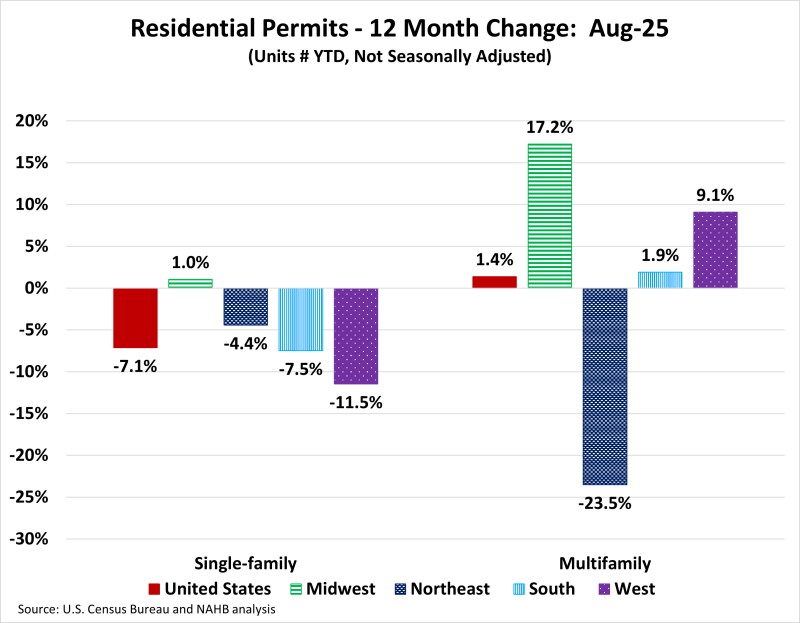
In August, single-family permit activity softened, reflecting caution among developers amid persistent economic headwinds. This trend has been consistent for eight continuous months. On the multifamily front, permitting also cooled in August but remains in the positive territory. While single-family continues to bear the brunt of affordability headwinds, the multifamily space is showing tentative signs of rebalancing. Over the first eight months of 2025, the total number of single-family permits issued year-to-date (YTD) nationwide reached 637,096. On a year-over-year (YoY) basis, this is a decline of 7.1% over the August 2024 level of 685,923. For multifamily, the total number of permits issued nationwide reached 330,617. This is 1.4% higher compared to the August 2024 level of 326,080. HBGI analysis indicates that this growth for multifamily development has been concentrated in lower density areas and among smaller builders. Year-to-date ending in August, single-family permits were up in one out of the four regions. The Midwest posted a minor increase of 1.0%. The Northeast was 4.4% lower, the South was down by 7.5%, and the West was down by 11.5% in single-family permits during this time. For multifamily permits, three out of the four regions posted increases. The Midwest was up by 17.2%, the West was up by 9.1%, and the South was up by 1.9%, Meanwhile, the Northeast declined steeply by 23.5%, driven by the New York-Newark-Jersey City, NY-NJ MSA which declined by 34.0%. Between August 2025 YTD and August 2024 YTD, 12 states posted an increase in single-family permits. The range of increases spanned 21.2% in Hawaii to 2.5% in Indiana. The remaining 38 states and the District of Columbia reported declines in single-family permits with New Mexico reporting the steepest decline of 35.1%. The ten states issuing the highest number of single-family permits combined accounted for 62.5% of the total single-family permits issued. Texas, the state with the highest number of single-family permits, issued 101,850 permits over the first eight months of 2025; this is a decline of 8.2% compared to the same period last year. The second highest state, Florida, decreased by 11.7%, while the third highest, North Carolina, posted a decline of 3.9%. Between August 2025 YTD and August 2024 YTD, 31 states and the District of Columbia recorded growth in multifamily permits, while 19 states recorded a decline. Mississippi (+113.2%) led the way with a sharp rise in multifamily permits from 250 to 533, while Maryland had the largest decline of 45.8% from 4,383 to 2,374. The ten states issuing the highest number of multifamily permits combined accounted for 60.0% of the multifamily permits issued. Over the first eight months of 2025, Florida, the state with the highest number of multifamily permits issued, experienced an increase of 20.0%. Texas, the second-highest state in multifamily permits, saw an increase of 1.5%. California, the third largest multifamily issuing state, increased by 10.1%. At the local level, below are the top ten metro areas that issued the highest number of single-family permits. For multifamily permits, below are the top ten local areas that issued the highest number of permits. Discover more from Eye On Housing Subscribe to get the latest posts sent to your email.
Builders Stay Cautious as Single-Family Permits Weaken2025-10-15T08:16:46-05:00

Custom Home Building Share Declines in 2024

2025-10-14T09:20:26-05:00

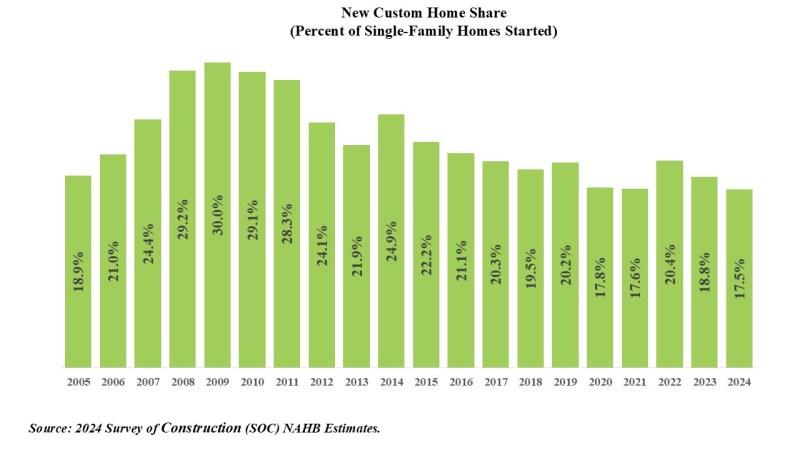
In 2024, 17.5% of all new single-family homes started were custom homes. This share decreased from 18.8% in 2023 and from 20.4% in 2022, according to data tabulated from the Census Bureau’s Survey of Construction (SOC). The custom home market consists of contractor-built and owner-built homes—homes built for owner occupancy on the owner’s land, with either the owner or a builder acting as a general contractor. The alternatives are homes built-for-sale (on the builder’s land, often in subdivisions, with the intention of selling the house and land in one transaction) and homes built-for-rent. In 2024, 73.1% of the single-family homes started were built-for-sale and 9.3% were built-for-rent. At a 17.5% share, the number of custom homes started in 2024 was 176,932, falling from 177,850 in 2023.    Quarterly statistics published by the Census Bureau for the second quarter of 2025 show year-over-year growth for custom home building amid broader single-family home building weakness. Although the quarterly statistics are timelier, they are often revised and lack the geographic detail available in the annual data set.  When analyzed across the nine census divisions, the annual data show that the highest custom home share in 2024 was 41.2% in the New England division. The lowest share was in the West South-Central division at just 10.7%.  Discover more from Eye On Housing Subscribe to get the latest posts sent to your email.
Custom Home Building Share Declines in 20242025-10-14T09:20:26-05:00

Hispanics Comprise Nearly One-Third of the Construction Labor Force 

2025-10-13T09:21:06-05:00

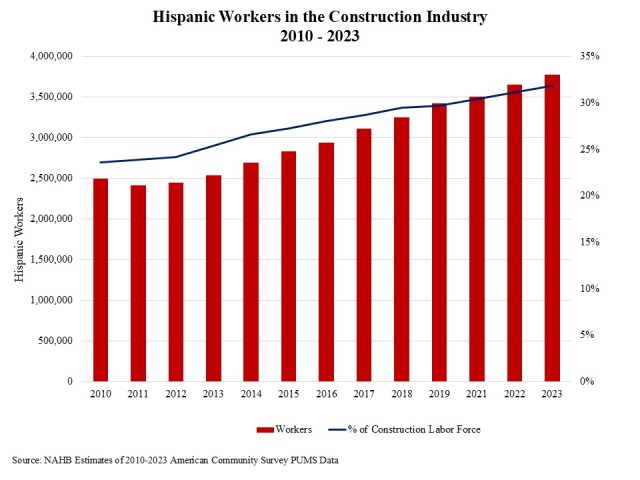
Diversifying the construction labor force remains a key priority amid persistent skilled labor shortages. According to the 2023 American Community Survey, non-Hispanic White workers still account for the majority of the construction industry at 57%. Hispanic workers now represent nearly one-third of the labor force at 32%, followed by non-Hispanic Black workers at 5% and non-Hispanic Asian workers at 1.8%.  The most notable trend in construction labor force has been the steady rise of Hispanic participation. Between 2010 and 2023, the number of Hispanic workers in construction increased from 2.5 million to almost 3.8 million. Over the same period, their share of the labor force climbed from 23.6% to 32%, meaning that nearly one in three construction workers today is Hispanic.  Hispanics workers comprise a larger share in the construction than the broader economy, making up 31.9% of the construction labor force compared with 19.2 % across all industries. Non-Hispanic White workers account for 57.5% of the construction labor force, about the same as their share across all industries at 58.3%. Black and Asian workers, by contrast, remain underrepresented in construction. The share of Hispanic workers varies widely across states. In Maine, only 1% of workers in construction are Hispanic, while in New Mexico, Texas, California, and Nevada, more than half the construction labor force is Hispanic. Overall, Hispanic construction workers are most concentrated in the South and West, where Hispanic populations are larger. Just three states—Texas with 803,000 workers, California with 772,000, and Florida with 374,000—together employ 52% of the nation’s Hispanic construction labor force. New Mexico leads in proportional terms, with 64% of its construction labor force identifying as Hispanic, followed by Texas at 61% and California at 59%.  In the Northeast, the construction industry remains dominated by non-Hispanic White workers. In New Hampshire, Vermont, and Maine, they account for more than 90% of the labor force. Non-Hispanic Black workers make up only 5% of construction labor force nationwide, compared with nearly 12% across all industries, though their shares are much higher in Mississippi at 18%, Louisiana at 17%, and Maryland at 14%. Non-Hispanic Asian workers account for less than 2% of the construction labor force overall, though they are a significant presence in Hawaii, where they comprise 29% of construction labor force. Discover more from Eye On Housing Subscribe to get the latest posts sent to your email.

Hispanics Comprise Nearly One-Third of the Construction Labor Force 2025-10-13T09:21:06-05:00

Vinyl Surpasses Stucco as Most Used Principal Exterior Wall Material 

2025-10-10T10:15:39-05:00

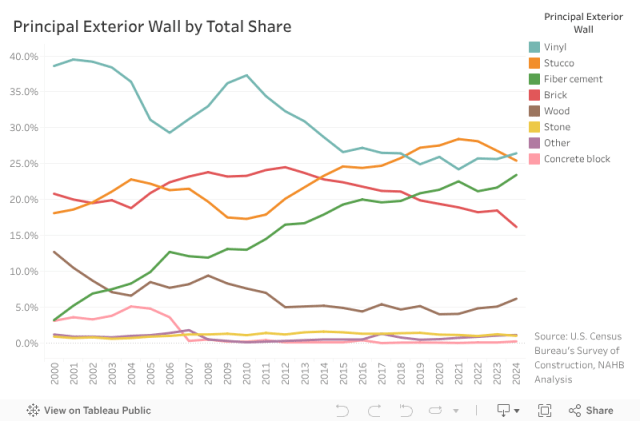
In 2024, vinyl siding was the most used principal exterior wall material for homes started. It holds just over a quarter share of homes, slightly surpassing stucco for the first time since 2018. For homes started in 2024, 26% had vinyl siding (including vinyl-covered aluminium) as their principal exterior wall material, according to the latest annual release of the U.S. Census Bureau’s Survey of Construction (SOC). Vinyl was followed closely by stucco at 25%, and by fiber cement siding (such as Hardiplank or Hardiboard) at 23%. Each of these materials holds about a quarter of the market, with another 16% held by brick or brick veneer. Far smaller shares of single-family homes started last year had wood or wood products (6%), stone, rock or other stone materials (1%), other (1%), or cement blocks (.2%) as the principal exterior wall material.  While vinyl has historically held a much larger share, at highs of almost 40% in 2001, the share fell rapidly between 2010 to 2015 by over 10 percentage points. However, since 2015, this share has remained fairly steady at around 26%. Meanwhile, stucco rose rapidly from 17% in 2010 until recently peaking at 28% in 2021.    However, the strongest trend has been the growing popularity in fiber cement siding. The share of exterior siding material for fiber cement siding has increased by 5.5 percentage points in the last ten years and by more than 15 percentage points in the past 20 years. Also notable is the decline of brick siding, from almost a quarter of homes in 2012, to just 16% in 2024. Although vinyl siding is most popular in the entire U.S., there are substantial differences in the use of siding when you look across geographies. In 2024, vinyl siding was the most used in the Midwest and Northeast regions. More specifically, vinyl siding was used on 73% of the new homes started in New England, 69% in the East North Central, 68% in the Middle Atlantic, and 49% in the West North Central.  Meanwhile, stucco was the most used primary exterior wall material in the Pacific, Mountain, and South Atlantic divisions in 2024 at 64%, 48% and 33%, respectively. Brick or brick veneer was the most common exterior siding material in the East South Central (39%) and West South Central (48%) divisions.  The West South Central division also had a substantially higher share of wood principal exterior homes at 27%.   Discover more from Eye On Housing Subscribe to get the latest posts sent to your email.
Vinyl Surpasses Stucco as Most Used Principal Exterior Wall Material 2025-10-10T10:15:39-05:00

Refinancing Activity Surges in September

2025-10-08T10:21:02-05:00

Refinancing activity surged in September, marking the largest monthly increase since the COVID-era of ultra-low interest rates. This increase followed mortgage rates dropping below 6.5% for the first time since October 2024 in anticipation of rate cuts that ultimately materialized. ­­­ The Mortgage Bankers Association’s (MBA)1 Market Composite Index, a measure of total mortgage application volume, rose 29.7% from August on a seasonally adjusted basis and was 29.6% higher than a year ago, the sharpest monthly gain since 2020. The average contract interest rate for 30-year fixed mortgages fell 27 basis points to 6.42%, the lowest in one year. Amid lower borrowing costs, homeowners seized the opportunity to refinance, driving a 54.2% increase in refinancing activity. Purchase applications also increased 7.7% month-over-month. Compared to a year ago, purchase and refinance applications were up 18.6% and 39.8%, respectively. Lower rates are unlocking activity in the housing market, reflected by these increases in mortgage activity. Alongside the jump in refinancing activity, the average refinance loan size increased 22.3% to $410,000, the largest monthly increase since the MBA began tracking in 2011. These coincided with one another, as homeowners with larger loans were the first to take advantage of these lower rates. Purchase loan sizes also increased 1.6% over the month to $436,000, and adjustable-rate mortgage (ARM) loans increased 4.0% to $984,000. The average loan amount across all loan types increased 9.2% to $423,000. The MBA posts weekly mortgage activity data; this analysis averages the weekly data to a monthly frequency. Discover more from Eye On Housing Subscribe to get the latest posts sent to your email.
Refinancing Activity Surges in September2025-10-08T10:21:02-05:00

Minority-Owned Residential Building Firms Continue to Rise

2025-10-07T08:15:19-05:00

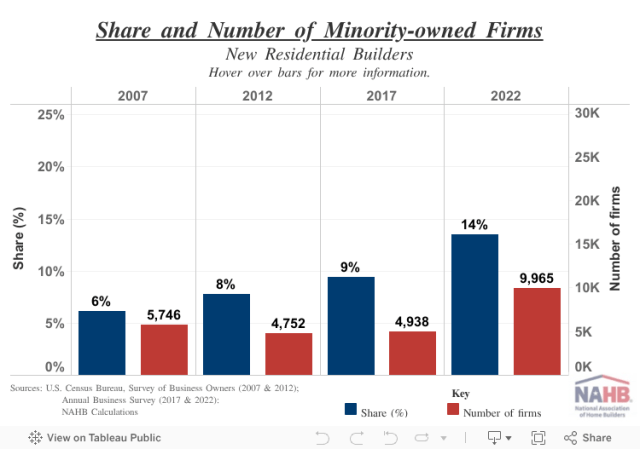
The share of minority-owned new residential builders and remodelers has more than doubled since the Great Recession, with noticeable gains from 2017 to 2022.  Nevertheless, when compared to the overall U.S. population, minority-owned firms continue to be underrepresented within both housing sectors. New Residential Builders Based on data from the Annual Business Survey (ABS) from the U.S. Census Bureau, 14% of new residential building firms1 were minority-owned in 2022.  The Census classifies firms as minority-owned if the owner with majority share (i.e., 51% or more of stock or equity in the business) identifies as “any race and ethnicity combination other than non-Hispanic and White.”  In 2007, when NAHB began tracking this data, only 6% of residential builders were minority-owned2. From 2017 to 2022, the number of minority-owned new residential builder firms increased 64%, from 4,938 to 9,965. Residential Remodelers The share of minority–owned residential remodeling firms3 also continues to rise, more than doubling from 8% in 2007 to 18% in 2022.  From 2017 to 2022, the number of minority-owned residential remodeling firms jumped by 91%, from 11,565 to 22,119. In contrast to the 14% of residential builders and 18% of residential remodelers that were minority-owned in 2022, around 40% of the overall U.S. population that year belonged to a racial minority group4. New residential building firms comprise of new single-family housing construction (NAICS: 236115), new multifamily housing construction (NAICS: 236116), and new housing for-sale builders (NAICS: 236117).Data for 2007 and 2012 within this blog post was taken from the U.S. Census Bureau’s Survey of Business Owners (SBO). The SBO was discontinued in 2012 and replaced by the ABS moving forward.NAICS: 236118Source: U.S. Census Bureau, 2022 American Community Survey. Discover more from Eye On Housing Subscribe to get the latest posts sent to your email.

Minority-Owned Residential Building Firms Continue to Rise2025-10-07T08:15:19-05:00

Shorter Apartment Construction Time in 2024

2025-10-06T09:14:42-05:00

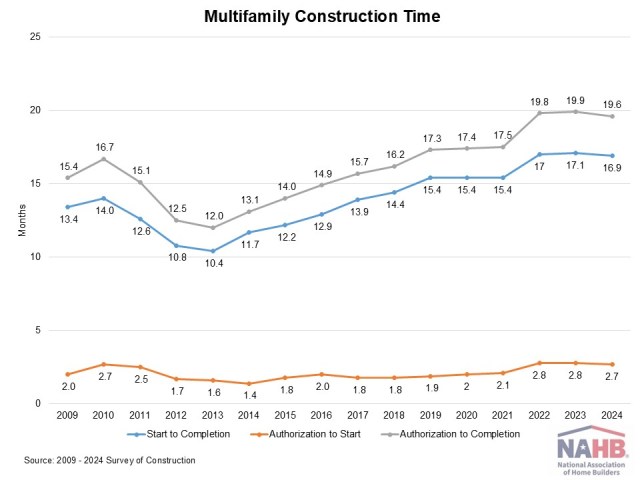
The average time needed to complete construction of a multifamily building after obtaining authorization edged down in 2024, according to the 2024 Survey of Construction (SOC) from the Census Bureau. On average, it took 19.6 months from permit to completion, about 0.3 months shorter than in 2023. While construction timelines remain lengthy, this modest decline occurred despite the industry continuing to grapple with a shortage of skilled labor. The average time to build multifamily homes varies with the number of units in the building. In general, the more units, the longer the construction time. In 2024, buildings with 20 or more units took the longest, 22.1 months, to build after obtaining authorization. By contrast, 2-to-4-unit buildings were finished the fastest, averaging 15.3 months. Mid-sized projects fell in between, with 10-to-19-unit buildings averaging 19.2 months and 5-to-9-unit buildings averaging 19.1 months. Year-over-year changes show a mixed pattern. Completion times for 2-to-4-unit buildings shortened by 2.3 months, while 10-to-19-unit projects took 2.3 months longer. The biggest increase occurred for 5-to-9-unit buildings, which required 2.2 more months to complete than in 2023. The 2024 SOC data also show a significant regional variation in the average construction duration of multifamily buildings. The Northeast had the longest time from authorization to completion at 23.4 months, followed by the West at 19.9 months, and then the South with 18.5 months. The shortest permit-to-completion period happened in the Midwest with 17.3 months. Discover more from Eye On Housing Subscribe to get the latest posts sent to your email.

Shorter Apartment Construction Time in 20242025-10-06T09:14:42-05:00

About My Work

Phasellus non ante ac dui sagittis volutpat. Curabitur a quam nisl. Nam est elit, congue et quam id, laoreet consequat erat. Aenean porta placerat efficitur. Vestibulum et dictum massa, ac finibus turpis.

Recent Works

Recent Posts