

The Fed Cuts amid Partly Cloudy Conditions

2025-10-29T14:19:05-05:00

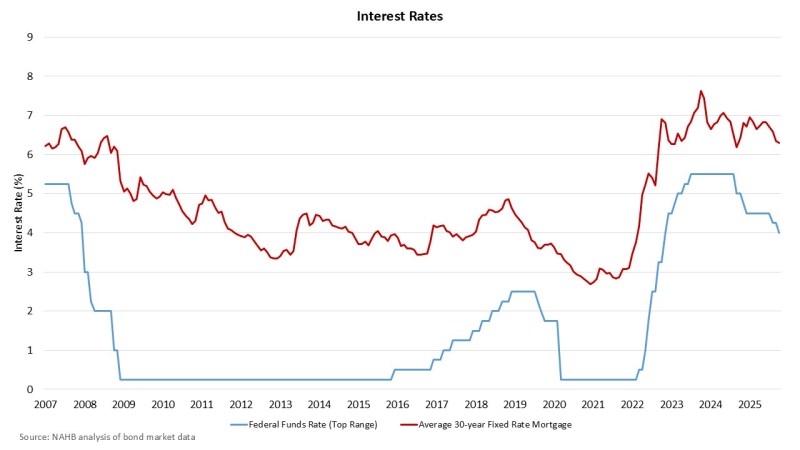
With the government shutdown limiting the quantity of economic data available to markets and policymakers, the central bank’s Federal Open Market Committee (FOMC) enacted a widely anticipated 25 basis point cut for the short-term federal funds rate. This marks the second consecutive cut this Fall, and the move decreases the policy rate to an upper rate of 4.25%. Reflecting that the market anticipated this policy move, long-term rates were relatively unchanged after the FOMC announcement. There were two dissenters to today’s decision, with new Fed Governor Miran voting no (preferring a larger 50 basis point reduction). Kansas City Fed President Schmid also voted no, but wanted no federal funds rate reduction. Chair Powell noted that there were “strongly differing” views at this meeting with respect to December policy action, with a possibility of no further cuts before the end of the year. Commenting on current economic conditions, the FOMC statement noted that “economic activity has been expanding at a moderate pace.” In his press conference, Chair Powell noted that activity in the housing market remains “weak.” As a justification for monetary policy easing, the FOMC stated that “job gains have slowed this year.” On the other side of the policy mandate, the Fed specified that “inflation has moved up since earlier in the year and remains somewhat elevated.” In a nod to some short-term liquidity concerns, the Fed also stated that it will conclude its quantitative tightening (QT) or balance sheet reduction program on December 1st. The Fed’s balance sheet has declined by more than $2.2 trillion during the course of this round of QT. However, the Fed will continue to allow mortgage-backed securities (MBS) to mature but reinvest those funds into Treasuries, which will allow the Fed to reduce net holdings of MBS while holding the size of the total balance sheet relatively constant. The Fed may also, in the future, reduce long-duration holdings in favor or more short-term debt. This presents a mixed view of possible impacts on mortgage interest rates from balance sheet actions. Current macro indicators, limited by data availability, present a cloudy or mixed picture. Layoffs are increasing. The two-year Treasury rate remains below the federal funds rate, suggesting ongoing tight policy. However, inflation remains above the Fed’s 2% target, stock and asset values continue to rise, and there are positive economic expectations from tax changes like expensing for business investment. Tariffs were not mentioned in the today’s statement, although Fed Governor Waller’s view that tariff impacts on domestic prices are likely to be one-off impacts has received more attention among market analysts and monetary policymakers. With respect to housing supply, in contrast to movement for long-term rates, the reduction of the federal funds rate will have a direct, beneficial effect on interest rates for acquisition, development and construction (AD&C) loans, the key financing channel for private builders who build more than 60% of single-family homes. This will reduce lending costs for builders across the nation and enable more attainable supply. Going forward, if labor market conditions continue to weaken, the Fed will continue to ease – at some point. However, future cuts are likely to be more hotly debated given the current rate of inflation. Chair Powell noted that there is “no risk free path for policy” in this kind of environment. Amid bifurcated market signals and economic conditions (particularly with respect to differentiated high income and low income consumer spending patterns), the vote at the December meeting will be contested. And the ongoing lack of data may cause the Fed to move more slowly as a precaution. Discover more from Eye On Housing Subscribe to get the latest posts sent to your email.
The Fed Cuts amid Partly Cloudy Conditions2025-10-29T14:19:05-05:00

Do Consumers Want Two-Story Foyers?

2025-10-29T13:14:24-05:00

Nearly a quarter of new homes were built with a two-story foyer in 2024 — a number that has been trending downward over the past eight years. Though the national decline continued, regional patterns were mixed. See where this feature is hot — and where it's not.

Do Consumers Want Two-Story Foyers?2025-10-29T13:14:24-05:00

Home Price Growth Slows

2025-10-28T11:24:29-05:00

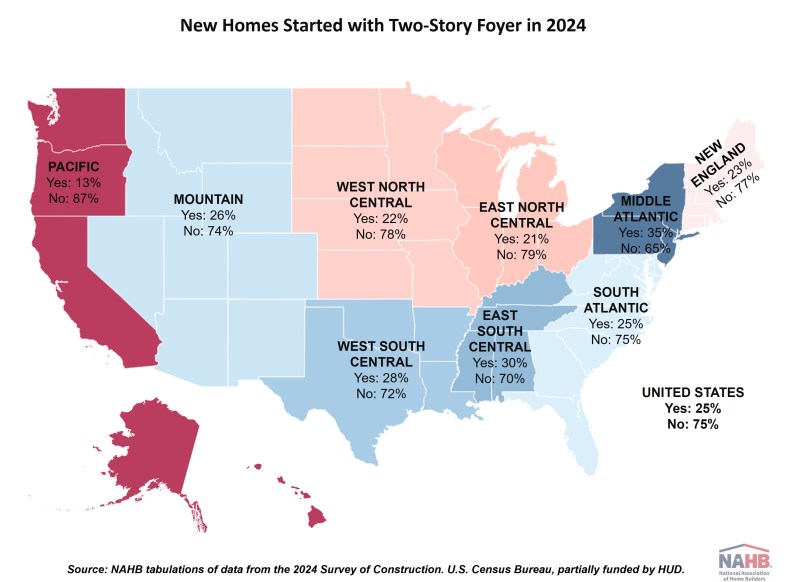
Home prices in August grew at the lowest annual rate in over two years, according to the recent release of the S&P Cotality Case-Shiller Home Price Index (seasonally adjusted – SA). Home prices grew at an annual rate of 1.51%, almost half the rate of inflation. This is well below the recent highs of around 6.5% at the beginning of 2024. On a monthly basis, the index posted a modest increase from July, following five consecutive months of decline. In addition to tracking national home price changes, the S&P Cotality CoreLogic Index (SA) also reports home price indexes across 20 major metro areas. Compared to last year, 11 of 20 metro areas reported a home price increase. There were 7 metro areas that grew more than the national rate of 1.51%. The highest annual rate was New York at 6.08%, followed by Chicago at 5.89% and Cleveland at 4.67%. Tampa fell at the fastest rate of -3.34%, followed by the other Florida metro area, Miami, at -1.69%. Discover more from Eye On Housing Subscribe to get the latest posts sent to your email.
Home Price Growth Slows2025-10-28T11:24:29-05:00

How COVID-19 Reshaped the U.S. Labor Market

2025-10-28T09:15:18-05:00

Between February 2020 and June 2022, the U.S. labor market experienced the deepest downturn and fastest rebound in a century. The global COVID-19 pandemic disrupted the economy, causing an unprecedented shutdown and record job loss across all industries. However, the labor market was still able to recover remarkably quickly, and this rebound continues to shape today’s employment trends and the broader economy.

How COVID-19 Reshaped the U.S. Labor Market2025-10-28T09:15:18-05:00

5 Ways to Get the Most Out of Attending Open Houses

2025-10-28T00:14:09-05:00

If you’re looking for a new home, open houses can assist in your search—even if you don’t like the properties you visit. Here are five steps to take so that you benefit from your time spent. Visit Different Kinds of Properties Do you like the layouts of ranch homes or townhouses better? Will an open floor plan fit with your lifestyle? Seeing a home’s style and features in person can inform what you want in your next property.  Take Notes Whether you visit three or fifteen houses, the details of those properies will blur together. Take notes about what you like and don’t like about a home, and be sure to grab the listing sheet provided by the agent hosting the open house. That will usually feature photos and basic information for easy reference.  Ask Questions The real estate agent is there to help you learn about and love the house. Ask the host about the neighborhood, HVAC system, roof, plumbing—anything that will help you understand what you get at that price point. Remember: You’re doing research to determine what you want to buy. Review Your Findings Soon Don’t wait two weeks to revisit your notes. Carve out time after your tours or the following day to go over every property and its listing sheet. You will start to form an idea of what you want your property to be like.   Don’t Be Afraid to Ask for Help Open houses can expose you to many different properties and narrow your home search. When you’re ready to find the property that meets your newly created requirements, talk to a REALTOR®. A REALTOR® knows your local market and will match you with the perfect property. Find one here. 

5 Ways to Get the Most Out of Attending Open Houses2025-10-28T00:14:09-05:00

Two-Story Foyer Trend Stabilize in 2024

2025-10-27T11:17:19-05:00

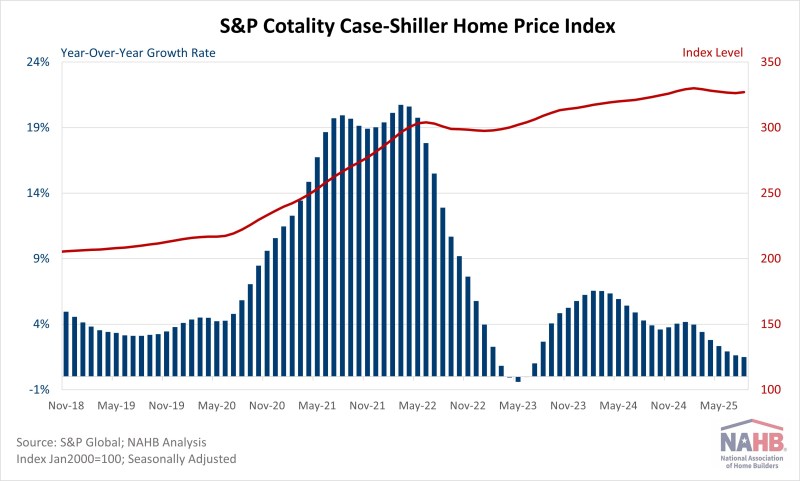
In 2024, nearly a quarter of new homes were built with a two-story foyer, virtually unchanged from 2023, according to data obtained from the Census Bureau’s Survey of Construction (SOC) and tabulated by NAHB. The market share of two-story foyers has been generally trending downward over the past eight years, with most new single-family homes being built without a two-story foyer nationally and regionally.   According to the Census, a two-story foyer is defined as the entranceway inside the front door of a house and has a ceiling that is at the level of the second-floor ceiling. In the United States, the share of new homes with two-story foyers slightly fell from 24.9% to 24.6% in 2024, the lowest level since NAHB began tracking this data in 2017. This feature is often considered energy-inefficient and is seen as undesirable by both builders and buyers. The declining trend is in line with NAHB’s What Home Buyer’s Really Want, in which recent and prospective buyers rated their preference for 18 specialty rooms. The study found that two-story entry foyers was one of the least desired specialty rooms, with 32% buyers likely to reject a potential home with this feature, and only 13% seeing it as an essential/must-have feature. Though the national decline continued, regional patterns were mixed compared to the broader declines seen in 2023. Three of the nine divisions saw a decline in 2024, including the West North Central, West South Central, and Pacific. The West North Central division reversed the notable increase seen in 2023, decreasing from 26.9% to 21.5%. Meanwhile, shares in both the West South Central and Pacific fell to their lowest levels since NAHB began tracking this data in 2017. Meanwhile, shares of two-story foyers rose in the other six divisions. New England rebounded from 17.5% to 23.2%, after declining in 2023. The Middle Atlantic continued its upward trend reaching 35.3%, the highest share since 2017. The East South Central and Mountain divisions also posted solid gains, increasing by 3.6 and 3.5 percentage points respectively. The South Atlantic and East North Central divisions saw modest increases, remaining relatively stable in 2024. Discover more from Eye On Housing Subscribe to get the latest posts sent to your email.

Two-Story Foyer Trend Stabilize in 20242025-10-27T11:17:19-05:00

About My Work

Phasellus non ante ac dui sagittis volutpat. Curabitur a quam nisl. Nam est elit, congue et quam id, laoreet consequat erat. Aenean porta placerat efficitur. Vestibulum et dictum massa, ac finibus turpis.

Recent Works

Recent Posts