

Purchase Activity Slips Despite Lower Mortgage Rates

2025-09-08T11:21:07-05:00

Mortgage application activity increased again in August, supported by lower interest rates. The Mortgage Bankers Association’s (MBA) Market Composite Index, a measure of total mortgage application volume, rose 5.0% from July on a seasonally adjusted basis and was 18.3% higher than a year ago. The average contract interest rate for 30-year fixed mortgages fell 13 basis points to 6.70%, the lowest level since November. Despite the decline, purchase applications slipped 3.0% month-over-month, while refinancing activity rose 15.6%. Compared to August 2024, purchase and refinance applications were up 19.4% and 16.9%, respectively. Loan sizes posted mixed results. The average loan amount across all loan types increased 2.7% to $386,600. Purchase loan sizes edged up 0.1% to $429,200, while the average refinance loan size jumped 11.8% to $334,600. The average size of adjustable-rate mortgage (ARM) loans decreased 1.3% to $957,500 from $945,200. Discover more from Eye On Housing Subscribe to get the latest posts sent to your email.
Purchase Activity Slips Despite Lower Mortgage Rates2025-09-08T11:21:07-05:00

Job Growth Slowed in August

2025-09-05T10:15:54-05:00

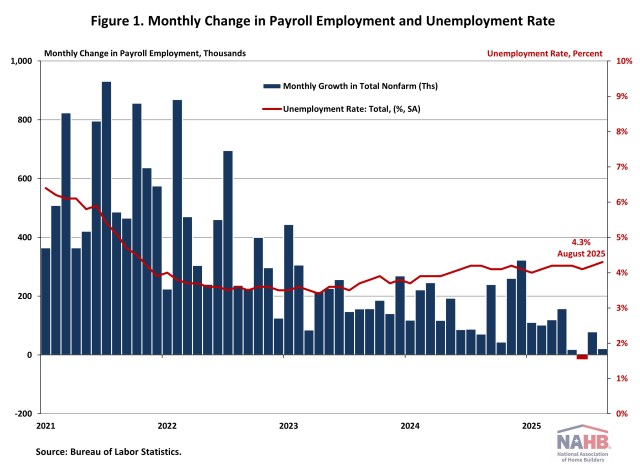
Job growth slowed sharply in August, and the unemployment rate rose to its highest level in nearly four years. The latest jobs report, along with downward revisions to previous months’ data, indicates a continued cooling in the U.S. labor market. This softening trend is likely to increase pressure on the Federal Reserve to consider an interest rate cut at its upcoming September meeting. In August, wage growth slowed. Year-over-year, wages grew at a 3.7% rate, down 0.2 percentage points from the previous month. Despite the deceleration, wage growth has been outpacing inflation for nearly two years, which typically occurs as productivity increases. National Employment According to the Employment Situation Summary reported by the Bureau of Labor Statistics (BLS), total nonfarm payroll employment showed little change in August, with a modest gain of 22,000 jobs. June’s job growth was revised down by 27,000, from an initial estimate of +14,000 to -13,000, making the first negative monthly job growth since January 2010. July’s job growth was revised up by 6,000, from 73,000 to 79,000. Combined, the revisions erased 21,000 jobs from previously reported figures. So far in 2025, monthly job growth has averaged 75,000, a significant slowdown compared to the 168,000 monthly average gain for 2024. The unemployment rate rose to 4.3% in August, its highest level in nearly four years. The August increase in the unemployment rate reflected the increase in the number of persons unemployed (+148,000) and the increase in the number of persons employed (+288,000). Meanwhile, the labor force participation rate—the proportion of the population either looking for a job or already holding a job—edged up by 0.1 percentage points to 62.3%. This remains below its pre-pandemic level of 63.3% recorded at the beginning of 2020. Among prime working-age individuals (aged 25 to 54), the participation rate rose by 0.3 percentage points to 83.7%, the highest level since October 2024. In August, employment continued to trend up in health care (+31,000) and in social assistance (+16,000), while employment in federal government, mining, wholesale trade, and manufacturing sectors experienced job losses. Federal government employment declined by 15,000 jobs in August and has now shed a total of 97,000 positions since peaking in January 2025. The BLS notes that “employees on paid leave or receiving ongoing severance pay are counted as employed in the establishment survey.” Construction Employment Employment in the overall construction sector declined by 7,000 in August, marking the third consecutive month of job losses in the industry. Downward revisions to June and July figures further underscore the sector’s ongoing weakness. Within the industry, residential construction lost 6,100 jobs, while non-residential construction employment declined by 1,200 jobs during the month. Residential construction employment now stands at 3.3 million in August, broken down as 954,000 builders and 2.4 million residential specialty trade contractors. The six-month moving average of job gains for residential construction was -4,783 a month, reflecting the five months of job losses recorded over the past six months, specifically in March, May, June, July, and August of 2025. Over the last 12 months, home builders and remodelers experienced a net loss of 26,100 jobs, marking the fourth annual decline since September 2020. Since the low point following the Great Recession, residential construction has gained 1,345,300 positions. In August, the unemployment rate for construction workers rose to 3.9% on a seasonally adjusted basis. The unemployment rate for construction workers has remained at a relatively lower level, after reaching 15.3% in April 2020 due to the housing demand impact of the COVID-19 pandemic. Discover more from Eye On Housing Subscribe to get the latest posts sent to your email.
Job Growth Slowed in August2025-09-05T10:15:54-05:00

Lots Still in Relatively Short Supply

2025-09-04T11:15:46-05:00

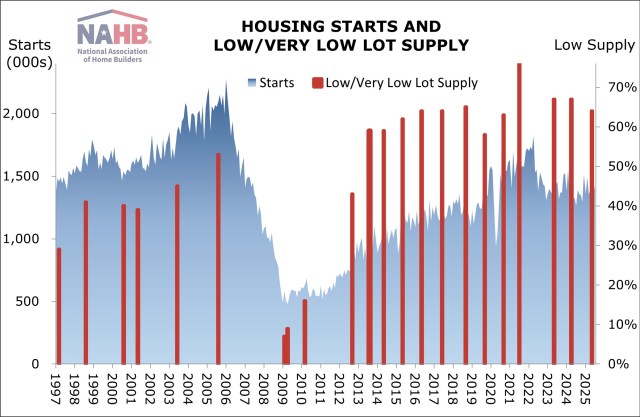
Although shortages are not quite as widespread as they were in 2021, obtaining lots remains a challenge for many builders, according to recent results from the NAHB/Wells Fargo Housing Market Index (HMI) survey.  In special questions on the May 2025 HMI survey, 38% of single-family builders characterized the supply of lots as low, and another 26% said it was very low, for a total of 64% reporting some type of shortage. This is down slightly from the 67% reported in both 2023 and 2024, and down significantly from the peak of 76% in 2021 (a year after the COVID-19 outbreak). Nevertheless, at 64% the shortage percentage is higher than it had been at any time between 1997 (when NAHB first began tracking the number) and 2016. The current lot shortage seems particularly severe relative to the level of new housing production. Before the historic 2009-2010 trough in housing starts, the share of builders reporting a low or very low supply of lots never exceeded 53%—even in 2005 when starts topped 2.0 million.  However, by 2015, when starts had partially recovered (from the trough of under 600,000 to 1.1 million), the share of builders reporting lot shortages unexpectedly climbed to over 60%, and it has remained there stubbornly ever since. Over the past three years, the annual starts rate has been consistently under 1.5 million (approximately the long-run average from 1970 through 2000), while the share of builders reporting a low availability of lots has never dipped below 64%. In addition to overall lot supply, the HMI survey asks builders to rate the supply of A, B and C lots individually. Not surprisingly, shortages tend to be most acute among lots in the most desirable, or “A,” locations. In the May 2025 survey, 67% of builders said that the supply of “A” lots was low or very low, compared to 62% for “B” lots and 52% for “C” lots. None of these percentages were drastically different than they had been in 2024. A shortage of lots is not the only headwind the home building industry is facing. Rising cost of materials, availability of credit for builders, finding enough skilled labor, and inefficient regulatory costs all remain significant issues. An inadequate supply of lots simply adds to the list of challenges making it difficult to build homes, especially at the lower end of the price scale, and adversely impacting housing affordability.  Discover more from Eye On Housing Subscribe to get the latest posts sent to your email.
Lots Still in Relatively Short Supply2025-09-04T11:15:46-05:00

HVAC in New Construction in 2024

2025-09-04T08:16:00-05:00

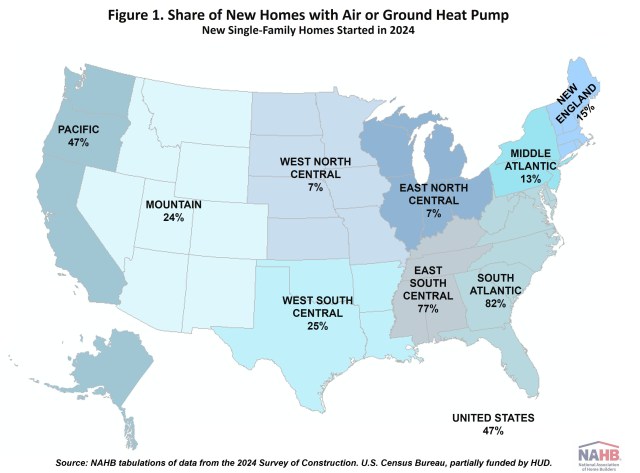
Almost all of new single-family homes started in 2024 used either an air/ground source heat pump or a forced air system for the primary heating equipment (97%), according to the Census’s Survey of Construction. Additionally, 20% percent of homes also used a secondary type of heating equipment.  Heating Systems The type of heating system installed varies significantly by Census Division. Figure 3 displays the share of new homes with an air or ground heat pump in 2024. In warmer regions of the country, these systems are more common with 82% in the South Atlantic and 77% in the East South Central. In colder regions, very few homes have air or ground heat pumps: only 7% of new homes started in both East North Central and West North Central. Forced air systems without heat pumps burn fuel to produce heat, while heat pumps transfer heat by moving air. In colder climates, heat pumps can become less efficient due to limited ambient heat available and rely more heavily on backup heating during winter. In general, the share of new homes using an air or ground source heat pump as the primary means of providing heat has increased, going from 23% in 2000 to 47% in 2024. Meanwhile, the share relying on a forced air system has slipped, going from 71% to 50% in the same time frame. Primary Fuel for Heating The SOC also provides data on the primary fuel used to heat new single-family homes. Approximately 54% of new homes started in 2024 use electricity as the primary heating fuel, compared to 41% powered by natural gas, 3% using bottle or liquified petroleum gas (propane), and 0.1% using oil. Heating fuel sources closely align with the types of heating systems used, with air and ground-source heat pumps running on electricity and most forced air systems without heat pumps using natural gas or propane. Similar to the type of heating system, the primary heating fuel source varies significantly by region of the country. For example, in the Middle Atlantic only 13% of new homes use electricity as the primary heating source. In contrast, 83 percent and 74 percent of new homes started in the South Atlantic and the East South Central used it. Additionally, while most regions fall under 10% in their usage of propane, New England had a 33% share and East North Central had 15%. Air Conditioning In 2024, 98% of new single-family homes started had a central AC system, virtually unchanged from 2023. This percentage has risen steadily since 2000 when only 85.5% of homes had  central AC. Though the share of new single-family homes started with central AC differs across the country’s nine Census divisions, the highest share is concentrated in the South region: 100% of homes started in the South Atlantic, East South Central, and West South Central divisions had central AC installed. Other regions also have shares close to 100%, ranging from 93% in East North Central to 99% in West North Central. New England has the lowest share at 85%. Discover more from Eye On Housing Subscribe to get the latest posts sent to your email.
HVAC in New Construction in 20242025-09-04T08:16:00-05:00

Open Construction Jobs Rise in July

2025-09-03T12:15:52-05:00

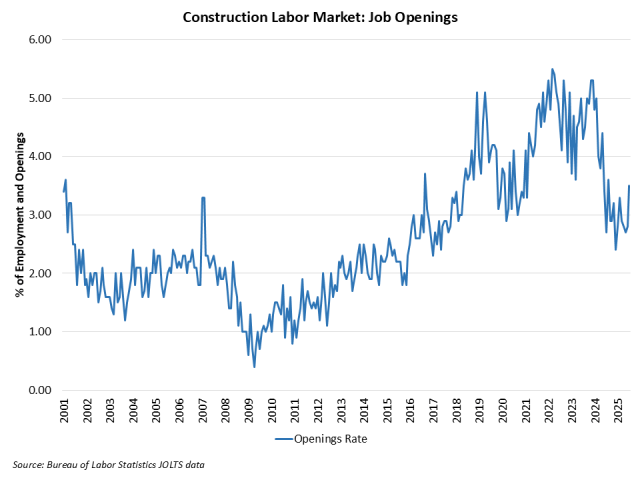
The count of open, unfilled positions in the construction industry increased in July, per the June Bureau of Labor Statistics Job Openings and Labor Turnover Survey (JOLTS) as the national labor market cooled. The number of open jobs for the overall economy decreased from 7.36 million in June to 7.18 million in July. The July reading was notably lower than the 7.50 million estimate from a year ago and reflects an overall cooling of the U.S employment market. Previous NAHB analysis indicated that this number had to fall below 8 million on a sustained basis for the Federal Reserve to move forward on interest rate reductions. With estimates remaining below 8 million for national job openings, the Fed, in theory, should be able to cut further despite a recent pause. There is growing pressure on the Fed to do so. Running counter to the national trend, the number of open construction sector jobs increased from a revised 242,000 level in June to 306,000 in July. This marks an increase of open, unfilled construction jobs than that registered a year ago (229,000). The chart below notes the declining trend that has been in place since the Fed raises the federal funds rate but with the recent uptick for unfilled positions in construction. The construction job openings rate increased to 3.5% in July, higher than the 2.7% estimated a year ago. The layoff rate in construction increased to 2.8% in July, the highest rate since March 2023. The quits rate declined to 0.9% in July, the lowest recorded for the construction sector (data starts in 2000). The construction market appears to have experienced considerable churn in July, with job openings rising, quits very low, and layoffs increasing. Future data will allow for identifying trends. Discover more from Eye On Housing Subscribe to get the latest posts sent to your email.
Open Construction Jobs Rise in July2025-09-03T12:15:52-05:00

House Price Appreciation by State and Metro Area: Second Quarter 2025

2025-09-03T10:21:20-05:00

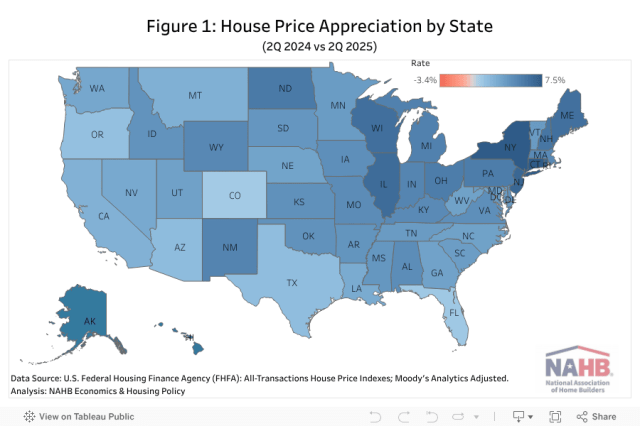
House price growth continued to slow in the second quarter of 2025, as the housing market faces mounting pressure from high mortgage rates, elevated inventory, and persistent economic uncertainty. After years of rapid growth, the District of Columbia and 27 metro areas recorded modest house price declines during this quarter, highlighting the regional variations in market performance. Nationally, according to the quarterly all-transactions House Price Index (HPI) released by the Federal Housing Finance Agency (FHFA), U.S. house prices rose 3.8% in the second quarter of 2025, compared to the second quarter of 2024. This marks the slowest year-over-year increase since 2013, indicating the broader market cooldown following a decade of robust gains. The FHFA’s all-transactions HPI tracks average price changes based on repeat sales and refinancings of the same single-family properties. It offers insights not only at the national level but also across states and metropolitan areas. Between the second quarter of 2024 and the second quarter of 2025, all 50 states experienced positive year-over-year (YoY) house price appreciation, ranging from 0.9% to 7.5%. In contrast, the District of Columbia saw a 3.4% decline in house prices. Connecticut and New York led the nation with a 7.5% gain each, followed by Rhode Island with a 6.9% gain. On the opposite end, Colorado recorded the lowest house price appreciation at 0.9%. Out of all 50 states and the District of Columbia, 30 states exceeded the national YoY growth rate of 3.8%. However, on a quarterly basis, home price appreciation decelerated in 44 states and the District of Columbia compared to the first quarter of 2025, highlighting a broad-based deceleration in the housing market. House price growth widely varied across U.S. metro areas year-over-year, ranging from -7.4% to +18.1%. Punta Gorda, FL recorded the largest decline in house prices, whereas Sumter, SC posted the highest increase over the previous four quarters. In the second quarter of 2025, 27 metro areas, in reddish color on the map above, experienced negative house price growth. Meanwhile, 359 metro areas experienced price increases. Since the onset of the COVID-19 pandemic, house prices have surged nationally. Between the first quarter of 2020 and the second quarter of 2025, house prices rose by 54.6% nationwide. More than half of metro areas outpaced this national price growth rate of 54.6%. The table below highlights the top ten and bottom ten markets for house price appreciation during this five-year period. Among all the metro areas, house price appreciation ranged from 11.4% to 87.8%. Morristown, TN led the nation with the highest house price appreciation. Lake Charles, LA recorded the lowest appreciation, marking its fifth consecutive quarter at the bottom. Discover more from Eye On Housing Subscribe to get the latest posts sent to your email.
House Price Appreciation by State and Metro Area: Second Quarter 20252025-09-03T10:21:20-05:00

June Private Residential Construction Spending Edges Higher 

2025-09-02T11:15:45-05:00

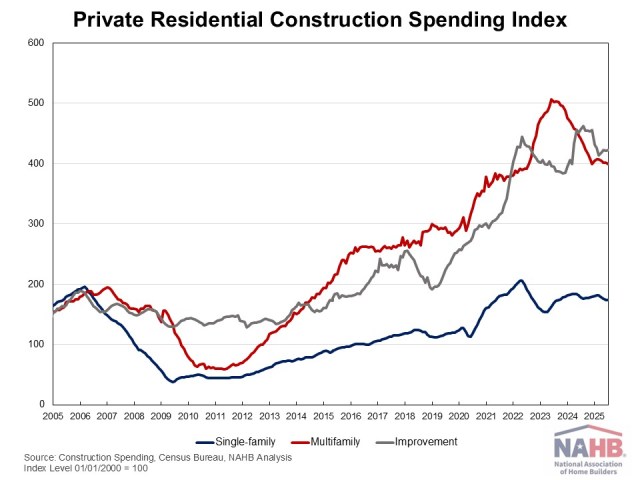
Private residential construction spending inched up 0.1% in June, registering the first monthly gain after six consecutive declines. This modest increase was primarily driven by more spending on single-family construction and home improvements. Despite this increase, total spending was 5.3% lower than a year ago, as the housing sector continues to navigate the economic uncertainty stemming from ongoing tariff concerns and elevated mortgage rates.  According to the latest U.S. Census Construction Spending data, single-family construction spending edged up 0.1% in June, in line with the slight improvement reflected in the July NAHB/Wells Fargo Housing Market Index (HMI). Compared to a year ago, single-family construction spending decreased by 2.1%. Improvement spending (remodeling) was up 0.1% for the month but remained 7.6% lower than in June 2024. Meanwhile, multifamily construction spending slipped 0.4% in June, continuing the downward trend that began in mid-2023. Compared to a year earlier, multifamily spending was down 9.4%.   The NAHB construction spending index is shown in the graph below. The index illustrates how   spending on single-family construction has slowed since early 2024 under the pressure of elevated interest rates and concerns over building material tariffs. Multifamily construction spending growth has also slowed down after the peak in July 2023. Improvement spending has also been weakening since the beginning of 2025. Spending on private nonresidential construction was down 3.7% over a year ago. The annual private nonresidential spending decrease was primarily driven by a $16 billion drop in commercial construction spending, followed by a $12.2 billion decrease in commercial construction spending.   Discover more from Eye On Housing Subscribe to get the latest posts sent to your email.

June Private Residential Construction Spending Edges Higher 2025-09-02T11:15:45-05:00

NAHB HBGI:  Relative Gains for Smaller Markets, Particularly for Multifamily

2025-09-02T09:21:24-05:00

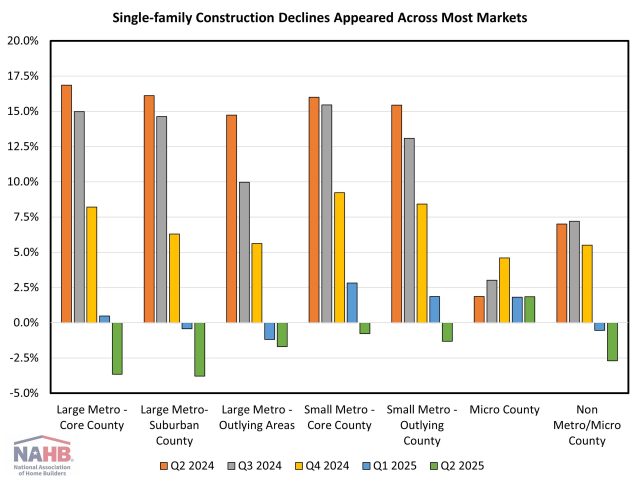
Single-family construction declined in the second quarter of 2025 for almost all tracked markets, according to the NAHB Home Building Geography Index (HBGI). Meanwhile, multifamily construction continued to expand in low population density markets, which have shown remarkable strength due to for-sale affordability challenges. The HBGI tracks single-family and multifamily permits across seven population density delineated geographies in the United States. Single-Family Home Building Among the HBGI markets, growth in the second quarter of 2025 was only registered in micro counties, which increased 1.8% year-over-year on a four-quarter moving average basis (4QMA). Most markets reported declines, with the largest occurring in large metro suburban counties, posting a decline of 3.8%. The drop in growth across the markets remains high, as five markets had single-family growth near 15% just one year ago. In terms of market share, single-family construction’s largest geography was small metro core county areas, representing 29.3% of single-family construction. The smallest single-family construction market remained non metro/micro county areas, with a 4.3% market share. As the largest declines in single-family construction over the past year occurred in large metro areas, smaller population and less densely populated counties have gained single-family construction market share. The combined market share of these smaller areas (excluding large metro areas), reached its highest level since the first quarter of 2023 (50.3%), marking 50.2% in the second quarter. Multifamily Home Building The largest gains for multifamily construction occurred in small metro outlying counties, growing 22.1% (4QMA) in the second quarter. This was the first time that small metro outlying counties had the largest gain among geographies since the second quarter of 2022, when it rose 29.6%. The largest decline was in large metro core counties declining 12.3%. The market share of multifamily construction for smaller markets has continued to climb since the pandemic. The loss in market share for large metro core counties, which continues to make up the bulk of multifamily construction, has mostly been absorbed by small metro core counties. The market share for small metro core counties is up 4.3 percentage points from the first quarter of 2020 to 24.9%. If this trend continues, small metro core counties could overtake large metro suburban counties for the second highest market share in the multifamily construction market as the gap between the two continues to shrink. The second quarter of 2025 HBGI data along with an interactive HBGI map can be found at http://nahb.org/hbgi. Discover more from Eye On Housing Subscribe to get the latest posts sent to your email.

NAHB HBGI:  Relative Gains for Smaller Markets, Particularly for Multifamily2025-09-02T09:21:24-05:00

About My Work

Phasellus non ante ac dui sagittis volutpat. Curabitur a quam nisl. Nam est elit, congue et quam id, laoreet consequat erat. Aenean porta placerat efficitur. Vestibulum et dictum massa, ac finibus turpis.

Recent Works

Recent Posts