
Who are NAHB Associate Members?

2025-09-19T08:19:23-05:00

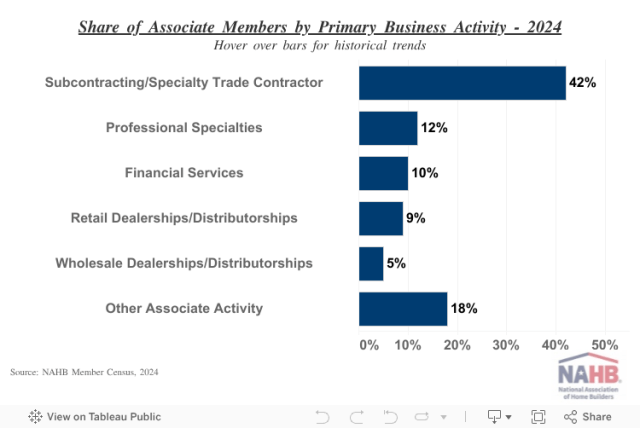
Every year since 2008, the NAHB has conducted a member census in order to better understand the composition and characteristics of the people who belong to its organization.  Similar to a previous post about builder members, NAHB conducted a related analysis of its associate members.  In 2024, 65% of NAHB’s members were associate members—those involved in a wide range of support industries and professions including, among others, trade contractors, manufacturers, retailers/distributors, designers, and architects. Of the 71,170 associate members, 42% are primarily subcontractor/specialty trade contractors, 12% have a professional specialty, 10% are in financial services, 9% are retail dealerships or distributorships, 5% are wholesale dealerships or distributorships, and the remaining 18% have some other type of primary activity. In 2024, associate members had a median of 12 employees on payroll, which has been unchanged since 2022.  Twenty-three percent of associate members had 1-4 employees, 19% had 5 to 9, 37% (plurality) had 10 to 49, and 19% had 50 or more employees.  Two percent had no payroll at all. The median revenue of NAHB associate members was $3.02 million in 2024, a slight increase from $3.00 million in 2023 and the highest in the 17-year history of the Census. In 2024, the median age of NAHB associate members was 56 which has remained constant since 2022.  Four percent of associate members were less than 35 years old, 16% were 35 to 44, 25% were 45 to 54, 34% (plurality) were 55 to 64, and 20% were 65 or older.  The share of associate members who identify as female stands at 25%, up one percentage point from 2023. For more details about NAHB associate members and a profile of each type of member, please visit housingeconomics.com or click here for the full article. Discover more from Eye On Housing Subscribe to get the latest posts sent to your email.
Who are NAHB Associate Members?2025-09-19T08:19:23-05:00

Women in Construction Reach Highest Share in Two Decades

2025-09-18T09:14:54-05:00

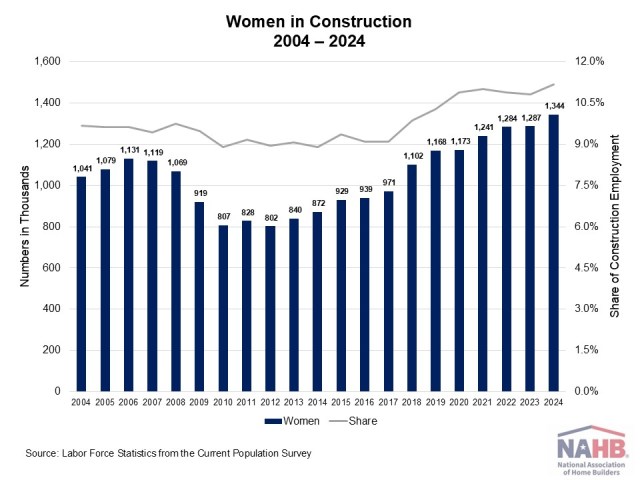
In 2024, the number of women employed in the construction industry rose to around 1.34 million. Women now represent 11.2% of the construction workforce, the highest share in the past 20 years.  This rise aligns with the growing presence of white-collar jobs in the industry. As the industry continues to face a persistent shortage of skilled labor, expanding the workforce remains one of the top priorities of the industry. Increasing the participation of women into the construction labor force represents a potential opportunity for future growth. This article examines the role of women in construction using labor force statistics from the Current Population Survey (CPS). The Great Recession brought a sharp contraction in the number of women working in construction, dropping by nearly 30% to 807,000 by 2010. From 2010 to 2017, the number gradually rose to around 970,000 but remained below the peak of pre-recession levels. In recent years, however, growth has accelerated, with the number of women in construction reaching a record of 1.34 million in 2024. Currently,  women make up 11.2% of the construction workforce. According to the CPS data, most women in the construction industry are employed in occupations such as office and administrative support, management, and business and financial operations. Sales and office occupations employed the highest number of women within the construction industry, with women making up 65.7% of these workers.  This includes 437,000 women in office and administrative support, and 39,000 in sales and related occupations.. Additionally, about 521,000 women held roles in management, professional, and related occupations, though they only took up 18% of all management positions. While construction and maintenance occupations account for the largest number of employees in construction and are where additional workers are most needed, women comprise only 4% (307,000) of such occupations. Additional steps should be taken to attract female workers into these high-demand occupations. Other occupation groups within the industry such as production, transportation, and material moving occupations, and service occupations employed only around 22,000 female workers. Discover more from Eye On Housing Subscribe to get the latest posts sent to your email.

Women in Construction Reach Highest Share in Two Decades2025-09-18T09:14:54-05:00

The Fed Cuts and Projects More Easing to Come

2025-09-17T15:15:58-05:00

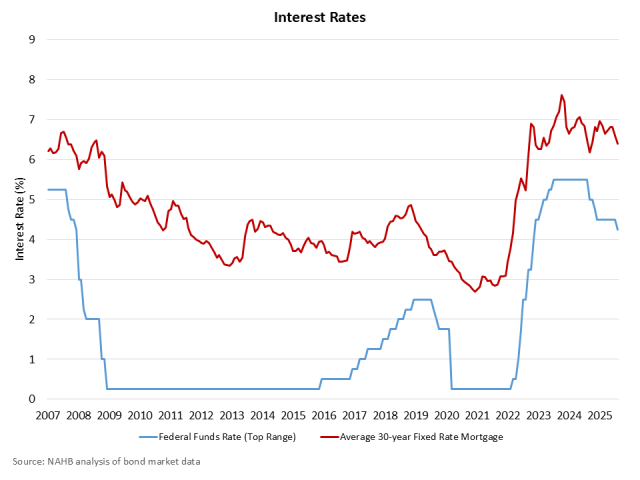
After a monetary policy pause that began at the start of 2025, the Federal Reserve’s monetary policy committee (FOMC) voted to reduce the short-term federal funds rate by 25 basis points at the conclusion of its September meeting. This move decreased the target federal funds rate to an upper rate of 4.25%. Economically, the cut is justified given signs of a softening labor market and moderate inflation readings. However, Chair Powell characterized today’s easing as a “risk management cut,” rather than one driven by fundamental changes in the economic outlook. NAHB is forecasting another 75 basis points of easing in the coming quarters, with 25 of that total coming before the end of the calendar year. The Fed announced no changes to its ongoing balance sheet reduction policy. While the Fed is easing on the short-end of the yield curve, the ongoing quantitative tightening (QT) program is still exerting upward pressure on mortgage interest rates and is partially responsible for the elevated spread of mortgage rates over the 10-year Treasury rate. The Fed’s balance sheet has contracted from almost $9 trillion in May 2022 to $6.6 trillion in September. A hypothetical slowing of QT for mortgage-backed securities would reduce mortgage interest rates, perhaps by 25 basis points. The Fed summarized current economic conditions as follows: “Recent indicators suggest that growth of economic activity moderated in the first half of the year. Job gains have slowed, and the unemployment rate has edged up but remains low. Inflation has moved up and remains somewhat elevated.” The FOMC statement also indicated that uncertainty about the outlook remains “elevated.” Given the size of recent employment revisions, it might be worth noting that both the outlook and some of the current data reporting is uncertain. Chair Powell noted in his press conference that activity in the housing market remains “weak,” consistent with recent data for the home building sector. He also noted that “housing was at the center monetary policy.” Powell once again noted that a housing shortage exists that lies beyond monetary policy, alluding to the challenges builders face from issues like regulatory cost burdens. The September FOMC policy decision was expected by markets, given recent communication from the Fed, including Chair Powell’s remarks at the Jackson Hole monetary policy conference. For this reason, much of the effect of today’s decision was already priced into long-term interest rates, including a decline for the average of the 30-year fixed rate mortgage. This rate has declined by 20 basis points to 6.35% over the last month, per Freddie Mac. In fact, the 10-year Treasury rate barely moved in response to today’s announcement. A growing risk for long-term rates, including mortgage rates, comes from federal government debt and deficits. In contrast to movement for long-term rates, the reduction of the federal funds rate will have a direct, beneficial effect on interest rates for acquisition, development and construction loans, the key financing channel for private builders who build more than 60% of single-family homes. This will reduce lending costs for builders across the nation and enable more attainable supply. There was considerably more internal drama entering today’s FOMC decision. Besides marking a resumption of Fed easing, today’s meeting featured newly installed Fed Governor Stephen Miran and the participation of embattled Governor Lisa Cook. It is worth noting that Miran was the only dissenter at today’s meeting. Instead of voting for a 25-basis point cut, Miran preferred a 50-basis point reduction. That said, today’s decision featured less division among the FOMC voting members than some analysts expected, which is a positive with respect to the Fed’s independence. A revised Summary of Economic Projections (SEP) was also published today. The SEP provides a view of Fed Governors’ and Federal Reserve Bank Presidents’ outlook for economic conditions, inflation expectations and future monetary policy actions (only 12 of the 19 SEP respondents are voting members at each meeting). While there was little dissension in today’s FOMC policy decision, the SEP reveals considerable disagreement for the outlook. Seven SEP respondents projected no additional cuts for the remainder of the year. Twelve projected more cuts. The median projection suggests two more rate cuts for 2025. One respondent, most likely Governor Miran, provided an outlook of five more 25 basis point cuts before the end of 2025. On a median basis, the Fed sees weaker economic growth ahead. The SEP reports a 1.6% GDP growth rate (measuring the 4th quarter to 4th quarter change) for 2025, 1.8% in 2026 and 1.9% in 2027. The SEP projection reports only small increase in the unemployment rate, with a peak rate ahead of 4.5% ahead. For the median SEP respondent, the economy is not seen as reaching the target 2% core CPE inflation rate until 2028. It is worth noting that prior editions of the SEP also saw this target as effectively two years away. Nonetheless, while taking longer than previously expected, the otherwise declining trend for expected inflation in the years ahead suggests the Fed sees any possible tariff effects on inflation will be one-off or otherwise limited, as Governor Waller in particular has explained. Overall, today’s decision was widely expected. Much of the benefit of today’s easing was already priced into long-term interest rates, but the rate cut will benefit business loan finance conditions. Further, additional rate cuts lie ahead, although as Chair Powell noted, “policy is not on a pre-set course.” Future Fed actions will depend on incoming data and the evolving policy environment. Discover more from Eye On Housing Subscribe to get the latest posts sent to your email.

The Fed Cuts and Projects More Easing to Come2025-09-17T15:15:58-05:00

Shelter Inflation Continued to Cool

2025-09-15T11:18:35-05:00

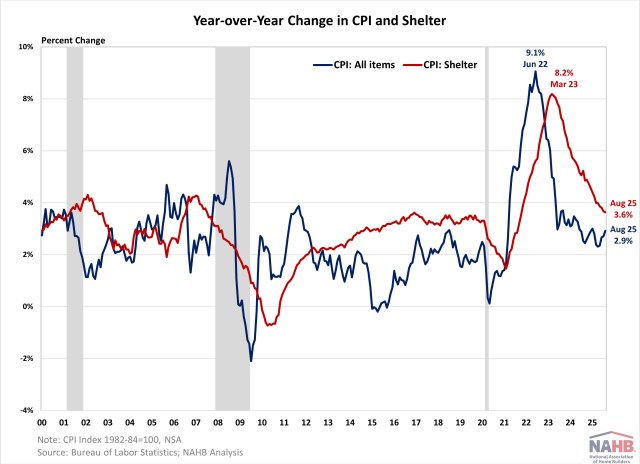
Inflation accelerated to a seven month high in August as tariff-related costs continued to pass through to consumers, according to the Bureau of Labor Statistics’ (BLS) latest report. Core goods prices, which exclude volatile food and energy, rose by 1.5% in August, the fastest annual pace since May 2023. Meanwhile, housing inflation continued to show signs of cooling, matching the lowest level since October 2021. Though inflation is likely to remain elevated this year, the Fed is expected to restart easing due to recent weaker job reports. Given the housing market’s sensitivity to interest rates, this could help ease the affordability crisis and support housing supply even as builders continue to face supply chain challenges. During the past twelve months, on a non-seasonally adjusted basis, the Consumer Price Index rose by 2.9% in August, the highest reading since January 2025. Excluding the volatile food and energy components, the “core” CPI increased by 3.1% over the past twelve months. A large portion of the “core” CPI is the housing shelter index, which increased 3.6% over the year, the lowest reading since October 2021.  Meanwhile, the component index of food rose by 3.2%, and the energy component index increased by 0.2%. On a monthly basis, the CPI rose by 0.4% in August (seasonally adjusted), after a 0.2% increase in July. The “core” CPI increased by 0.3% in August, unchanged from July. The price index for a broad set of energy sources rose by 0.7% in August, with declines in natural gas (-1.6%) and fuel oil (-0.3%) offset by increases in gasoline (+1.9%) and electricity (+0.2%). Meanwhile, the food index rose by 0.5% in August, after being unchanged in July. The index for food away from home increased by 0.3%, while the index for food at home fell by 0.6%. The index for shelter (+0.4%) continued to be the largest contributor to the monthly increase in all items index. Other top contributors that rose in August include indexes for airline fares (+5.9%), used cars and trucks (+1.0%), apparel (+0.5%) as well as new vehicles (+0.3%). Meanwhile, the index for medical care (-0.2%), recreation (-0.1%) and communication (-0.1%) were among the few major indexes that decreased over the month. The index for shelter makes up more than 40% of the “core” CPI, rising by 0.4% in August, following a 0.2% increase last month. The index for owners’ equivalent rent (OER) rose by 0.4% and index for rent of primary residence (RPR) increased by 0.3% over the month. Despite the moderation, shelter costs remained the largest contributors to headline inflation.  NAHB constructs a “real” rent index to indicate whether inflation in rents is faster or slower than core inflation. It provides insight into the supply and demand conditions for rental housing. When inflation in rents is rising faster than core inflation, the real rent index rises and vice versa. The real rent index is calculated by dividing the price index for rent by the core CPI (to exclude the volatile food and energy components). In August, the Real Rent Index remained unchanged. Over the first eight months of 2025, the average monthly growth rate remained flat at 0.0%, slower than the average of 0.1% in 2024. Discover more from Eye On Housing Subscribe to get the latest posts sent to your email.

Shelter Inflation Continued to Cool2025-09-15T11:18:35-05:00

Builders Stay Cautious as Single-Family Permits Extend Downtrend

2025-09-15T09:16:49-05:00

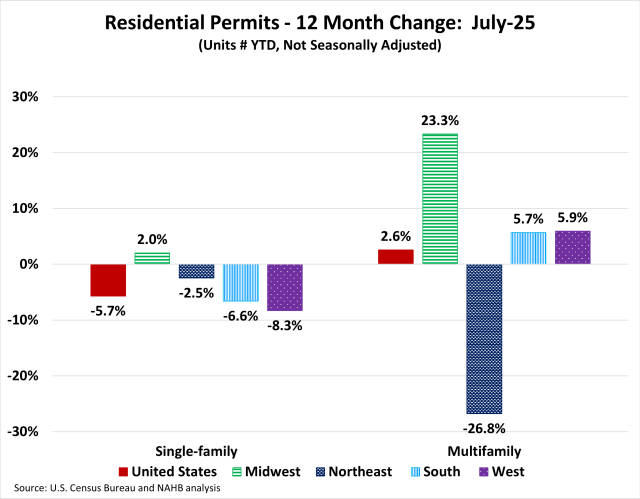
Single-family housing permits slipped for the seventh month in a row, highlighting affordability headwinds and weak demand. While multifamily permits ticked up, the sector’s volatility leaves the outlook uncertain. The split underscores a housing market still under strain, with single-family softness weighing on broader growth prospects. Over the first seven months of 2025, the total number of single-family permits issued year-to-date (YTD) nationwide reached 565,208. On a year-over-year (YoY) basis, this is a decline of 5.7% over the July 2024 level of 599,308. For multifamily, the total number of permits issued nationwide reached 286,836. This is 2.6% higher compared to the July 2024 level of 279,618. Year-to-date ending in July, single-family permits were up in one out of the four regions. The Midwest posted a small increase of 2.0%. The Northeast was 2.5% lower, the South was down by 6.6%, and the West was down by 8.3% in single-family permits during this time. For multifamily permits, three out of the four regions posted increases. The Midwest was up by 23.3%, the West was up by 5.9%, and the South was up by 5.7%, Meanwhile, the Northeast declined steeply by 26.8%, driven by the New York-Newark-Jersey City, NY-NJ MSA which declined by 38.0%. Between July 2025 YTD and July 2024 YTD, 16 states posted an increase in single-family permits. The range of increases spanned 18.1% in Hawaii to 0.5% in New Jersey. The remaining 34 states and the District of Columbia reported declines in single-family permits with the District of Columbia reporting the steepest decline of 28.8%. The ten states issuing the highest number of single-family permits combined accounted for 62.8% of the total single-family permits issued. Texas, the state with the highest number of single-family permits, issued 90,561 permits over the first seven months of 2025; this is a decline of 7.2% compared to the same period last year. The second highest state, Florida, decreased by 11.9%, while the third highest, North Carolina, posted a decline of 2.2%. Between July 2025 YTD and July 2024 YTD, 29 states recorded growth in multifamily permits, while 21 states and the District of Columbia recorded a decline. Mississippi (+97.3%) led the way with a sharp rise in multifamily permits from 222 to 438, while Wyoming had the largest decline of 53.1% from 196 to 92. The ten states issuing the highest number of multifamily permits combined accounted for 61.6% of the multifamily permits issued. Over the first seven months of 2025, Florida, the state with the highest number of multifamily permits issued, experienced an increase of 23.8%. Texas, the second-highest state in multifamily permits, saw an increase of 10.9%. California, the third largest multifamily issuing state, increased by 5.8%. At the local level, below are the top ten metro areas that issued the highest number of single-family permits. For multifamily permits, below are the top ten local areas that issued the highest number of permits. Discover more from Eye On Housing Subscribe to get the latest posts sent to your email.

Builders Stay Cautious as Single-Family Permits Extend Downtrend2025-09-15T09:16:49-05:00

Household Real Estate Asset Values Reach New High

2025-09-12T09:15:06-05:00

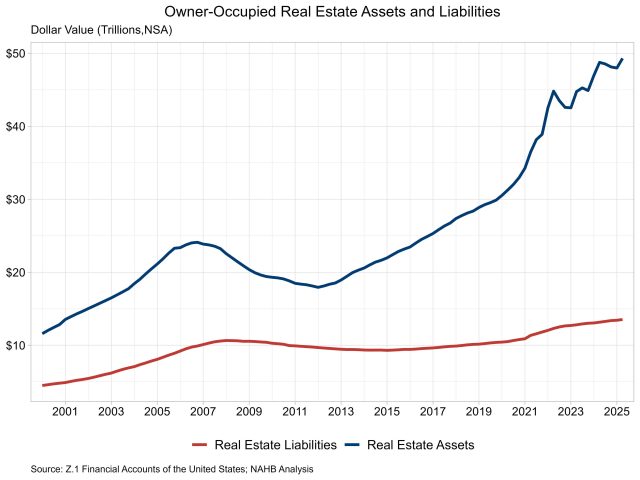
The market value of household real estate assets rose to $49.3 trillion in the second quarter of 2025, according to the most recent release of U.S. Federal Reserve Z.1 Financial Accounts. The value rose by 2.7% from the first quarter and is 1.1% higher than a year ago. This measure of market value estimates the value of all owner-occupied real estate nationwide. The calculation combines both repeat-home sales data with estimates of additions to the housing stock, essentially measuring both price changes and the change in quantity of housing assets. This approach helps explain why household real estate wealth can continue to rise even as other measures may show a slowing in home price growth. Real estate secured liabilities of households’ balance sheets, i.e. mortgages, home equity loans, and HELOCs, increased 0.8% over the second quarter to $13.5 trillion. This level is 2.8% higher compared to the second quarter of 2024. Owners’ equity share1 of real estate assets was 72.6% in the second quarter, marking an increase in owners’ equity share from the first quarter. The share in the second quarter of 2024 was 73.0% and has been above 70% for 14 consecutive quarters, the longest stretch since the 1950s. Owners’ equity in real estate was $35.8 trillion in the second quarter. Owners’ equity as a percentage of household real estate; Difference between assets and liabilities as a share of assets Discover more from Eye On Housing Subscribe to get the latest posts sent to your email.

Household Real Estate Asset Values Reach New High2025-09-12T09:15:06-05:00

Parking Trends in Newly Completed Single-Family Homes, 2024

2025-09-11T08:17:15-05:00

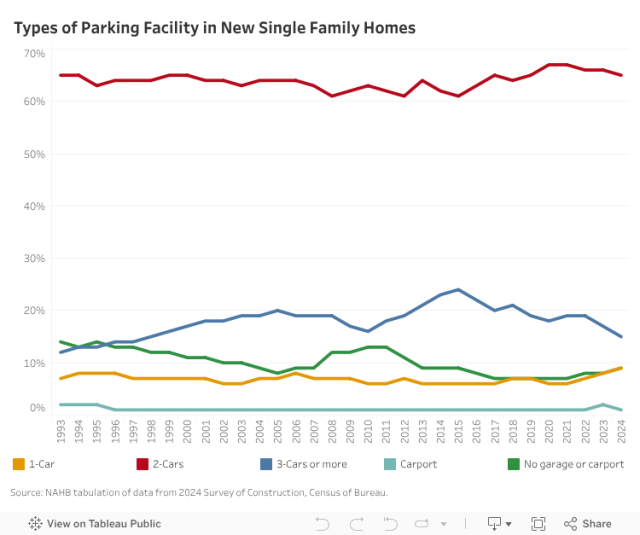
In 2024, 65% of newly completed single-family homes featured two-car garages, according to NAHB’s analysis of the Census’s Survey of Construction data. The share of new homes with three or more car garages stood at 15%, continuing a downward trend from its peak of 24% in 2015 and decreasing 2 percentage points from 2023. On the other hand, one-car garages, which have been steadily increasing in recent years, reached 9% – their highest share in three decades. Shares of homes with carports and homes without any parking facility remained steady, accounting for 1% and 9% of completions, respectively.  The 2024 data also show notable differences in parking facility shares across Census divisions. Two-car garages led in every region but ranged from 54% of completions in the East North Central to 72% in the West South Central. Three or more car garages were most common in the West North Central (33%), followed by the East North Central (28%) and Mountain (27%) divisions, but accounted for only 4% of completions in New England. One-car garages were most prevalent in the Middle Atlantic (19%) and South Atlantic (14%), compared with under 5% in several Midwest and Mountain divisions. “Other” parking options, including carports and off-street parking, reached their highest share in the East South Central (17%) and New England (14%), while making up only 5% in the West North Central. These figures illustrate how the second-most common parking type after two-car garages varies greatly depending on the size and density of the region. Garage size also tended to grow with the house. Smaller homes – under 1,200 square feet – were most likely to come with “other” parking options, making up 70% of completions in that size category.  One-car garages were most common in homes between 1,200 and 1,599 square feet, at 20%. Two-car garages were the leading choice for homes between 1,200 and 4,999 square feet, with their share peaking at 82% for homes between 2,000 and 2,399 square feet.  Among the largest homes – those exceeding 5,000 square feet – three or more car garages were the most prevalent option, comprising 70% of completions. Taken together, the 2024 figures show that the two-car garage remains the most common parking option for new single-family construction. They also highlight where shifts in shares have occurred. Larger garages, such as those with three or more spaces, have been gradually losing ground, while smaller one-car garages have inched upward to their highest share in decades. Discover more from Eye On Housing Subscribe to get the latest posts sent to your email.

Parking Trends in Newly Completed Single-Family Homes, 20242025-09-11T08:17:15-05:00

Year-over-Year Building Material Price Growth Advances  

2025-09-10T11:19:08-05:00

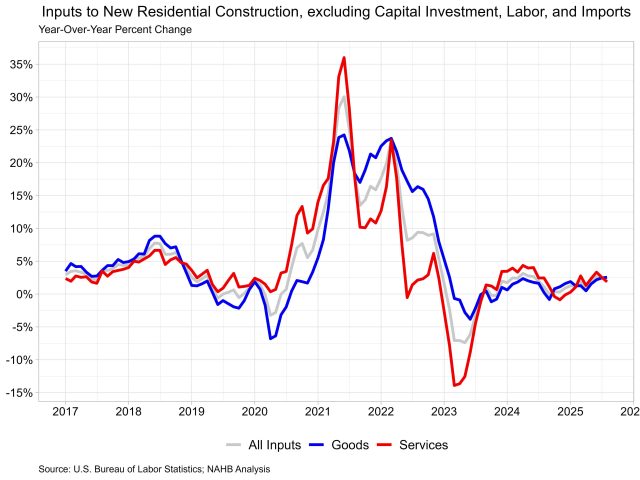
Price growth for residential building materials rose for the fourth straight month in August, reaching its highest level since January 2023.  Across domestic inputs goods and services into residential construction, service prices decreased in August while goods prices slightly advanced.   Prices for inputs to new residential construction—excluding capital investment, labor, and imports—fell 0.1% in August, matching the decrease of 0.1% in July. These figures are taken from the most recent Producer Price Index (PPI) report published by U.S. Bureau of Labor Statistics. The PPI measures prices that domestic producers receive for their goods and services; this differs from the Consumer Price Index which measures what consumers pay and includes both domestic products as well as imports.   The inputs to the new residential construction price index grew 2.3% from August of last year. The index can be broken into two components—the goods component increased 2.6% over the year, while services increased 1.9%. For context, the total final demand index, which measures all goods and services across the economy, increased 2.6% over the year, with final demand with respect to goods up 2.1% and final demand for services up 2.9%. Compared to July, the August results indicate services price growth slowed while goods price growth rose according to producer prices. Input Goods The goods component has a larger importance to the inputs to residential construction price index, representing around 60%. On a monthly basis, the price of input goods to new residential construction was up 0.1% in August.   The input goods to residential construction index can be further broken down into two separate components, one measuring energy inputs with the other measuring remaining goods. The latter of these two components simply represents building materials used in residential construction, which makes up around 93% of the goods index.   Energy input prices fell 1.8% in August and were 7.5% lower than one year ago. Building material prices were up 0.3% in August and up 3.4% compared to one year ago. This was the second straight month of above three percent price growth, after increasing 3.3% in July. The August yearly increase was the largest since building material prices rose 4.9% in January of 2023.  Input Services Prices for service inputs to residential construction reported a decrease of 0.5% in August. On a year-over-year basis, service input prices are up 1.9%. The price index for service inputs to residential construction can be broken out into three separate components: a trade services component, a transportation and warehousing services component, and a services excluding trade, transportation and warehousing component (other services).   The most significant component is trade services (around 60%), followed by other services (around 29%), and finally transportation and warehousing services (around 11%). The largest component, trade services, was up 2.0% from a year ago. The other services component was up 1.5% over the year.  Lastly, prices for transportation and warehousing services rose 1.9% compared to August of last year.   Expanded Inputs to New Construction Data Within the PPI that BLS publishes, new experimental data was recently published regarding inputs to new construction. The data expands existing inputs to industry indexes by incorporating import prices with prices for domestically produced goods and services. With this additional data, users can track how industry input costs are changing among domestically produced products and imported products. This data focuses on new construction, but the complete dataset includes indices across numerous industries that can be found here on BLS website.  New construction input prices are primarily influenced by domestically produced goods and services, with domestic products accounting for 90% of the weight of the industry index for new construction. Imported goods make up the remaining 10% of the index.   The latest available data, for June 2025, showed that domestically produced goods continue to have faster price growth compared to imported goods used in new construction. On a year-over-year basis, the index for domestic goods increased 2.3%, while prices for imported goods fell 1.1% over the same period. Comparatively, service prices have risen more than good prices over the past year, rising 3.0% year-over-year. The combined index for inputs to new construction is up 2.1% on a yearly basis.    Discover more from Eye On Housing Subscribe to get the latest posts sent to your email.

Year-over-Year Building Material Price Growth Advances  2025-09-10T11:19:08-05:00

Share of New Homes with Patios Edges Down for First Time in Fifteen Years

2025-09-09T10:16:12-05:00

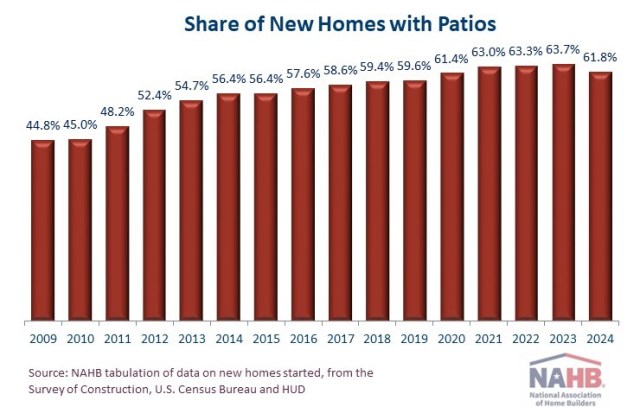
For the first time in 15 years, the share of new homes with patios finally declined in 2024, according to NAHB tabulation of data from the Survey of Construction (conducted by the U.S. Census Bureau with partial funding from the Department of Housing and Urban Development). Of the roughly 1.0 million single-family homes started during the year, 61.8% came with patios. This is down from 63.7% in 2024 and marks the lowest the percentage has been since 2020. Historically, fewer than half of new homes came with patios during the 2008-2011 period of extreme weakness in the housing market. But soon thereafter, the share jumped to 52.4% in 2012 and has been climbing ever since. The percentage increased every year from 2012 through 2023 (except in 2015, when it was unchanged before the dip in 2024. Historically, fewer than half of new homes came with patios during the 2008-2011 period of extreme weakness in the housing market. But soon thereafter, the share jumped to 52.4% in 2012 and has been climbing ever since. The percentage increased every year from 2012 through 2023 (except in 2015, when it was unchanged before the dip in 2024. During this period, the broad geographic distribution of new homes with porches has remained relatively consistent. At the low end of the scale, only 14% percent of new single-family homes built in New England and 23% in the Middle Atlantic came with patios in 2024. At the high end, the incidence of patios on new homes was over 80% in the West South Central and around 70% in the South Atlantic and Mountain divisions. Additional detail on the characteristics of new-home patios is available from the Annual Builder Practices Survey (BPS) conducted by Home Innovation Research Labs. For the U.S. as a whole, the 2025 BPS report (based on homes built in 2024, like the SOC-based statistics cited above) shows that the average size of a new-home patio is about 320 square feet, but with considerable geographic variation. The average is over 400 square feet in the adjacent East North Central and East South Central divisions. New home patios are considerably smaller on the other side of the Mississippi River, with an average size of under 200 square feet in the West South Central, and only a little over 200 square feet in the West North Central division. In most parts of the country, poured concrete dominates all other building materials used in new-home patios.  Across the entire country, poured concrete accounts for over 60% of new-home patios on a square-foot basis. The major counter-example is the New England division, where builders use concrete pavers and natural stone more often than poured concrete. Discover more from Eye On Housing Subscribe to get the latest posts sent to your email.

Share of New Homes with Patios Edges Down for First Time in Fifteen Years2025-09-09T10:16:12-05:00

Who Are NAHB Remodelers?

2025-09-09T08:27:07-05:00

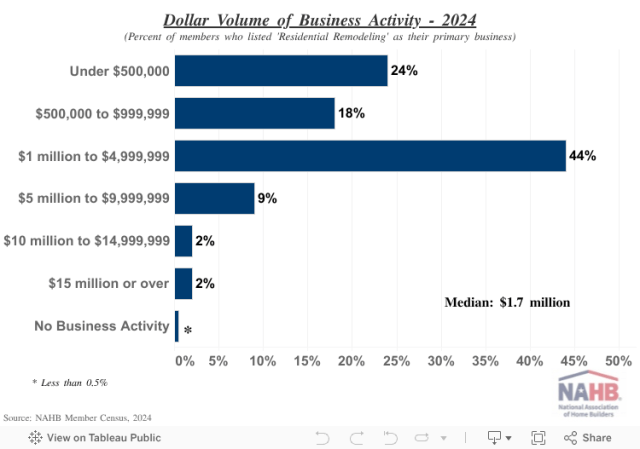
Twenty-one percent of NAHB builder members listed residential remodeling as their primary business activity, according to the 2024 Member Census.  These remodelers tend to be relatively small companies, with a median of five employees, $1.7 million in median revenue, and 15 remodeling jobs completed over $10,000.  Dollar Volume of Business Activity in 2024 Over 80% of remodelers earned less than $5 million in 2024: 24% reported a dollar volume of less than $500,000, 18% reported between $500,000 and $999,999, 44% (plurality) between $1.0 and $4.9 million, 9% between $5.0 and $9.9 million, 2% between $10.0 million and $14.9 million, and another 2% reported $15.0 million or more.  The median annual revenue for residential remodelers in 2024 was $1.7 million. For comparison, the Small Business Administration’s size standards classify residential remodelers as small if they have average annual receipts of $45.0 million or less. Number of Residential Remodeling Jobs >$10,000 Completed in 2024 The typical residential remodeler completed 15 jobs costing more than $10,000 in 2024. Twenty percent completed 1 to 5 jobs of this size, 19% did 6 to 10, 25% did 11 to 25, another 25% did 26 to 99, and 7% completed 100 or more jobs costing more than $10,000.   More than half of remodelers are secondarily engaged in single-family home building.  The typical residential remodeler started one housing unit and had five employees on payroll in 2024. For more details about NAHB builder members containing this profile of remodelers, please visit housingeconomics.com or click here for the full article. Discover more from Eye On Housing Subscribe to get the latest posts sent to your email.
Who Are NAHB Remodelers?2025-09-09T08:27:07-05:00

About My Work

Phasellus non ante ac dui sagittis volutpat. Curabitur a quam nisl. Nam est elit, congue et quam id, laoreet consequat erat. Aenean porta placerat efficitur. Vestibulum et dictum massa, ac finibus turpis.

Recent Works

Recent Posts