


Market Share for Modular and Other Non-Site Built Housing in 2024

2025-08-11T09:17:25-05:00

The total market share of non-site built single-family homes (modular and panelized) was just 3% of single-family homes in 2024, according to completion data from the Census Bureau Survey of Construction data and NAHB analysis. This is the same as the 3% share in 2023. This share has been steadily declining since the early-2000s despite the high-level of interest for non-site built construction. This low market share in fact runs counter to some media commentary on off-site construction suggesting recent gains. Nonetheless, there exists potential for market share gains in the years ahead due to the need to increase productivity in the residential construction sector. In 2024, there were 28,000 total single-family units built using modular (13,000) and panelized/pre-cut (15,000) construction methods, out of a total of 1,019,000 single-family homes completed. It is worth noting that the Census definitions of off-site construction are relatively narrow. In a separate survey, the Home Innovation Research Labs Survey of U.S. Home Builders has a higher share for panelized construction (5-12%) due to a wider definition of “panelized” construction. While the Census-measured market share is small, there exists potential for expansion. This 3% market share for 2024 represents a decline from years prior to the Great Recession. In 1998, 7% of single-family completions were modular (4%) or panelized (3%). This marked the largest share for the 1992-2024 period. One notable regional concentration is found in the Midwest and the Northeast. These two regions have the highest market share of homes built using non-site build methods. In the Midwest, 7% (8,000 homes) of the region’s 136,000 housing units were completed using these methods. In the Northeast, 5% (3,000 homes) of the region’s 66,000 housing units were completed using non-site build methods. However, numerically, the South continues to be the biggest market for this type of construction where 13,000 homes were built using non-site build methods. With respect to multifamily construction, approximately 3% of multifamily buildings (properties, not units) were built using modular and panelized methods. This is significantly lower than the 7% share in 2023 but on par with the average for the last 5 years. It is notable that modular construction method accounted for 2% of this share. In previous years it was only panelized construction methods that made up the higher share of non-site build methods in multifamily construction. Prior to last year, the highest levels of modular and panelized methods share in multifamily construction was in 2000 and 2011, where 5% of multifamily buildings were constructed with modular (1%) or panelized construction methods (4%). Discover more from Eye On Housing Subscribe to get the latest posts sent to your email.
Market Share for Modular and Other Non-Site Built Housing in 20242025-08-11T09:17:25-05:00

Foundation Types in 2024: Slabs Continue to Rise, Crawl Spaces Decline

2025-08-08T14:16:32-05:00

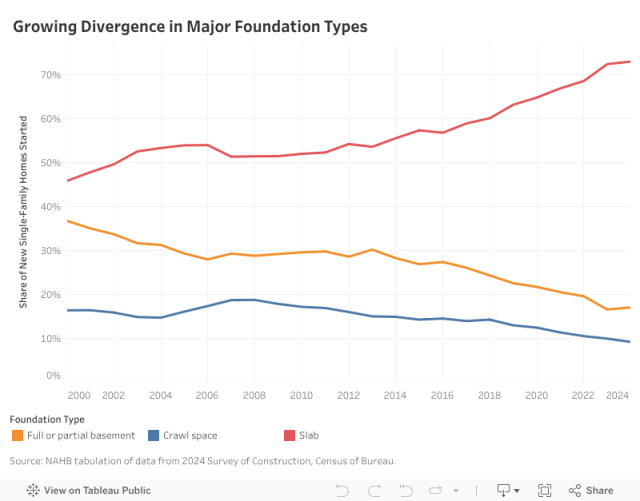
In 2024, 73% of new single-family homes started were built on slab foundations, according to NAHB analysis of the U.S. Census Bureau’s Survey of Construction (SOC). Although this was a modest year-over-year increase of 0.6 percentage points, it continues the upward trend in slab adoption, widening the gap between slabs and other foundation types. In comparison, basements (full or partial) accounted for 17% of new homes, while crawl spaces made up just 9.2%. Foundation type continues to follow regional climate patterns. In colder northern divisions, where foundations to extend below the frost line, basements are more common. In 2024, the majority of homes in New England (67.2%), West North Central (62.3%), East North Central (50.3%), and the Middle Atlantic (48.8%) were built with full or partial basements. Among these, East North Central (1,119 sq. ft.) and the Middle Atlantic (1,113 sq. ft.) had the largest average finished basement areas, both exceeding the national average of 1,112 sq. ft. West North Central followed with 940 sq. ft., and New England averaged 810 sq. ft. In contrast, warmer regions favor slab foundations for their affordability and efficiency. Nearly all new single-family homes in West South Central (97.9%), Pacific (89.9%), and South Atlantic (85.7%) divisions were built on slabs in 2024. The cost advantages of slabs have also led to increased adoption in some northern divisions – especially post-pandemic, as rising material costs and supply chain disruptions pushed builders to prioritize cost-effective construction methods. Crawl space foundations have seen a long-term decline. While East South Central and Pacific divisions have historically led in crawl space usage, both have experienced noticeable decreases, particularly the Pacific, which saw a sharp drop in the past decade. Interestingly, the Mountain division has seen a gradual rebound in crawl space use, now ranking second in crawl space share. Meanwhile, divisions such as East North Central, New England, and West South Central have consistently maintained shares of new homes started below 10%, reflecting persistent regional preferences. Notably, the West North Central division surpassed the 10% threshold in 2024 after several years of incremental growth, although it remains unclear whether this marks a lasting shift or a one-time fluctuation. Discover more from Eye On Housing Subscribe to get the latest posts sent to your email.

Foundation Types in 2024: Slabs Continue to Rise, Crawl Spaces Decline2025-08-08T14:16:32-05:00

Weaker Demand for Residential Mortgages in Second Quarter

2025-08-08T09:31:35-05:00

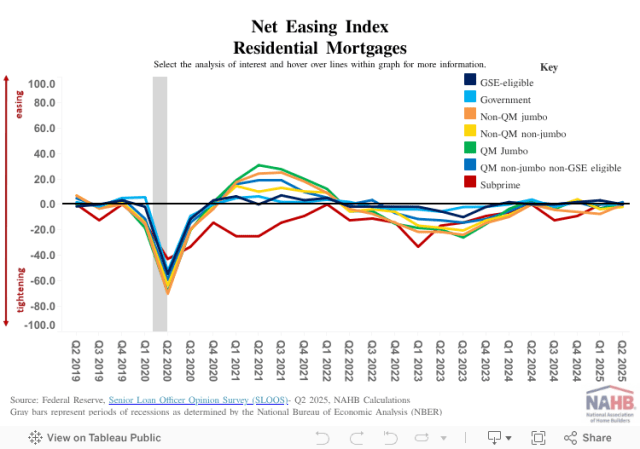
In the second quarter of 2025, overall demand for residential mortgages was weaker, while lending standards for most types of residential mortgages were essentially unchanged1, according to the recent release of the Senior Loan Officer Opinion Survey (SLOOS).  For commercial real estate (CRE) loans, lending standards for construction & development were modestly tighter, while demand was moderately weaker. However, for multifamily loans within the CRE category, lending conditions and demand were essentially unchanged for the third consecutive quarter.  Last week, the Federal Reserve left its monetary policy stance (i.e., Federal Funds rate) unchanged for the fifth consecutive meeting, with Chairman Jerome Powell indicating in his statement that the Fed “is attentive to the risks to both sides of its dual mandate [maximum employment and inflation at the rate of 2%]” and the “uncertainty about the economic outlook remains elevated”.  NAHB is still forecasting two interest rate cuts before the end of 2025. Residential Mortgages In the second quarter of 2025, five of seven residential mortgage loan categories saw a neutral net easing index (i.e., 0) for lending conditions.  Only Qualified Mortgage (QM) non-jumbo non-GSE eligible loans experienced easing, as evidenced by a positive2 value (+1.8). Meanwhile, the only loans to experience tightening were non-QM non-jumbo loans at -2.0.  Nevertheless, based on the Federal Reserve classification of any reading between -5 and +5 as “essentially unchanged,” all seven categories fell within this range. All residential mortgage loan categories reported at least modestly weaker demand in the second quarter of 2025, except for QM-jumbo which was essentially unchanged for the second consecutive quarter.  Most notably, non-QM non-jumbo (-22.0%) and subprime (-20.0%) loans experienced significantly weaker demand during the quarter.  The net percentage of banks reporting stronger demand for most of the residential mortgage loan categories has been negative for at least four years. Commercial Real Estate (CRE) Loans Across CRE loan categories, construction & development loans recorded a net easing index of -9.7 for the second quarter of 2025, indicating modestly tighter credit conditions.  For multifamily loans, the net easing index was -4.8, or essentially unchanged.  Both categories of CRE loans show tightening of lending conditions (i.e., net easing indexes below zero) since Q2 2022.  However, the tightening has become less defined recently for multifamily, with its net easing index essentially unchanged (i.e., between -5.0 and +5.0) for three consecutive quarters. The net percentage of banks reporting stronger demand was -11.3% for construction & development loans and -3.2% for multifamily loans, with negative numbers indicating weakening demand.  Like the trend for lending conditions, demand for multifamily loans has experienced unchanged conditions (i.e., between -5.0% and +5.0%) for three straight quarters. The Federal Reserve uses the following descriptors when analyzing results from the survey which will be used, in principle, within this blog post as well: – “Remained basically unchanged” means that the change or actual reading is greater than or equal to 0 and less than or equal to 5 percent. – “Modest” means that the change or actual reading is greater than 5 and less than or equal to 10 percent. – “Moderate” means that the change or actual reading is greater than 10 and less than or equal to 20 percent. – “Significant” means that the change or actual reading is greater than 20 and less than or equal to 50 percent. – “Major” means that the change or actual reading is greater than or equal to 50 percent.A value above zero (i.e., positive) indicates that lending conditions are easing while a value below zero (i.e., negative) indicates that lending conditions are tightening. Discover more from Eye On Housing Subscribe to get the latest posts sent to your email.

Weaker Demand for Residential Mortgages in Second Quarter2025-08-08T09:31:35-05:00

About My Work

Phasellus non ante ac dui sagittis volutpat. Curabitur a quam nisl. Nam est elit, congue et quam id, laoreet consequat erat. Aenean porta placerat efficitur. Vestibulum et dictum massa, ac finibus turpis.

Recent Works

Recent Posts