

Retreat for Single-Family Built-for-Rent Housing

2025-08-20T11:14:43-05:00

Single-family built-for-rent construction fell back in the second quarter, as a higher cost of financing crowded out development activity. According to NAHB’s analysis of data from the Census Bureau’s Quarterly Starts and Completions by Purpose and Design, there were approximately 12,000 single-family built-for-rent (SFBFR) starts during the second quarter of 2025. This is down significantly relative to the second quarter of 2024 (25,000 starts). Over the last four quarters, 71,000 such homes began construction, which is a 16% decrease compared to the 85,000 estimated SFBFR starts in the four quarters prior to that period. The SFBFR market is a source of inventory amid challenges over housing affordability and downpayment requirements in the for-sale market, particularly during a period when a growing number of people want more space and a single-family structure. Single-family built-for-rent construction differs in terms of structural characteristics compared to other newly-built single-family homes, particularly with respect to home size. However, investor demand for single-family homes, both existing and new, has cooled with higher interest rates. Given the relatively small size of this market segment, the quarter-to-quarter movements typically are not statistically significant. The current four-quarter moving average of market share (7%) is nonetheless higher than the historical average of 2.7% (1992-2012). Importantly, as measured for this analysis, the estimates noted above include only homes built and held by the builder for rental purposes. The estimates exclude homes that are sold to another party for rental purposes, which NAHB estimates may represent another three to five percent of single-family starts based on industry surveys. The Census data notes an elevated share of single-family homes built as condos (non-fee simple), with this share averaging more than 4% over recent quarters. Some, but certainly not all, of these homes will be used for rental purposes. Additionally, it is theoretically possible some single-family built-for-rent units are being counted in multifamily starts, as a form of “horizontal multifamily,” given these units are often built on a single plat of land. However, spot checks by NAHB with permitting offices indicate no evidence of this data issue occurring. With the onset of the Great Recession and declines for the homeownership rate, the share of built-for-rent homes increased in the years after the recession. While the market share of SFBFR homes is small, it has clearly expanded. Given affordability challenges in the for-sale market, the SFBFR market will likely retain an elevated market share. However, in the near-term, SFBFR construction is likely to slow until the return on new deals improves. Discover more from Eye On Housing Subscribe to get the latest posts sent to your email.
Retreat for Single-Family Built-for-Rent Housing2025-08-20T11:14:43-05:00

State-Level Employment Situation: July 2025

2025-08-20T09:17:14-05:00

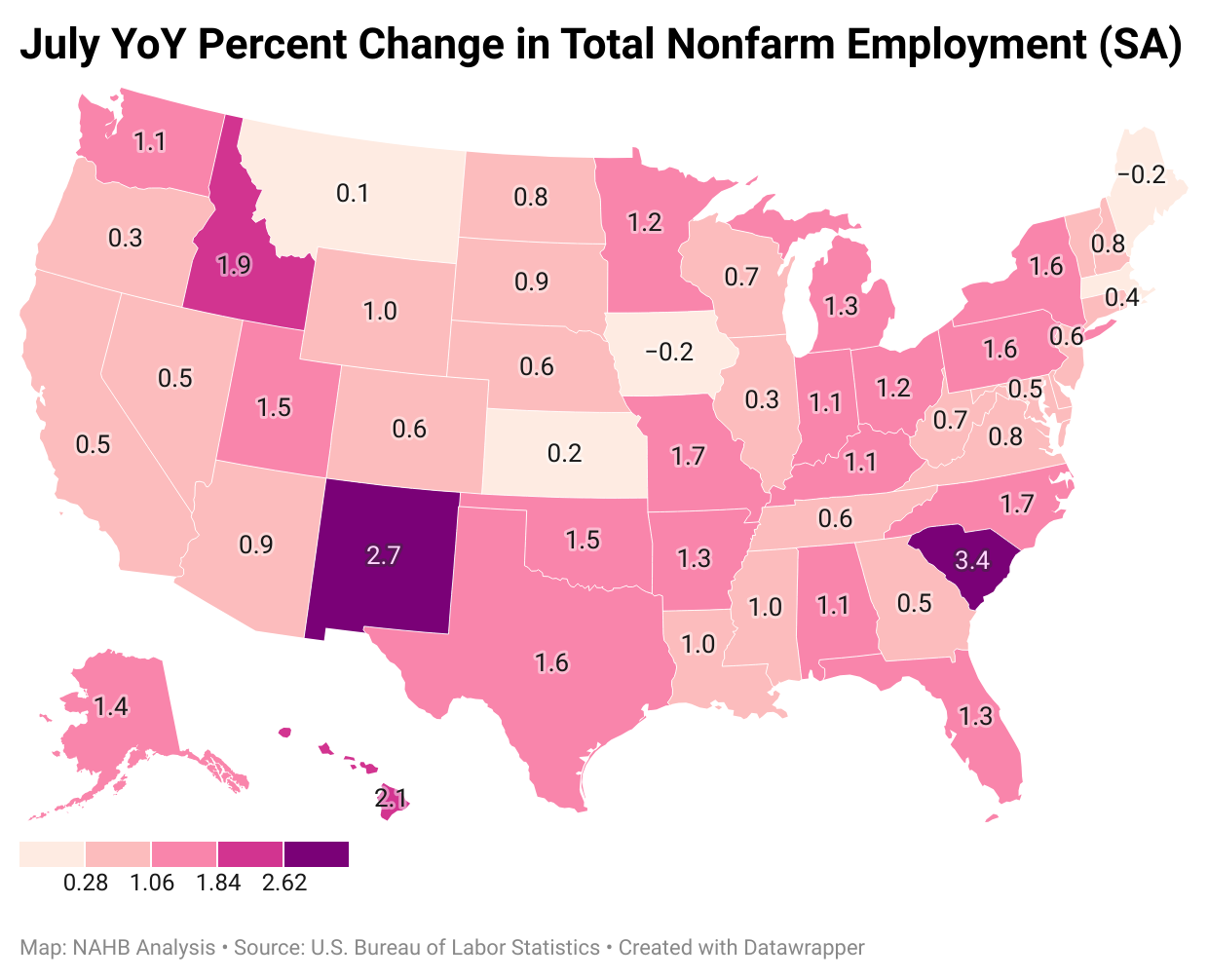
Nonfarm payroll employment increased in 30 states and the District of Columbia in July compared to the previous month, while decreasing in 20 states. According to the Bureau of Labor Statistics, nationwide total nonfarm payroll employment increased by 73,000 in July, falling short of expectations and following significant downward revisions to the previous two months’ figures. On a month-over-month basis, employment data was most favorable in New York, which added 55,500 jobs. Missouri came in second (+17,100), followed by California (+15,000). Meanwhile, a total of 37,100 jobs were lost across 20 states, with Utah reporting the steepest job losses at 5,200. In percentage terms, employment increased the highest in Missouri at 0.6%, while Wyoming saw the largest decline at 0.5% between June and July. Year-over-year ending in July, 1.5 million jobs have been added to the labor market, which is a 1.0% increase compared to the July 2024 level. The range of job gains spanned from 400 jobs in Montana to 232,500 jobs in Texas. Two states and the District of Columbia lost a total of 8,900 jobs in the past 12 months, with the District of Columbia reporting the steepest job losses at 4,200. In percentage terms, the range of job growth spanned 0.1% in Montana to 3.4% in South Carolina. The range of job losses in Maine, Iowa, and the District of Columbia spanned 0.2%-0.5%. Construction Employment Across the nation, construction sector jobs data 1—which includes both residential and non-residential construction—showed that 22 states reported an increase in July compared to June, while 22 states lost construction sector jobs. The six remaining states and the District of Columbia reported no change on a month-over-month basis. Colorado, with the highest increase, added 3,800 construction jobs, while California, on the other end of the spectrum, lost 3,300 jobs. Overall, the construction industry added a net 2,000 jobs in July compared to the previous month. In percentage terms, Oregon reported the highest increase at 2.6% and Wyoming reported the largest decline at 3.4%. Year-over-year, construction sector jobs in the U.S. increased by 96,000, which is a 1.2% increase compared to the July 2024 level. Texas added 27,000 jobs, which was the largest gain of any state, while California lost 18,200 construction sector jobs. In percentage terms, New Mexico had the highest annual growth rate in the construction sector at 14.3%. During this period, New Jersey reported the largest decline of 4.9%. For this analysis, BLS combined employment totals for mining, logging, and construction are treated as construction employment for the District of Columbia, Delaware, and Hawaii. Discover more from Eye On Housing Subscribe to get the latest posts sent to your email.
State-Level Employment Situation: July 20252025-08-20T09:17:14-05:00

Growth for Custom Home Building

2025-08-20T08:16:47-05:00

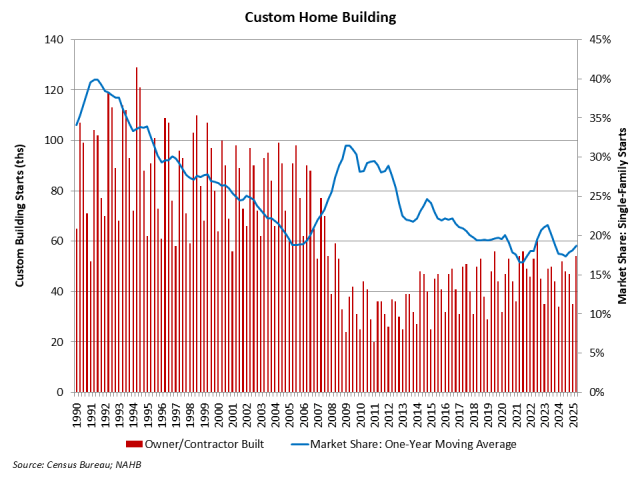
NAHB’s analysis of Census Data from the Quarterly Starts and Completions by Purpose and Design survey indicates year-over year growth for custom home builders amid broader single-family home building weakness. The custom building market is less sensitive to the interest rate cycle than other forms of home building but is more sensitive to changes in household wealth and stock prices. With spec home building down and the stock market up, custom building is gaining market share. There were 54,000 total custom building starts during the second quarter of 2025. This was up 4% relative to the second quarter of 2024. Over the last four quarters, custom housing starts totaled 184,000 homes, just more than a 2% increase compared to the prior four quarter total (180,000). Currently, the market share of custom home building, based on a one-year moving average, is approximately 19% of total single-family starts. This is down from a prior cycle peak of 31.5% set during the second quarter of 2009 and the 21% recent peak rate at the beginning of 2023, after which spec home building gained market share. The current market share is the highest since 2022. Note that this definition of custom home building does not include homes intended for sale, so the analysis in this post uses a narrow definition of the sector. It represents home construction undertaken on a contract basis for which the builder does not hold tax basis in the structure during construction. Discover more from Eye On Housing Subscribe to get the latest posts sent to your email.
Growth for Custom Home Building2025-08-20T08:16:47-05:00

Residential Building Worker Wage Growth Slows Amid Housing Slowdown 

2025-08-18T10:15:16-05:00

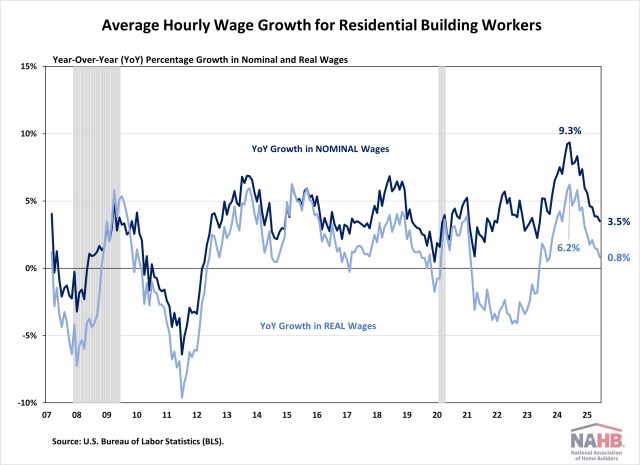
Both real and nominal wage growth for residential building workers slowed during the second quarter of 2025, reflecting a broader cooling in the construction labor market, according to the latest report from the U.S. Bureau of Labor Statistics (BLS). In nominal terms, average hourly earnings (AHE) for residential building workers rose to $39.35 in June 2025, a 3.5% increase from $38.02 a year ago. This marks a continued deceleration in the year-over-year wage growth, which peaked at 9.3% in June 2024. The recent slowdown reflects a slowdown in residential construction activity and a decline in labor demand across the sector. Meanwhile, the number of open, and unfilled construction sector jobs has continued to trend downward, in line with the overall slowdown in housing activity. Despite the slowdown in wage growth, residential building workers’ wages remain competitive: 11.4% higher than the manufacturing sector ($35.32/hour) 25.3% higher than the transportation and warehousing sector ($31.4/hour) 2.3% lower than the mining and logging sector ($40.29/hour) Note: Data used in this post relate to all employees in the residential building industry. This group includes both new single-family housing construction (excluding for-sale builders) and residential remodelers but does not include specialty trade contractors. Discover more from Eye On Housing Subscribe to get the latest posts sent to your email.
Residential Building Worker Wage Growth Slows Amid Housing Slowdown 2025-08-18T10:15:16-05:00

June Single-Family Permits Slumps, Multifamily Gains

2025-08-15T09:17:49-05:00

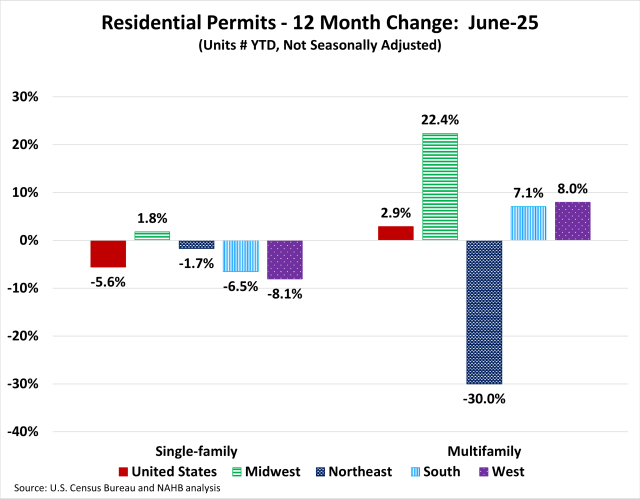
Single-family housing permits continued a downhill trend for the sixth month in a row. The continuous decline in single-family permits highlights persistently weak housing demand, tied to affordability challenges like high mortgage rates. Builders appear cautious amid economic uncertainty, labor constraints, and rising inventories. The uptick in multi-family permits suggests a potentially stabilizing trend, though it’s important to note its volatility. The housing market’s mixed signals—weak single-family coupled with some resilience in multi-family—could mean continued drag on residential investment and the broader economy this year. Over the first six months of 2025, the total number of single-family permits issued year-to-date (YTD) nationwide reached 485,935. On a year-over-year (YoY) basis, this is a decline of 5.6% over the June 2024 level of 514,728. For multifamily, the total number of permits issued nationwide reached 244,812. This is 2.9% higher compared to the June 2024 level of 237,935. Year-to-date ending in June, single-family permits were up in one out of the four regions. The Midwest posted a small increase of 1.8%. The Northeast was 1.7% lower, the South was down by 6.5%, and the West was down by 8.1% in single-family permits during this time. For multifamily permits, three out of the four regions posted increases. The Midwest was up by 22.4%, the West was up by 8.0%, and the South was up by 7.1%, Meanwhile, the Northeast declined steeply by 30.0%, driven by the New York-Newark-Jersey City, NY-NJ MSA which declined by 40.0%. Between June 2025 YTD and June 2024 YTD, 15 states posted an increase in single-family permits. The range of increases spanned 19.9% in Hawaii to 0.2% in Kentucky. The remaining 35 states and the District of Columbia reported declines in single-family permits with the District of Columbia reporting the steepest decline of 24.2%. The ten states issuing the highest number of single-family permits combined accounted for 63.0% of the total single-family permits issued. Texas, the state with the highest number of single-family permits, issued 78,104 permits over the first six months of 2025; this is a decline of 8.0% compared to the same period last year. The second highest state, Florida, decreased by 10.6%, while the third highest, North Carolina, posted a decline of 0.9%. Between June 2025 YTD and June 2024 YTD, 29 states recorded growth in multifamily permits, while 21 states and the District of Columbia recorded a decline. Iowa (+165.5%) led the way with a sharp rise in multifamily permits from 1,178 to 3,128, while Alabama had the largest decline of 49.6% from 1,788 to 901. The ten states issuing the highest number of multifamily permits combined accounted for 61.8% of the multifamily permits issued. Over the first six months of 2025, Florida, the state with the highest number of multifamily permits issued, experienced an increase of 25.0%. Texas, the second-highest state in multifamily permits, saw an increase of 14.1%. California, the third largest multifamily issuing state, increased by 11.5%. At the local level, below are the top ten metro areas that issued the highest number of single-family permits. For multifamily permits, below are the top ten local areas that issued the highest number of permits. Discover more from Eye On Housing Subscribe to get the latest posts sent to your email.
June Single-Family Permits Slumps, Multifamily Gains2025-08-15T09:17:49-05:00

Credit Conditions for Builders Tighten

2025-08-15T08:16:00-05:00

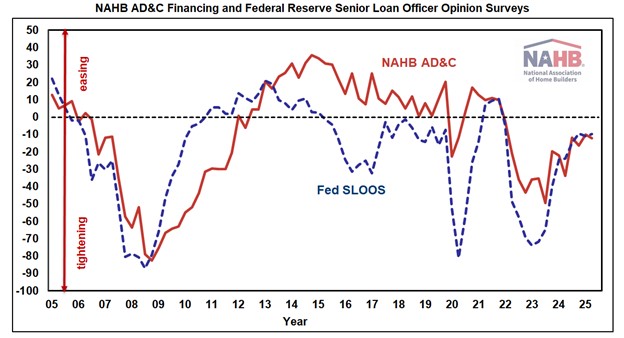
For the fourteenth consecutive quarter, builders and developers reported tighter credit conditions on loans for residential Land Acquisition, Development & Construction (AD&C) in NAHB’s quarterly survey on AD&C Financing.   In the second quarter of 2025, the NAHB survey’s net easing index posted a reading of -12.3 (the negative number indicating that credit tightened since the previous quarter).  This is in reasonably close agreement with the second quarter reading of -9.7 for the similar net easing index derived from the Federal Reserve’s survey of senior loan officers.  Like the NAHB net easing index, the one from the Fed has been in negative territory (indicating credit tightening) for fourteen consecutive quarters.  Over the past year the additional tightening indicated by both indices has been relatively modest, with index levels hovering between -20 and 0.  Modest or not, however, after fourteen straight quarters of tightening, many builders are probably wondering how much room lenders have left to tighten further.     More details from the Fed’s survey of lenders—including measures of demand and net easing for residential mortgages—appeared in a previous post. According to NAHB builders, the most common ways lenders tightened credit on AD&C loans in the second quarter were by reducing the amount they are willing to lend (cited by 60% of the builders who reported tighter credit), requiring personal guarantees (53%), increasing the interest rate and not making new loans (47% each), and increasing documentation requirements (40%).  Also in the second quarter, the cost of credit declined on loans made specifically for residential land acquisition (the “A” in AD&C).  The average contract interest rate on the loans declined from 8.23% to 7.82%, while the average initial points dropped from 0.71% to 0.56%.  As a result, the average effective interest rate (which takes both the contract rate and initial points into account) on land acquisition loans declined from 10.68% to 9.95%. For the other three categories of AD&C loans tracked in the NAHB survey, credit became more expensive since the previous quarter.  The average contract interest rate increased on loans for land development (from 7.86% to 8.04%) and speculative single-family construction (from 8.08% to 8.17%), while declining only slightly (from 7.96% to 7.95%) on loans for pre-sold single-family construction.  Meanwhile, average initial points were unchanged at 0.74% on loans for land development, but increased from 0.68% to 0.72% on loans for speculative single-family construction, and from 0.45% to 0.58% on loans for pre-sold single-family construction. Those combinations of quarter-to-quarter changes took the effective interest up from 11.50% to 11.77%  on loans for land development, from 12.59% to 12.82% on loans for speculative single-family construction, and from 12.49% to 12.73% on loans for pre-sold single-family construction. Although the average effective interest rate was higher in 2025 Q2 than in 2025 Q1 for three of the four categories of AD&C loans, the rate was down year-over-year for all four.  Financing costs for builders and developers could decline further over the next quarter, especially if (as NAHB expects) the Federal Reserve reduces the target federal funds rate at its September meeting.  In fact, as discussed in NAHB’s post on the Fed’s July meeting, a reduction in construction financing costs rather than an effect on mortgage rates is the main benefit builders can expect from easier monetary policy. More detail on credit conditions for residential builders and developers is available on NAHB’s AD&C Financing Survey web page. Discover more from Eye On Housing Subscribe to get the latest posts sent to your email.
Credit Conditions for Builders Tighten2025-08-15T08:16:00-05:00

Building Material Prices Rise in July

2025-08-14T10:28:37-05:00

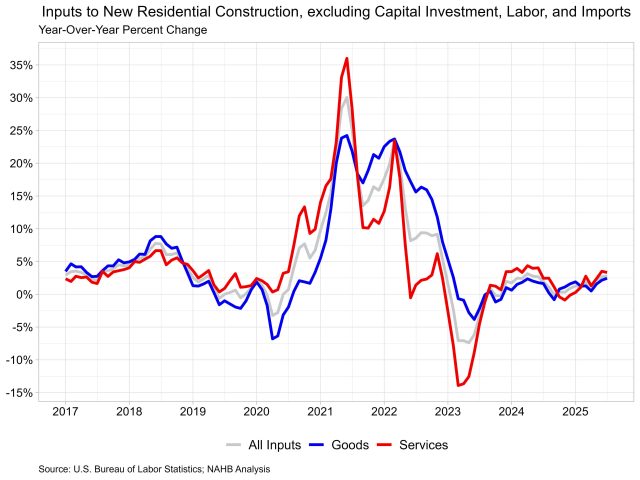
Prices for residential building materials rose again in July, marking the largest year-over-year increase in over two years. The underlying price growth trend remained the same, with service prices continuing to grow at a faster pace than goods prices. Similar to last month, parts for construction machinery and metal molding/trim experienced significant price growth, as both increased over 25% compared to last year. Prices for inputs to new residential construction—excluding capital investment, labor, and imports—rose 0.2% in July, following a 0.8% increase in June. These figures are taken from the most recent Producer Price Index (PPI) report published by U.S. Bureau of Labor Statistics. The PPI measures prices that domestic producers receive for their goods and services; this differs from the Consumer Price Index which measures what consumers pay and includes both domestic products as well as imports. The inputs to the new residential construction price index grew 2.8% from July of last year. The index can be broken into two components­—the goods component increased 2.4% over the year, while services increased 3.3%. For comparison, the total final demand index, which measures all goods and services across the economy, increased 3.3% over the year, with final demand with respect to goods up 1.9% and final demand for services up 4.0%. Input Goods The goods component has a larger importance to the total residential construction inputs price index, representing around 60%. On a monthly basis, the price of input goods to new residential construction was up 0.4% in July. The input goods to residential construction index can be further broken down into two separate components, one measuring energy inputs with the other measuring remaining goods. The latter of these two components simply represents building materials used in residential construction, which makes up around 93% of the goods index. Energy input prices jumped up 3.9% between June and July but were 8.1% lower than one year ago. Building material prices were up 0.2% between June and July and up 3.3% compared to one year ago. Tariffs on building materials do not directly show up in the PPI data because the PPI measures prices for domestically produced goods and services. In fact, tariffs and taxes are explicitly excluded from the PPI. Despite this, price changes in reaction to tariffs are included in the PPI, meaning price increases to pass on increased costs of materials will show up in this pricing data.  Announced tariffs in recent months have resulted in material increases across a few different goods, specifically certain metal products and equipment. In July, the largest year-over-year input price increase was for construction machinery and equipment parts, reporting a 31.4% increase over the year. Meanwhile, metal molding and trim prices were up 25.6%, fabricated steel plate prices were up 14.3%, and nonferrous wire/cable up 10.5%. Metal commodities have been the primary targets of tariffs, with 50% tariffs in effect on steel and aluminum products and a 50% tariff on semifinished products of copper. Input Services Prices for service inputs to residential construction reported a decrease of 0.2% in July. On a year-over-year basis, service input prices are up 3.3%. The price index for service inputs to residential construction can be broken out into three separate components: a trade services component, a transportation and warehousing services component, and a services excluding trade, transportation and warehousing component (other services).  The most significant component is trade services (around 60%), followed by other services (around 29%), and finally transportation and warehousing services (around 11%). The largest component, trade services, was up 5.2% from a year ago. The other services component was up 1.2% over the year.  Lastly, prices for transportation and warehousing services fell 0.6% compared to July of last year. Inputs to New Construction Satellite Data Within the PPI that BLS publishes, new experimental data was recently published regarding inputs to new construction. The data expands existing inputs to industry indexes by incorporating import prices with prices for domestically produced goods and services. With this additional data, users can track how industry input costs are changing among domestically produced products and imported products. This data focuses on new construction, but the complete dataset includes indices across numerous industries that can be found here on the BLS website. New construction input prices are primarily influenced by domestically produced goods and services, with domestic products accounting for 90% of the weight of the industry index for new construction. Imported goods make up the remaining 10% of the index. The latest available data, for May 2025, showed that domestically produced goods have experienced faster price growth compared to imported goods used in new construction. On a year-over-year basis, the index for domestic goods increased 1.6%, while prices for imported goods rose 0.1% over the same period. Comparatively, service prices have risen more than good prices over the past year, rising 2.7% year-over-year. Across the three indexes, all inputs remain at higher levels compared to pre-pandemic prices. Discover more from Eye On Housing Subscribe to get the latest posts sent to your email.
Building Material Prices Rise in July2025-08-14T10:28:37-05:00

U.S. Economy Rebounded in Second Quarter

2025-08-13T11:16:12-05:00

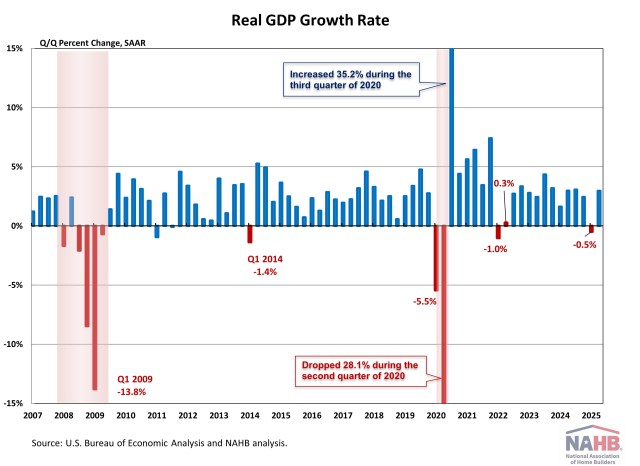
Real GDP growth rebounded in the second quarter, driven by a turnaround in the trade balance and stronger consumer spending. According to the “advance” estimate released by the Bureau of Economic Analysis (BEA), real gross domestic product (GDP) expanded at an annual rate of 3.0% in the second quarter of 2025, following a 0.5% contraction in the first quarter. The latest data from the GDP report suggests that inflationary pressures are easing. The GDP price index rose 2.0% for the second quarter, down from a 3.8% increase in the first quarter of 2025. The Personal Consumption Expenditures Price (PCE) Index, which measures inflation (or deflation) across various consumer expenses and reflects changes in consumer behavior, rose 2.1% in the second quarter. This is down from a 3.7% increase in the first quarter of 2025. This quarter’s increase in real GDP primarily reflected a decrease in imports, which are a subtraction in the calculation of GDP, and increases in consumer spending. Consumer spending, the backbone of the U.S. economy, rose at an annual rate of 1.4% in the second quarter, up from 0.5% in the first quarter but well below the 2.8% pace recorded a year earlier. Both goods and services contributed to the gain, with goods spending rising at a 2.2% annual rate and spending on services increasing at a 1.1% annual rate. A steep drop in imports also provided a significant boost to GDP, as imports are subtracted in GDP calculations. Imports fell 30.3% in the second quarter, a sharp reversal from the 37.9% surge in the first quarter. Nonresidential fixed investment increased 1.9% in the second quarter. The increases in equipment (+4.8%) and intellectual property products (+6.4%) offset the decrease in structures (-10.3%). Meanwhile, residential fixed investment (RFI) declined 4.6% in the second quarter, following a 1.3% decline in the previous quarter. Within the residential category, single-family structures fell 12.6% at an annual rate, multifamily structures declined 1.3%, and improvements rose 4.2%. For the common BEA terms and definitions, please access bea.gov/Help/Glossary. Discover more from Eye On Housing Subscribe to get the latest posts sent to your email.
U.S. Economy Rebounded in Second Quarter2025-08-13T11:16:12-05:00

Student Loan Balances Rise

2025-08-12T11:17:05-05:00

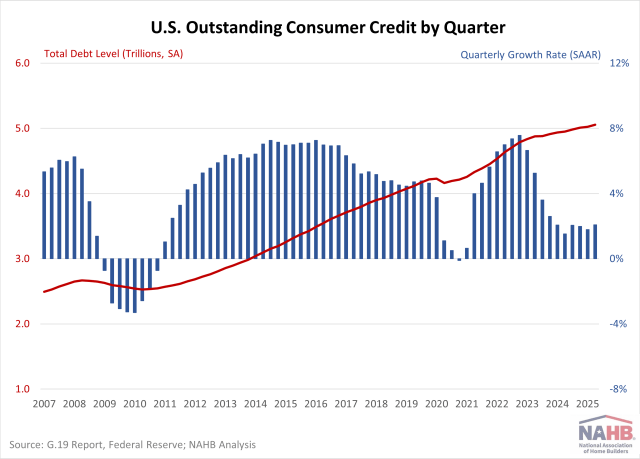
Overall consumer credit continued to rise in 2025, but the pace of growth remains slow. Student loan balances also rose year-over-year as borrowers resumed payments following the end of pandemic-era relief. Meanwhile, credit card and auto loan debt both experienced their slowest annual growth rates in years. Despite historically high interest rates, credit card and auto loan rates have eased slightly, providing some relief for consumers facing elevated borrowing costs. Total outstanding U.S. consumer credit reached $5.05 trillion for the second quarter of 2025, according to the Federal Reserve’s G.19 Consumer Credit Report. This is an increase of 2.32% at a seasonally adjusted annual rate (SAAR) compared to the previous quarter, and a 2.09% increase compared to last year. Both rates have increased from last quarter. Nonrevolving Credit Nonrevolving credit, largely driven by student and auto loans (the G.19 report excludes mortgage loans), reached $3.76 trillion (SA) in the second quarter of 2025. This marks a 2.90% increase (SAAR) from the previous quarter, and a 1.94% increase from last year. Student loan debt stood at $1.81 trillion (NSA) for the second quarter of 2025, marking a 4.16% increase from a year ago. The end of the COVID-19 Emergency Relief—which allowed 0% interest and halted payments until September 1, 2023—led year-over-year growth to decline for four consecutive quarters, from Q3 2023 through Q2 2024 as borrowers resumed payments and took on less new debt. The past four quarters have shown a return to growth, nearly matching pre-pandemic growth rates. Auto loans reached a level of $1.56 trillion (NSA), showing a year-over-year increase of only 0.31%, marking the slowest growth rate since 2010. The deceleration in growth can be attributed to several factors, including stricter lending standards, elevated interest rates, and overall inflation. Auto loan rates for a 60-month new car stood at 7.67% (NSA) for the second quarter of 2025, a historically elevated level. However, auto rates have slowed modestly, decreasing by 0.53 percentage points compared to a year ago. Revolving Credit Revolving credit, primarily made up of credit card debt, rose to $1.30 trillion (SA) in the second quarter of 2025. This represents a 0.66% increase (SAAR) from the previous quarter and a 2.54% increase year-over-year. Both measures reflect a notable slowdown, marking the weakest growth in revolving credit in several years. This deceleration comes as credit card interest rates remain elevated, with the average rate held by commercial banks (NSA) at 21.16%. Although rates have hovered near historic hi­ghs since Q4 2022, the past two quarters have shown modest year-over-year declines, reflecting the impact of rate cuts that began in 2024. Discover more from Eye On Housing Subscribe to get the latest posts sent to your email.

Student Loan Balances Rise2025-08-12T11:17:05-05:00

Core Inflation Accelerates Amid Tariff Pressure

2025-08-12T10:20:25-05:00

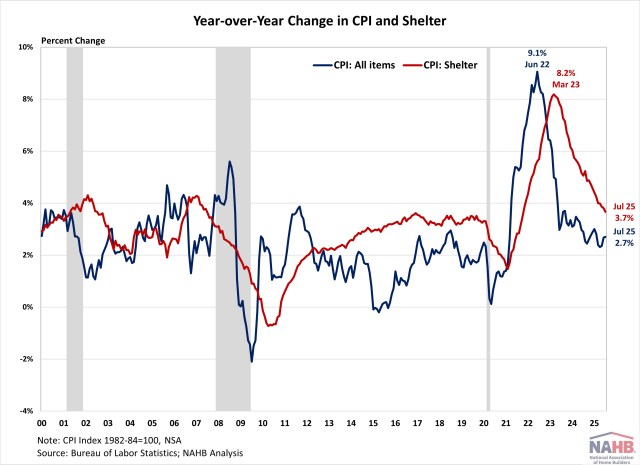
Inflation held steady at 2.7% in July as food an energy prices remained subdued and offset increases in service prices, according to the Bureau of Labor Statistics’ (BLS) latest report. Core inflation, which exclude volatile food and energy, picked up to its largest monthly increase since January and fastest annual pace since February. Meanwhile, housing inflation continued to show signs of cooling, matching the lowest level since October 2021. Despite the modest overall increase, concerns over inflation data quality continue to grow as BLS revealed more details about data collection challenges. BLS reduced its CPI collection sample starting in April due to staffing shortages, suspending data collection in Lincoln (NE), Provo (UT), and Buffalo (NY). It also suspended collection on 15% of the sample in 72 other areas on average. When prices are unavailable, BLS uses different cell imputation, and this share jumped to 35% in June from 30% in May and just 8% in June 2024. During the past twelve months, on a non-seasonally adjusted basis, the Consumer Price Index rose by 2.7% in July, unchanged from June and the highest since February 2025. Excluding the volatile food and energy components, the “core” CPI increased by 3.1% over the past twelve months. A large portion of the “core” CPI is the housing shelter index, which increased 3.7% over the year, the lowest reading since October 2021.  Meanwhile, the component index of food rose by 2.9%, and the energy component index fell by 1.6%. On a monthly basis, the CPI rose by 0.2% in July (seasonally adjusted), after a 0.3% increase in June. The “core” CPI increased by 0.3% in July. The price index for a broad set of energy sources fell by 1.1% in July, with increases in fuel oil (+1.8%) offset by declines in gasoline (-2.2%), natural gas (-0.9%) and electricity (-0.1%). Meanwhile, the food index was unchanged, after a 0.3% increase in June. The index for food away from home increased by 0.3% while the index for food at home fell by 0.1%. The index for shelter (+0.2%) continued to be the largest contributor to the monthly increase in all items index. Other top contributors that rose in July include indexes for medical care (+3.5%), airline fares (+4.0%), recreation (+0.4%), household furnishings and operation (+3.4%), as well as used cars and trucks (+0.5%). Meanwhile, the index for lodging away from home (-1.0%) and communication (-0.3%) were among the few major indexes that decreased over the month. The index for shelter makes up more than 40% of the “core” CPI, rising by 0.2% in July, following the same increase last month. The index for owners’ equivalent rent (OER) and for rent of primary residence (RPR) both increased by 0.3% over the month. Despite the moderation, shelter costs remained the largest contributors to headline inflation. NAHB constructs a “real” rent index to indicate whether inflation in rents is faster or slower than core inflation. It provides insight into the supply and demand conditions for rental housing. When inflation in rents is rising faster than core inflation, the real rent index rises and vice versa. The real rent index is calculated by dividing the price index for rent by the core CPI (to exclude the volatile food and energy components). In July, the Real Rent Index fell by 0.1%. Over the first seven months of 2025, the average monthly growth rate held steady at 0.1%, unchanged from the same period in 2024. Discover more from Eye On Housing Subscribe to get the latest posts sent to your email.

Core Inflation Accelerates Amid Tariff Pressure2025-08-12T10:20:25-05:00

About My Work

Phasellus non ante ac dui sagittis volutpat. Curabitur a quam nisl. Nam est elit, congue et quam id, laoreet consequat erat. Aenean porta placerat efficitur. Vestibulum et dictum massa, ac finibus turpis.

Recent Works

Recent Posts