

Multifamily Absorption Rises in the Second Quarter

2025-08-29T08:21:31-05:00

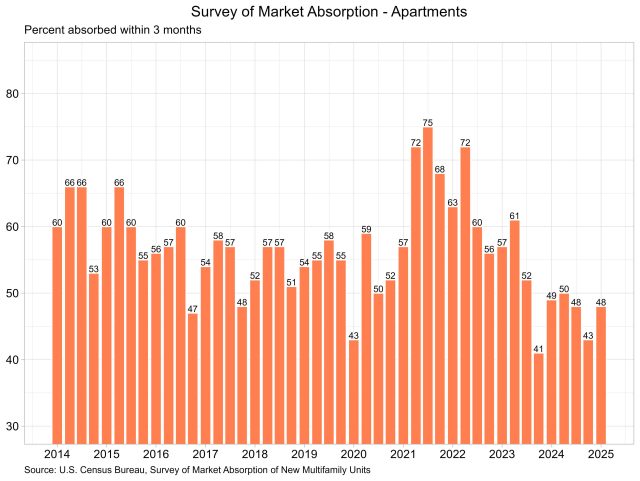
The percentage of new apartment units that were absorbed within three months after completion rose in the second quarter, according to the Census Bureau’s latest release of the Survey of Market Absorption of New Multifamily Units (SOMA). The survey covers new units in multifamily residential buildings with five or more units. The number of new multifamily units completed fell for the second consecutive quarter, down to the lowest level since the fourth quarter of 2023. Apartments The percentage of apartments absorbed within three months has fallen significantly from its peak of 75% in the third quarter of 2021, as shown in the graph above. Currently, the rate stands at 48%, meaning that 48% of the 98,520 units completed in the first quarter were rented within three months of completion. The median asking rent in the second quarter was $1,920, up 12.3% from $1,710 a year ago. This marks the second consecutive quarter of record high asking rent in the SOMA survey. Along with the three-month absorption rate and completions, SOMA also reports absorption rates at six, nine, and twelve months after completion. For apartments completed six months ago (124,300 units), 70% have been absorbed into the market. Of the 143,400 apartments completed nine months ago, 81% have been absorbed. For those completed twelve months ago (118,700 units), 91% have been absorbed into the multifamily market. Condominiums and Cooperative Units The three-month absorption rate for new condominiums and cooperative units fell four percentage points to 66%. Total completions of new condominiums and cooperative units, according to the SOMA, fell in the first quarter from 2,902 to 2,639. Completions of these units peaked in the second quarter of 2018 at 7,996 and have steadily fallen since then. Discover more from Eye On Housing Subscribe to get the latest posts sent to your email.
Multifamily Absorption Rises in the Second Quarter2025-08-29T08:21:31-05:00

Mortgage Rates Move Lower, Hitting 10-Month Low

2025-08-28T14:15:42-05:00

Average mortgage rates in August continued their steady decline and are now at their lowest rate since last November. According to Freddie Mac, the 30-year fixed-rate mortgage averaged 6.59%, 13 basis points (bps) lower than July. Meanwhile, the 15-year rate declined 15 bps to 5.71%. Compared to a year ago, the 30-year rate is higher by 9 basis points (bps), and the 15-year rate is marginally higher by 3 bps. The 10-year Treasury yield, a key benchmark for long-term borrowing, averaged 4.29% in August – an 8 bps decrease from the previous month. Yields moved unevenly during the month: initially declining, then rising following July’s inflation report that noted an acceleration in core inflation. Long-term yields subsequently retreated following Federal Reserve Chair Jerome Powell’s Jackson Hole speech last Friday, where he signaled possible rate cuts. Powell noted that the downside risk to employment is on the rise while inflation expectations are well-anchored around the Fed’s longer-run target of 2%. Recently, President Trump sought to fire Federal Reserve Governor Lisa Cook, alleging she submitted fraudulent information on mortgage applications. Cook has since filed a lawsuit to block her dismissal, arguing that the president lacks authority to remove a Fed governor without cause. The case underscores ongoing concerns about the central bank’s independence from political influence. Separately, former Federal Reserve Governor Adriana Kugler resigned earlier this month to return to academia, creating a vacancy on the Board of Governors for the President to fill. Both Cook and Kugler were nominated by President Joe Biden. Discover more from Eye On Housing Subscribe to get the latest posts sent to your email.
Mortgage Rates Move Lower, Hitting 10-Month Low2025-08-28T14:15:42-05:00

Wood-Framed Home Share Increased in 2024

2025-08-27T08:27:12-05:00

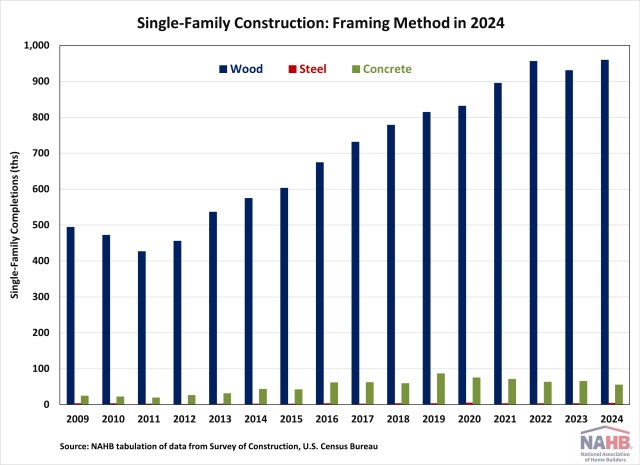
Wood framing continues to dominate the U.S. single-family home construction market, according to NAHB analysis of 2024 Census Bureau data. In 2024, wood framing accounted for 94% of all completed single-family homes, reinforcing its position as the leading construction method. Concrete-framed homes represented 5% of completions, while steel-framed homes remained relatively rare, comprising less than half a percent of the market. On a count basis, approximately 959,000 wood-framed homes were completed in 2024. This was a 3% increase compared to the 2023 total. This growth also marked a rebound in market share, with wood-framed market share rising from 93% in 2023 to 94% in 2024. Steel-framed homes, while still uncommon, experienced notable growth. About 4,000 steel-framed homes were completed in 2024, representing a 33% increase from the previous year. Meanwhile, concrete-framed homes saw a decline. Their market share decreased from 7% in 2023 to 5% in 2024. On a count basis, 55,000 concrete-framed homes were completed in 2024, a 15% decrease compared to the prior year. Non-wood based framing methods are primarily concentrated in the South due to residential resiliency requirements. In 2024, concrete-framed homes made up 9% of all single-family home completions in the South. Additionally, nearly 95% of all steel-framed homes completed in 2024 were built in the South, highlighting the region’s distinct building trends. Discover more from Eye On Housing Subscribe to get the latest posts sent to your email.
Wood-Framed Home Share Increased in 20242025-08-27T08:27:12-05:00

Most Home Builders are Small Businesses

2025-08-27T08:27:22-05:00

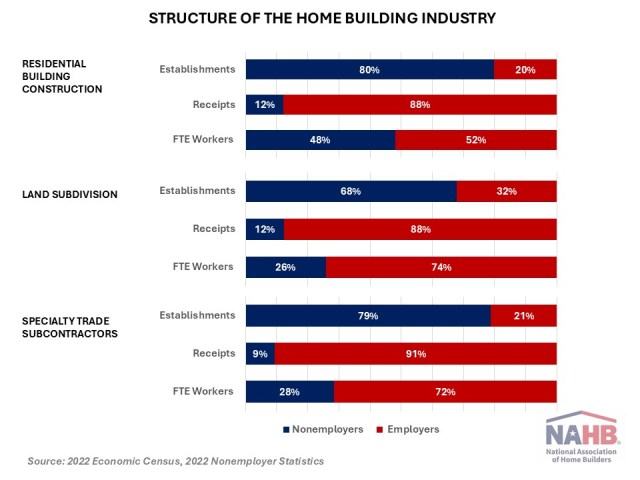
Despite historically low self-employment rates and the rising market share of top ten builders, residential construction remains an industry dominated by independent entrepreneurs, with nearly 80% of home builders and specialty trade contractor firms being self-employed independent contractors. Even among firms with paid employees, the industry continues to be dominated by small businesses, with 63% of homebuilders and two out of three specialty trade contractors generating less than one million dollars in total business receipts. The new estimates are based on the 2022 Economic Census and Nonemployer Statistics data.1The Economic Census covers several construction subsectors that comprise the home building industry: Residential Building Construction (RBC) – Single-family general contractors (except for-sale builders) – Multifamily general contractors (except for-sale builders) – New housing for-sale builders Residential Remodelers Land Subdivision (or land developers) Specialty Trade Contractors (STC) The 2022 statistics show that the majority of residential construction businesses are self-employed independent contractors.  There are over 813,000 nonemployer firms in residential building construction (RBC), accounting for close to 80% of all establishments. In land subdivision, more than 9,000 independent contractors account for 68% of land subdivision firms.  Over 1.9 million specialty trade independent contractors make up 79% of all STC establishments. These nonemployer firms also account for almost half of the full-time employees (FTE) in residential building construction, 26% in land subdivision, and 28% in STC.  Most of these self-employed mom-and-pop firms are very small, with annual receipts averaging under $103,000 for residential building construction, and under $70,000 for specialty trade contractors. Self-employed independent contractors in land subdivision average around $288,000 in annual business receipts. As a result, these nonemployer firms make up only 12% of all sales and receipts generated by residential building construction and land subdivision, and 9% of specialty trade contractors’ revenue. Among residential construction businesses with paid employees, remodeling, land subdivision, and specialty trade subcontractors (STC) companies tend to be smaller.  Three out of four remodeling establishments, 63% of land developers, and 59% of STC companies generate under $1 million in receipts.   Home builders are typically somewhat larger, with about 45% of companies reporting annual sales over $1 million. Among homebuilders, multifamily general contractors tend to be the largest. However, the Census Bureau did not disclose the number of the largest (with revenue over $100 million) and smallest (with revenue under $100K) multifamily and single-family custom builders in 2022. As a result, the revenue spectrum for MF and SF contractors is incomplete and is presented in a separate chart.  Multifamily contractors are typically larger compared to single-family contractors and for-sale builders (who build on land they own and control). Ten percent of multifamily contractors reported annual sales between $10 million and 25 million, and an additional 11% earned between $25 million and $100 million in 2022.   Under the most recent U.S. Small Business Administration (SBA) size standards, the vast majority of residential construction companies qualify as small businesses. The most recent small business size limits for all types of builders are $45 million, $34 million for land subdivision, and $19 million for specialty trade contractors. By these standards, almost all remodelers and single-family contractors, and at least 98% of land developers, and 96% of specialty trade contractors, easily qualify as small businesses.  The Economic Census, like many other federal statistics programs, collects data only on establishments with payroll employees. The Nonemployer Statistics Program by the Census Bureau collects annual data for businesses that have no paid employees, including the number of businesses and total receipts by industry, which largely come from the IRS. Discover more from Eye On Housing Subscribe to get the latest posts sent to your email.
Most Home Builders are Small Businesses2025-08-27T08:27:22-05:00

Who Are NAHB’s Builder Members?

2025-08-26T08:15:19-05:00

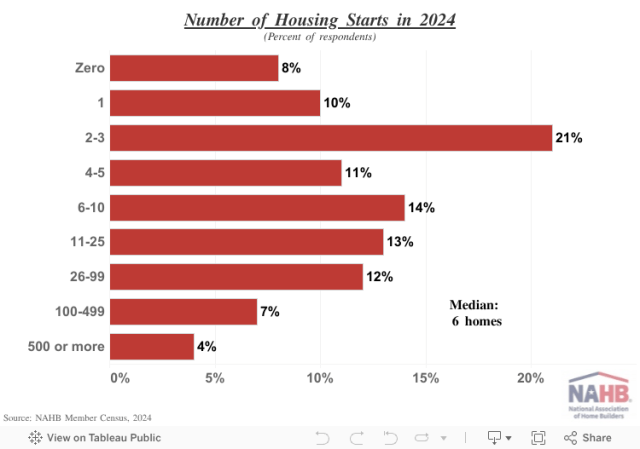
The National Association of Home Builders (NAHB) conducts an annual member census to better understand the composition and characteristics of the people who belong to its organization.  In 2024, 35% of NAHB’s membership was comprised of builder members—single-family and multifamily builders, residential and commercial remodelers, commercial builders, land developers, and manufacturers of modular/panelized/log homes.  The remaining 65% were associate members—those involved in support industry and professions, such as trade contractors, manufacturers, retailers/distributors, designers, and architects. Number of Housing Starts in 2024 The typical builder runs a small business. The median number of homes started by NAHB builders in 2024 was six.  This figure has remained unchanged since 2021.  Ten percent started one unit, 21% (the plurality) started two or three units, 11% started four or four units, 14% started six to ten, 13% started 11 to 25, 12% started 26 to 99, 7% started 100 to 499, and 4% started 500 homes or more.  Eight percent indicated that they did not start any homes in 2024. Median Revenue of Builder Members in 2024 Most builders earned less than $5 million in total revenue in 2024: 13% reported a dollar volume of less than $500,000, 12% reported between $500,000 and $999,999, 35% (plurality) between $1.0 and $4.9 million, 15% between $5.0 and $9.9 million, 7% between $10.0 million and $14.9 million, and 16% reported $15.0 million or more. The median revenue edged up to $3.7 million, up 8% from 2023.  For comparison, the Small Business Administration’s size standards classify residential builders and remodelers as small if they have average annual receipts of $45.0 million or less ($34.0 million or less for land developers). Median Number of Employees in 2024 The typical builder member had six employees on payroll in 2024, unchanged from 2023.  Due to their status as small businesses and extensive use of subcontractors, many builders carry relatively few employees on their payrolls.   For more detail on the 2024 NAHB Builder Member Census, including a profile for each of the seven major categories of builder, please see the August 2025 Special Study. Discover more from Eye On Housing Subscribe to get the latest posts sent to your email.

Who Are NAHB’s Builder Members?2025-08-26T08:15:19-05:00

Multifamily Missing Middle Trends

2025-08-25T12:14:48-05:00

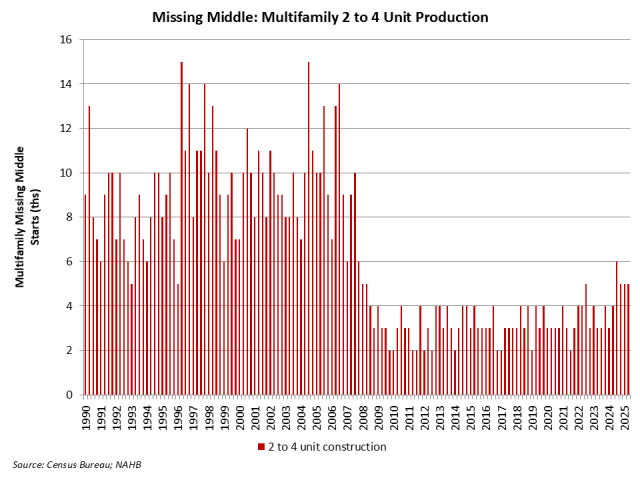
The missing middle construction sector includes development of medium-density housing, such as townhouses, duplexes and other small multifamily properties. The multifamily segment of the missing middle (apartments in 2- to 4-unit properties) has generally disappointed since the Great Recession. For the second quarter of 2025, there were 5,000 2- to 4-unit housing unit construction starts. This represents a small increase relative to the second quarter of 2024. Over the last four quarters this type of construction totaled 21,000 units, up 50% over the four quarters prior to that period (14,000). As a share of all multifamily production, 2- to 4-unit development was just 4% of total multifamily development for the second quarter. This remains lower than recent historic trends. From 2000 to 2010, such home construction made up a little less than 11% of total multifamily construction. Construction of the missing middle has clearly lagged during the post-Great Recession period and will continue to do so without zoning reform focused on light-touch density. But recent gains offer hope for additional housing supply for these kind of homes. Discover more from Eye On Housing Subscribe to get the latest posts sent to your email.
Multifamily Missing Middle Trends2025-08-25T12:14:48-05:00

Multifamily Built-for-Rent Share

2025-08-25T08:15:28-05:00

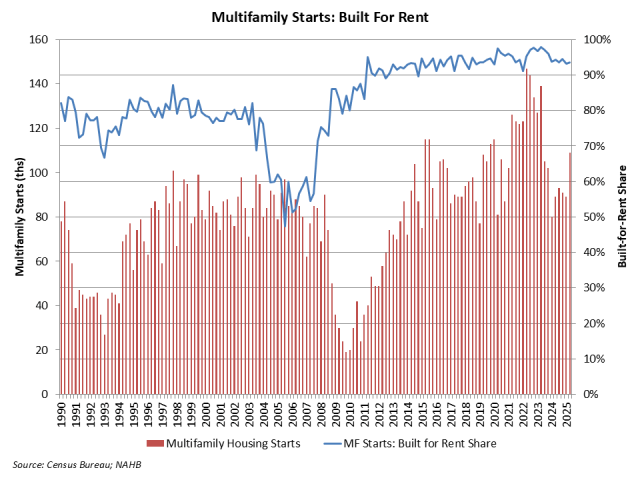
According to NAHB analysis of quarterly Census data, the count of multifamily, for-rent housing starts increased during the second quarter of 2025. For the quarter, 109,000 multifamily residences started construction. Of this total, 102,000 were built-for-rent. This built-for-rent total was 21% higher than the second quarter of 2024. The market share of rental units of multifamily construction starts was 94% for the second quarter. A historical low market share of 47% for bult-for-rent multifamily construction was set during the third quarter of 2005, during the condo building boom. An average share of 80% was registered during the 1980-2002 period. For the second quarter, there were 7,000 multifamily condo unit construction starts, an increase from a year ago. An elevated rental share of multifamily construction is holding typical apartment size below levels seen during the pre-Great Recession period. However, according to the second quarter 2025 data, the average square footage of multifamily construction starts increased to 1,077 square feet. The median increased to 1,092 square feet. Multifamily unit size is tending higher as the market captures priced-out buyers from the single-family for-sale market. Discover more from Eye On Housing Subscribe to get the latest posts sent to your email.

Multifamily Built-for-Rent Share2025-08-25T08:15:28-05:00

Powell Appears to Signal Rate Cuts Due to Evolving Circumstances

2025-08-22T12:19:40-05:00

While acknowledging that ongoing uncertainty complicates policymaking, Federal Reserve Chair Powell gave a mostly green light for monetary policy easing in September, following a policy pause that has lasted since the end of last year. Noting that inflation remains elevated, Powell stated that “the balance of risks appears to be shifting.” In particular, the central bank chair noted that downside risks for the labor market are rising. The implication of this observation is that easing is in view for monetary policy given the Fed’s dual mandate of maintaining both price stability and full employment. Markets expect a cut in September. Powell detailed an important point for the housing demand, that the labor market has avoided large job losses due to policy tightening and the economy has shown “resilience.” The Fed chair also indicated that inflation pressure is now in the data from tariffs, including a rise in goods prices. However, Powell articulated the view that while tariffs can affect the price level, that effect may not be a persistent impact on inflation and therefore can be consistent with near-term easing of monetary policy. He stated, “…the effects will be short-lived – a one-time shift in the price level.” However, he also warned that “one-time” does not mean all at once and that the effects of tariffs will materialize over an adjustment period. Moreover, while not addressed in today’s comments, some of the pressure from tariffs is being relaxed as trade deals are arranged and de-escalations of some trade tensions are undertaken. This morning’s action by Canada to drop most retaliatory trade actions against the U.S. is a good example, as is the ongoing discussions with China to achieve a fairer, more sustainable trading relationship. Powell repeated that housing-related inflation remains on a downward trend. I would add for emphasis that softening of housing market data (including home price weakness that will indirectly affect inflation data) is a dovish sign for future monetary policy given that housing has been the major source of inflation for the last two years. Summarizing the current data and the monetary policy outlook, Powell concluded his analysis with commentary suggesting a shift in the Fed’s policy stance to easing (perhaps as a preventative cut), while still tied to data: “In the near term, risks to inflation are tilted to the upside, and risks to employment to the downside—a challenging situation. When our goals are in tension like this, our framework calls for us to balance both sides of our dual mandate. Our policy rate is now 100 basis points closer to neutral than it was a year ago, and the stability of the unemployment rate and other labor market measures allows us to proceed carefully as we consider changes to our policy stance. Nonetheless, with policy in restrictive territory, the baseline outlook and the shifting balance of risks may warrant adjusting our policy stance. Monetary policy is not on a preset course. FOMC members will make these decisions, based solely on their assessment of the data and its implications for the economic outlook and the balance of risks. We will never deviate from that approach.“ Chair Powell’s comments also emphasize the importance of central bank independence. Politicizing monetary policy would introduce a future inflation premium into the bond market, resulting in reduced investor demand and some additional upward pressure on long-term interest rates, including mortgage rates. Today’s speech also addressed the Fed’s policy framework, including “flexible average inflation targeting” and the central bank’s 2% target for inflation. Powell committed to the 2% target. While this commitment is important for institutional credibility and bond market confidence, some economists, including myself, question the appropriateness of 2% as a target given U.S. economic and productivity growth. Would, as a theoretical question, a 2.5% inflation target in a period of declining birth rates and rising technological change unanchor inflation expectations for investors? This is an important question for future monetary policymaking. Nonetheless, today’s speech suggests, and the market expects, that the Fed will resume monetary policy easing at its September meeting. Discover more from Eye On Housing Subscribe to get the latest posts sent to your email.

Powell Appears to Signal Rate Cuts Due to Evolving Circumstances2025-08-22T12:19:40-05:00

Single-Family Home Size: 2Q25 Data

2025-08-22T12:19:51-05:00

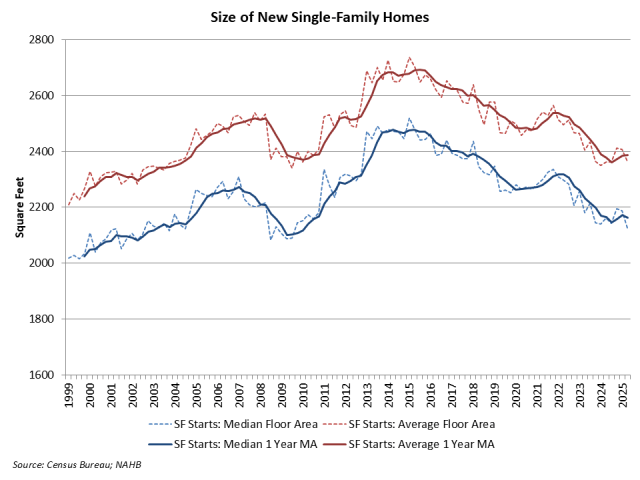
An expected impact of the virus crisis was a need for more residential space, as people used homes for more purposes including work. Home size correspondingly increased in 2021 as interest rates reached historic lows. However, as interest rates increased in 2022 and 2023, and housing affordability worsened, the demand for home size has trended lower. According to second quarter 2025 data from the Census Quarterly Starts and Completions by Purpose and Design and NAHB analysis, median single-family square floor area was 2,125 square feet, a decline from the start of the year. Average (mean) square footage for new single-family homes registered at 2,364 square feet. The average size of a new single-family home, on a one-year moving average basis, was flat at 2,386 square feet, while the median size declined to 2,162 square feet. Home size increased from 2009 to 2015 as entry-level new construction lost market share. Home size declined between 2016 and 2020 as more starter homes were developed. After a brief increase during the post-COVID building boom, home size has trended lower due to declining affordability conditions. Discover more from Eye On Housing Subscribe to get the latest posts sent to your email.

Single-Family Home Size: 2Q25 Data2025-08-22T12:19:51-05:00

Existing Home Sales Rise in July

2025-08-21T11:20:18-05:00

Existing home sales rebounded in July as mortgage rates retreated from the recent peak and home price growth slowed, according to the National Association of Realtors (NAR). This rebound was also supported by inventory improvements, with housing supply at its highest level since May 2020. Despite the ever-so-slight improvement in housing affordability, higher mortgage rates and elevated home prices continue to sideline buyers. Mortgage rates have hovered between 6.5% and 7% due to ongoing economic and tariff uncertainty this year, prompting the Fed to pause interest rate cuts. Though mortgage rates recently peaked at 6.89% in May and have drifted downward in recent weeks, they are expected to stay above 6% for longer due to an anticipated slower easing pace in 2025, these prolonged higher rates and high home prices would continue to weigh on the market. As such, sales are likely to remain limited in the coming months. Total existing home sales, including single-family homes, townhomes, condominiums, and co-ops, rose 2.0% to a seasonally adjusted annual rate of 4.01 million in July. On a year-over-year basis, sales were 0.8% higher than a year ago. The existing home inventory level was 1.55 million units in July, up 0.6% from June and up 15.7% from a year ago. At the current sales rate, July unsold inventory sits at a 4.6-months’ supply, down from 4.7-months in June but up from 4.0-months in July 2024. Inventory between 4.5 to 6 month’s supply is generally considered a balanced market. Homes stayed on the market for a median of 28 days in July, up from 27 days last month and 24 days in July 2024. The first-time buyer share was 28% in July, down from 30% in June and 29% from a year ago. The July all-cash sales share was 31% of transactions, up from 29% in June and 27% a year ago. All-cash buyers are less affected by changes in interest rates. The June median sales price of all existing homes was $422,400, up 0.2% from last year. This marks the 25th consecutive month of year-over-year increases. The median condominium/co-op price in July was down 1.2% from a year ago at $362,600.  Recent gains for home inventory will put downward pressure on resale home prices in most markets in 2025. Geographically, three of the four regions experienced gains in existing home sales in July, with an increase of 1.4% in the West, 2.2% in the South, and 8.7% in the Northeast. Meanwhile, sales in the Midwest fell 1.1%. On a year-over-year basis, sales were up in the Midwest (1.1%), the Northeast (2.0%) and the South (1.7%) but were down in the West (-4.0%). The Pending Home Sales Index (PHSI) is a forward-looking indicator based on signed contracts. The PHSI fell from 72.6 to 72.0 in June, suggesting elevated mortgage rates continued keeping buyers on the sidelines despite improved inventory. On a year-over-year basis, pending sales were 2.8% lower than a year ago, per National Association of Realtors data. Discover more from Eye On Housing Subscribe to get the latest posts sent to your email.

Existing Home Sales Rise in July2025-08-21T11:20:18-05:00

About My Work

Phasellus non ante ac dui sagittis volutpat. Curabitur a quam nisl. Nam est elit, congue et quam id, laoreet consequat erat. Aenean porta placerat efficitur. Vestibulum et dictum massa, ac finibus turpis.

Recent Works

Recent Posts